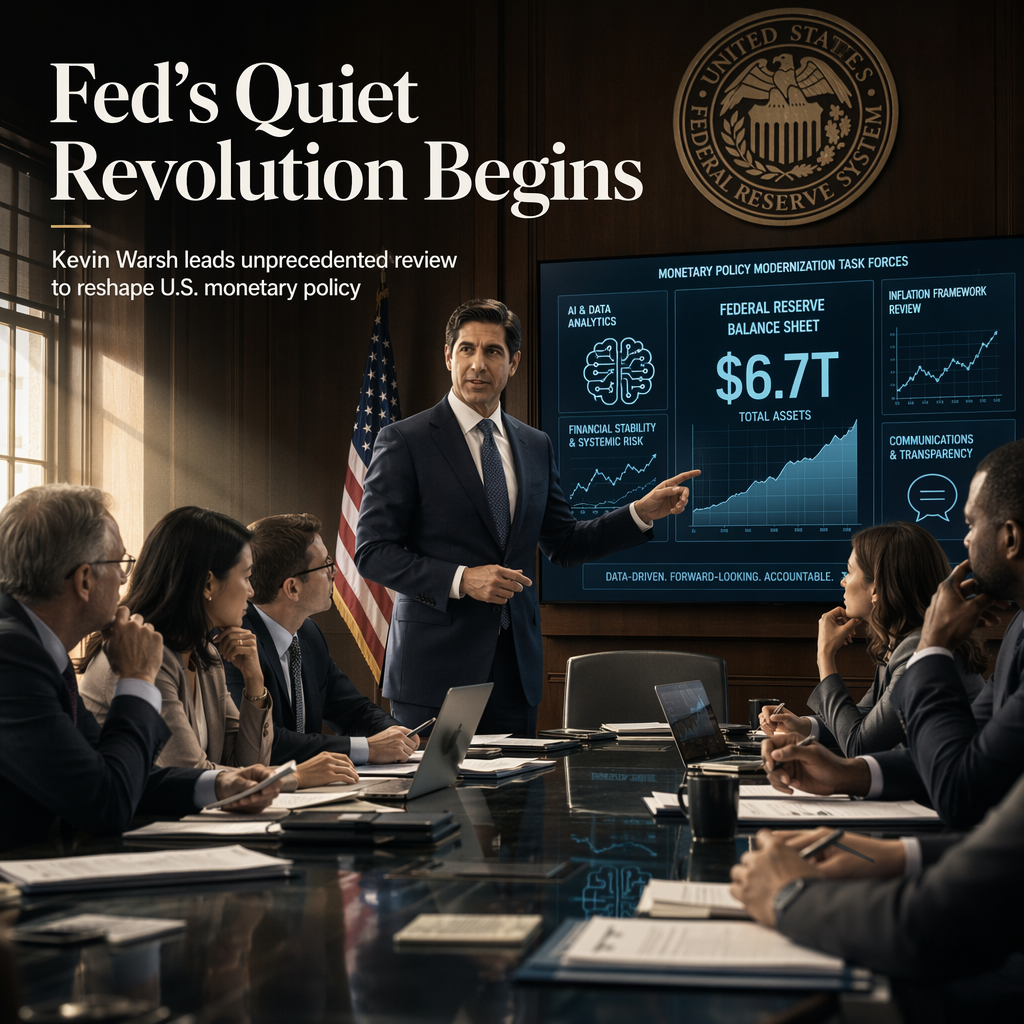
Federal Reserve Chairman Kevin Warsh has initiated a comprehensive review of the central bank's approach to monetary policy, marking what several observers describe as a 'quiet revolution' at the Fed [1]. Following his first meeting as chair on June 17, 2026, Warsh announced the creation of five task forces that will examine all major aspects of the Fed's policy framework, including communications, economic data analysis, views on inflation and its causes, the impact of technology such as artificial intelligence, and the size and composition of the Fed's $6.7 trillion balance sheet, including potential strategies for reducing its holdings [1].
Warsh emphasized that these task forces will 'start with first principles, ask hard questions, examine current practice, consider alternatives, and ultimately propose next steps for policymaker consideration' [1]. He described the initiative as a collective effort to ensure the Federal Reserve is 'clear-eyed about its mission, fit for purpose, and focused on the future' [1]. The scale and ambition of this review are unprecedented in recent Fed history, with no previous chair having launched a project of similar scope [1].
Market participants and Fed veterans have responded positively to Warsh's direction. Rick Rieder, BlackRock's fixed income chief, called the chairman's approach 'a new era of monetary policy in the United States' [1]. Scott Clemons, chief investment strategist at Brown Brothers Harriman, described the changes as 'regime change, but in a velvet glove,' noting the shift from Warsh's previously critical tone to a more collegial and constructive atmosphere within the institution [1].
While the immediate market reaction was not detailed, the ambitious nature of the review and the focus on foundational change suggest significant implications for future monetary policy decisions and the Fed's operational framework [1].
CONCLUSION
Kevin Warsh's sweeping review signals a major shift in the Federal Reserve's approach to monetary policy, with broad support from market participants and Fed insiders. The establishment of five task forces to examine core aspects of the Fed's operations points to potentially significant changes ahead, marking the beginning of what some are calling a new era for the central bank.