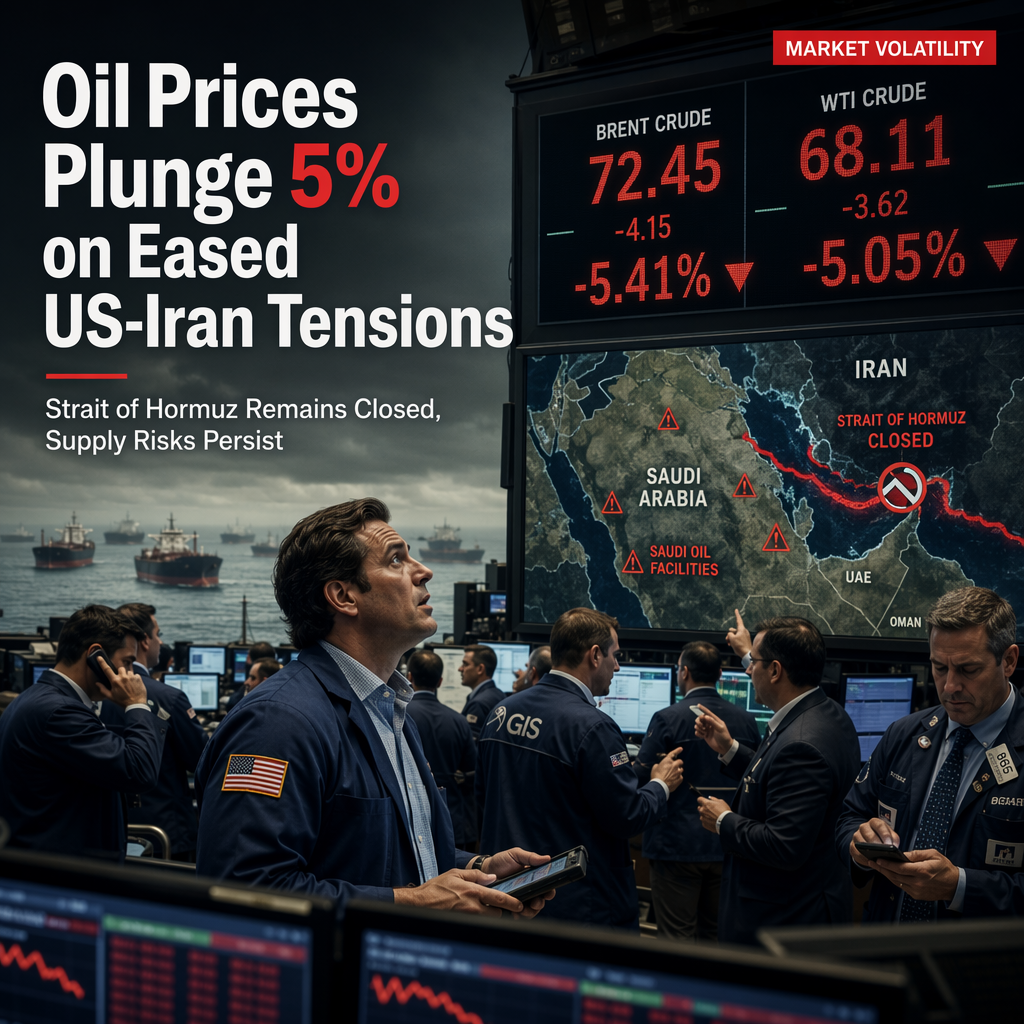
Oil markets experienced a sharp sell-off at the start of the week, with Brent crude dropping nearly 5% from approximately $98.75 to $93.50 within minutes of the session opening on Sunday, despite the Strait of Hormuz remaining closed and no improvement in the physical supply situation [1]. West Texas Intermediate (WTI) crude also fell, trading below $64 and losing more than 6% on the day [2]. The decline in oil prices was attributed to a de-escalation in geopolitical tensions after the United States and Iran both paused military strikes, with the US holding off on further action for a second consecutive night and Iran announcing it had stopped retaliating [1][2][3]. Omani and Iranian deputy foreign ministers held constructive talks in Tehran, further supporting the risk-on sentiment [1].
Despite the price drop, the physical risks to oil supply remained acute. The Strait of Hormuz was still closed, and the Houthis launched missile and drone attacks on Saudi Aramco facilities in Jizan and Yanbu over the weekend, threatening Saudi Arabia’s Red Sea backup route, which has been critical for oil exports since the closure of Hormuz [1][3]. Analysts at ING and Rabobank highlighted that while the pause in US-Iran strikes was the first tangible signal of de-escalation, there was no meaningful pickup in vessel flows through the Strait of Hormuz, and the underlying supply risks persisted [2][3]. Rabobank’s Benjamin Picton emphasized that ongoing Middle East tensions, including the threat of a Saudi-Houthi escalation, continue to pose significant energy security risks and could quickly re-tighten oil markets [3].
The market reaction extended beyond oil. US stock index futures rose between 0.8% and 1.4% on the day, reflecting improved risk sentiment, while the US Dollar Index fell more than 0.2% to near 101.20 [2]. The US Dollar was the weakest against the Swiss Franc, declining 0.38% [2]. Analysts noted that the oil price decline was driven by a shrinking risk premium as escalation odds fell, rather than any actual recovery in supply, and warned that this could reverse quickly if tensions flare again [1][2].
Looking ahead, analysts at ING cautioned that a recovery in oil flows is unlikely until there is clarity on whether the current de-escalation will hold [2]. Rabobank pointed out that the potential for less fragile supply chains in the future exists but is uncertain and does not address immediate market risks [3]. Meanwhile, the Federal Reserve’s upcoming policy meeting and key US economic data releases are expected to influence broader market sentiment in the days ahead [2][5].
CONCLUSION
Oil prices fell sharply on easing US-Iran tensions, but the physical supply situation remains unchanged with the Strait of Hormuz still closed and Saudi export routes under attack. The market’s risk premium shrank on hopes of de-escalation, but analysts warn that supply risks persist and price volatility could return if tensions escalate. Broader markets responded positively, but the outlook remains fragile pending further developments.