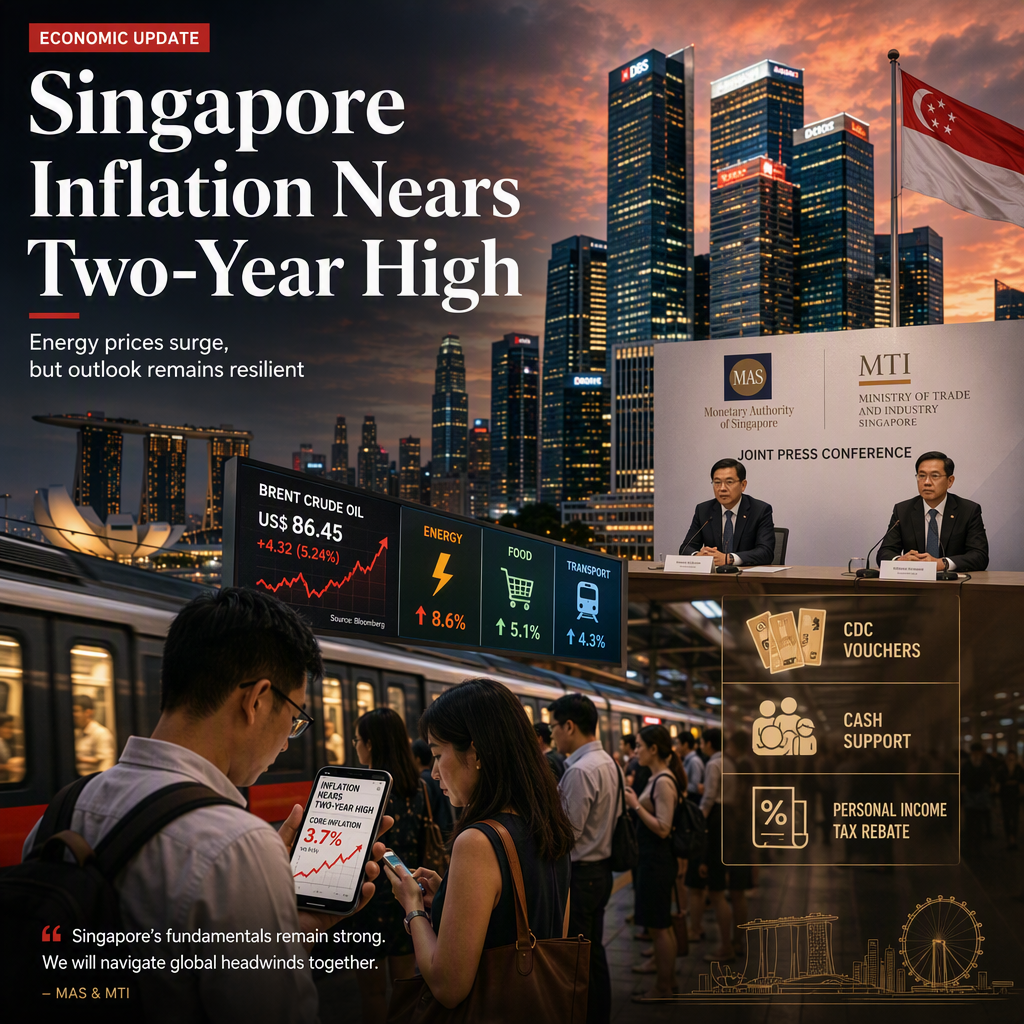
Singapore's headline inflation accelerated to 2.2% year-on-year in July, reaching its highest level in nearly two years, but still undershot economists' expectations of 2.3% as polled by Reuters [1]. Core inflation, which excludes private transport and accommodation, rose to 2%, also below the anticipated 2.2% [1]. On a month-on-month basis, the consumer price index declined by 0.2% [1]. The rise in inflation was primarily attributed to higher energy prices resulting from the Iran war, which led to increased electricity and gas charges, as well as higher transportation fares [1].
A joint statement from the Monetary Authority of Singapore (MAS) and the Ministry of Trade and Industry highlighted that global oil prices remain elevated and volatile, and adverse weather conditions are expected to reduce agricultural yields, thereby raising Singapore's imported food prices [1]. The authorities warned that prices of more imported goods and services are expected to climb in the coming months [1]. In response to these inflationary pressures, the MAS had already tightened its monetary policy in July, citing expectations of rising imported inflation due to higher fuel and electronic input costs [1].
To mitigate the impact of the Iran war and rising costs, Singapore rolled out two support packages totaling about 2 billion Singapore dollars, which include cash handouts, consumption vouchers for households, and tax rebates for companies [1]. Despite the inflationary environment, Singapore upgraded its GDP growth forecast for the full year 2026 to 4.5% to 5.5%, more than double the lower end of its previous forecast range of 2% to 4% [1].
CONCLUSION
Singapore's inflation reached a near two-year high in July but remained below market expectations, driven by elevated energy prices linked to the Iran war. While the government anticipates further imported cost pressures, robust support measures and an upgraded GDP forecast suggest resilience in the broader economy.