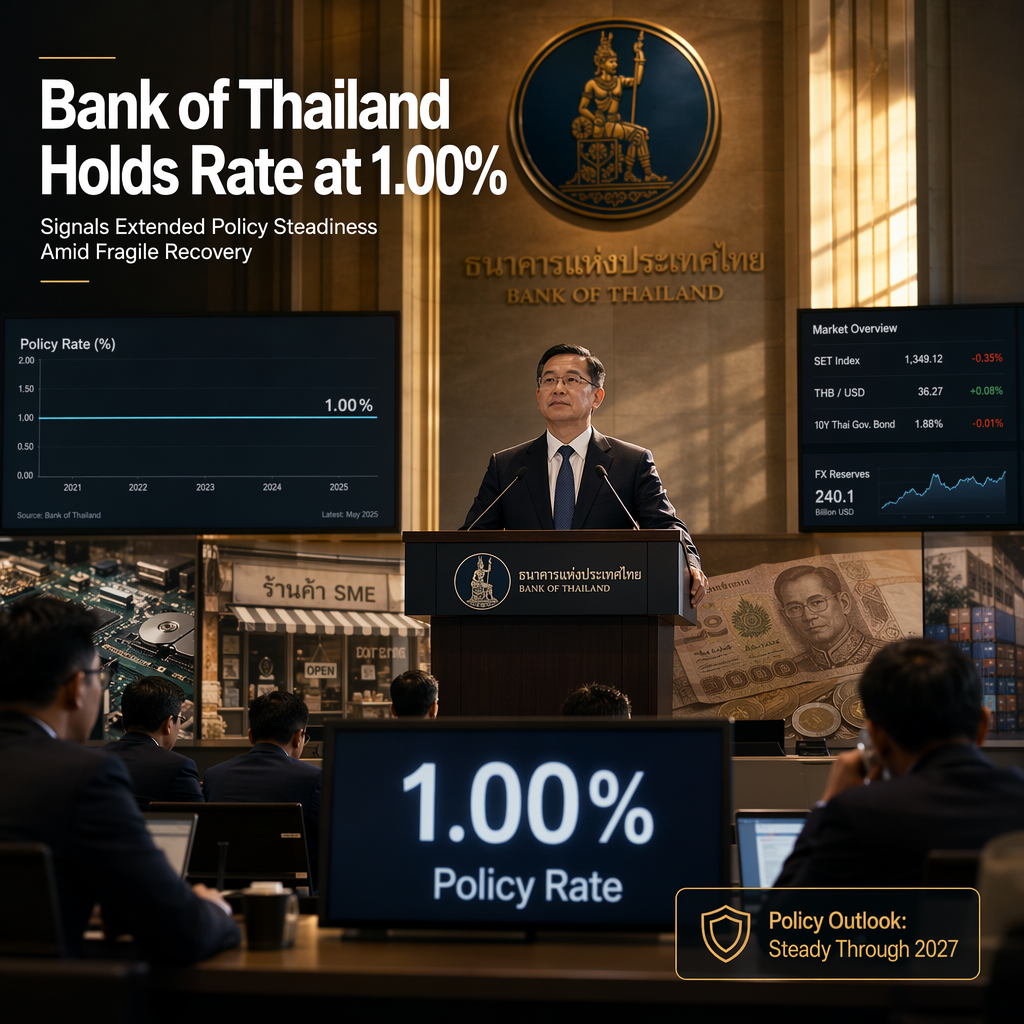
The Bank of Thailand (BoT) has decided to keep its policy rate unchanged at 1.00%, with UOB economists Enrico Tanuwidjaja and Sathit Talaengsatya expecting this level to be maintained through 2027 [1]. The economists highlight that Thailand's economic recovery remains narrow, supported by strength in technology exports but hampered by weak household demand and sluggish SME credit growth [1]. They describe current cost-push inflation as temporary and not sufficient to trigger rate hikes, emphasizing that the BoT's policy stance is best interpreted as a conditional, data-dependent hold with a high threshold for any policy changes [1].
The BoT's guidance suggests that the current rate is considered 'appropriate,' as evidenced by a unanimous vote and repeated statements, with no indication of renewed easing or pre-emptive hikes [1]. Instead, the central bank is expected to focus on targeted fiscal, debt-restructuring, and credit-enhancement measures to support the economy, rather than further broad-based rate reductions [1]. Near-term policy attention will be directed at monitoring cost pass-through, inflation expectations, baht volatility, and borrower credit quality [1].
Risks to the current rate outlook are described as two-sided, but the thresholds for any move remain high. A rate hike would require clear evidence of generalized inflation, such as persistent services inflation, stronger wage growth, a material rise in medium-term inflation expectations, or disorderly baht depreciation that amplifies imported-price pass-through [1]. UOB's house view is that the US Federal Reserve will also remain on hold through 2026, resuming easing in 2027, with no further hikes expected in either year [1].
CONCLUSION
The Bank of Thailand's decision to hold its policy rate at 1.00% reflects a cautious approach amid Thailand's fragile and uneven economic recovery. With a high threshold for policy changes and a focus on targeted fiscal and financial measures, the central bank is expected to maintain its current stance through 2027 unless significant inflationary pressures emerge. Market participants should monitor inflation dynamics and baht volatility for any potential shifts in policy.