
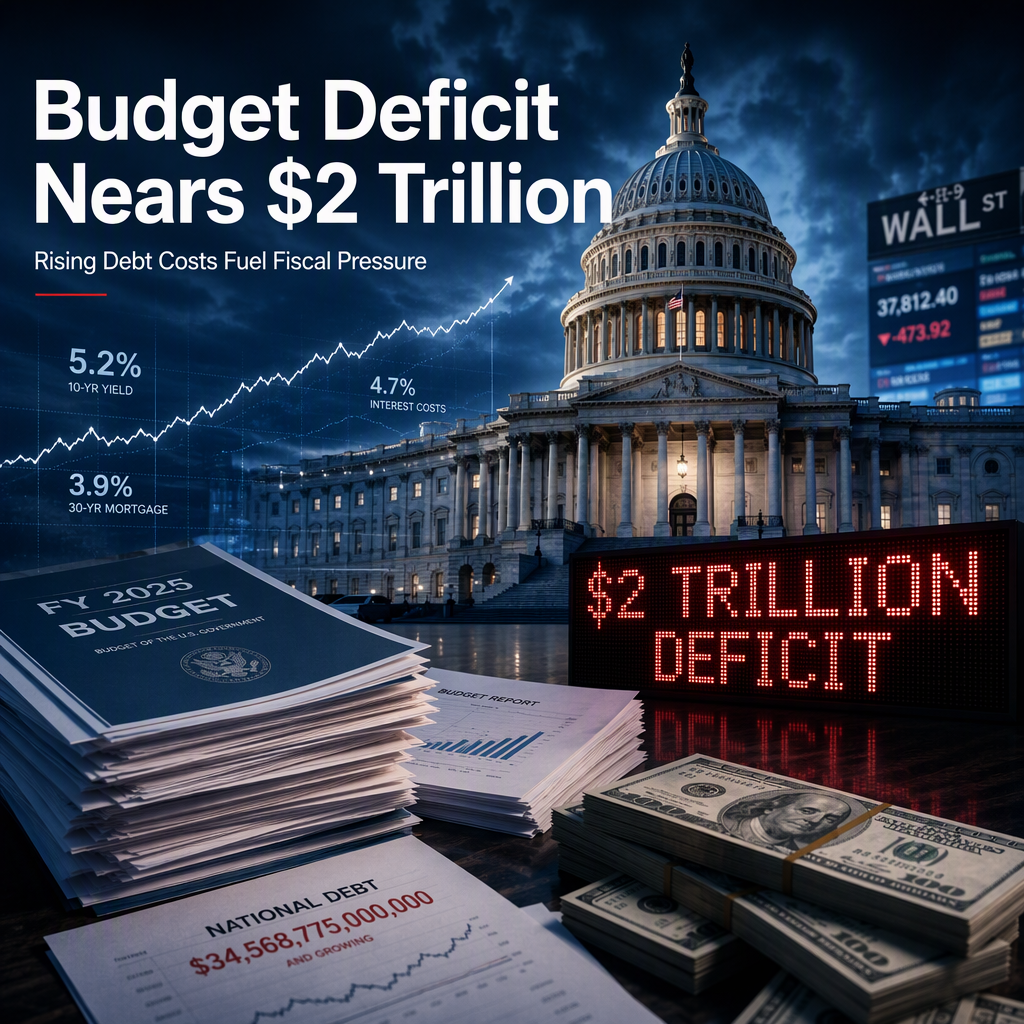
The U.S. federal government's budget deficit reached $1.993 trillion in fiscal year 2026, marking a $218 billion, or 12%, increase from the $1.775 trillion deficit recorded in fiscal year 2025, according to preliminary data released by the Congressional Budget Office (CBO) on Thursday [1]. This surge in the deficit was primarily driven by escalating costs associated with servicing the national debt, which now exceeds $40 trillion. Net interest expenses on the national debt saw the largest spending increase, rising by $115 billion, or 11%, compared to the previous year, due to both a larger debt load and higher long-term interest rates [1].
Federal tax receipts grew by 3% to more than $5.4 trillion in fiscal year 2026, but this increase was outpaced by a 6% rise in federal spending, which reached nearly $7.4 trillion [1]. Social Security benefits increased by $86 billion, or 5%, reflecting higher average benefits and more beneficiaries, though the rise was tempered by one-time retroactive payments under the Social Security Fairness Act [1]. Medicare and Medicaid spending also climbed, with Medicare up $77 billion (8%) and Medicaid up $55 billion (8%), driven by increased enrollment and higher payment rates [1].
Military spending by the Department of War rose $48 billion, or 5%, with the largest increases in research and development and military personnel costs [1]. The Department of Education's spending jumped $41 billion, or 117%, largely due to changes in the estimated costs of outstanding student loans and smaller program modifications in the One Big Beautiful Bill Act (OBBBA) compared to the prior year [1].
On the revenue side, individual income and payroll taxes increased by $255 billion, or 6%, with withheld amounts rising $168 billion (5%) and non-withheld payments up $108 billion (9%). However, higher individual income tax refunds, which grew by $16 billion (5%) due to OBBBA provisions, partially offset these gains. Corporate income tax receipts fell by $70 billion, or 16%, as larger deductions for certain investments under OBBBA reduced payments. Customs duties collections, including tariffs, declined by $22 billion, or 11% [1].
CONCLUSION
The sharp rise in the federal budget deficit and national debt costs signals mounting fiscal pressures for the U.S. government. With spending outpacing revenue growth and interest expenses climbing, market participants may anticipate continued volatility and heightened concerns over fiscal sustainability. The data underscores the urgent need for policy adjustments to address the growing deficit and debt burden.