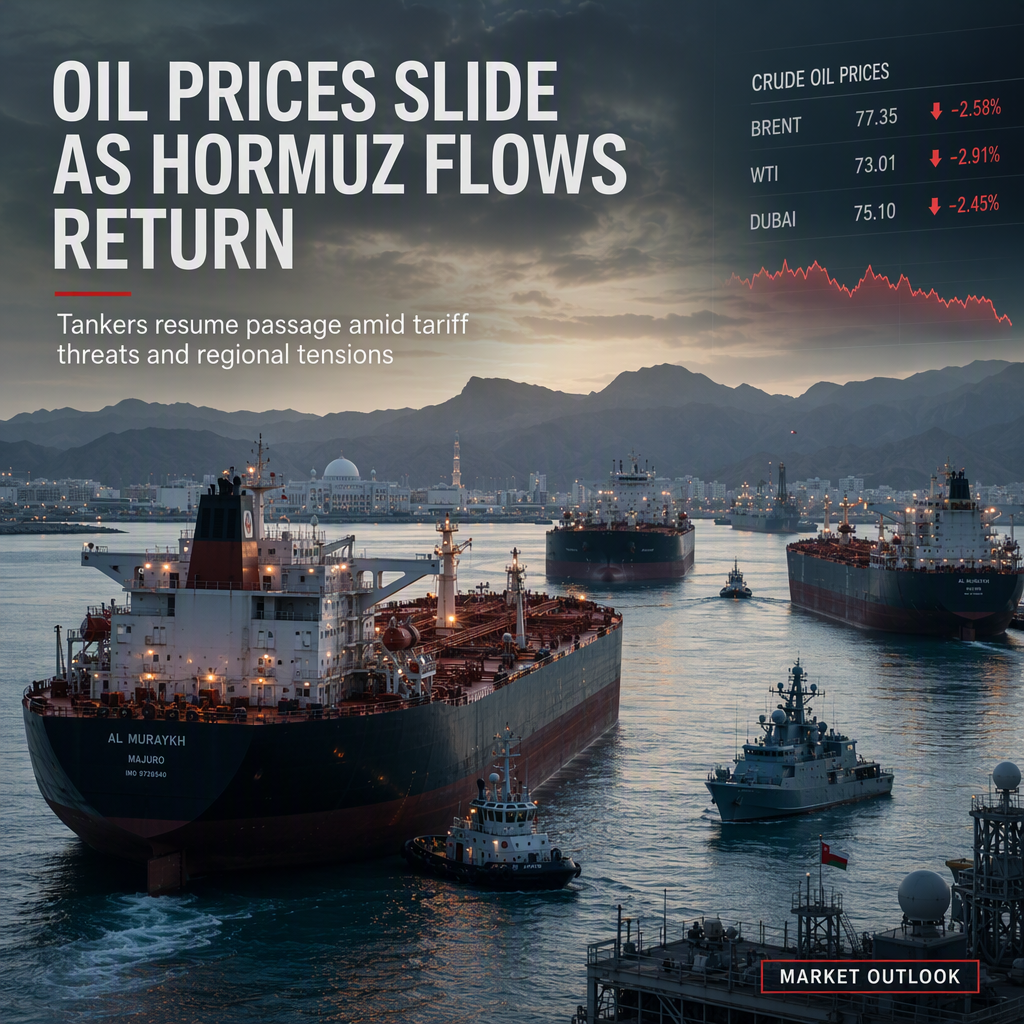
Oil prices declined on Friday following signs of recovery in crude flows through the Strait of Hormuz, which had previously been disrupted by U.S.-Iran strikes earlier in the week. Commonwealth Bank of Australia (CBA) estimates that traffic through the critical waterway has rebounded to approximately 30%-35% of pre-war levels, easing supply concerns that had temporarily pushed Brent crude above $93 a barrel earlier in the week [1]. West Texas Intermediate futures for September delivery fell by 1.62% to $82.24, while Brent crude futures dropped 0.98% to $88.16 a barrel [1].
CBA noted that a further rebound in Hormuz traffic to around 50%-60% of normal flows could be sufficient to reassert oversupply conditions in the global oil market, potentially exerting additional downward pressure on prices [1]. The market also reacted to President Donald Trump's call to add tariffs on Iran as part of a bipartisan sanctions bill targeting both Tehran and Russia. While sanctions against these countries have broad support in Congress, Trump's advocacy for tariffs as an economic tool remains divisive [1].
According to the Office of the U.S. Trade Representative, the U.S. imported only $1.4 million in goods from Iran in 2025, with works of art, collectors pieces, and antiques accounting for 55% of that value [1]. The proposed legislation would also empower Trump to impose targeted tariffs on goods imported from the top five countries that purchase Russian energy and assist Russia in evading sanctions [1].
Oil tankers and cargo vessels were observed anchored off Port Sultan Qaboos in Muscat, Oman, as of June 21, 2026, indicating ongoing logistical challenges in the region [1].
CONCLUSION
The recovery of crude flows through the Strait of Hormuz has alleviated immediate supply concerns, leading to a drop in oil prices. However, ongoing geopolitical tensions and potential new tariffs on Iran could add complexity to the market outlook. Investors remain cautious as further improvements in Hormuz traffic may shift the market toward oversupply.