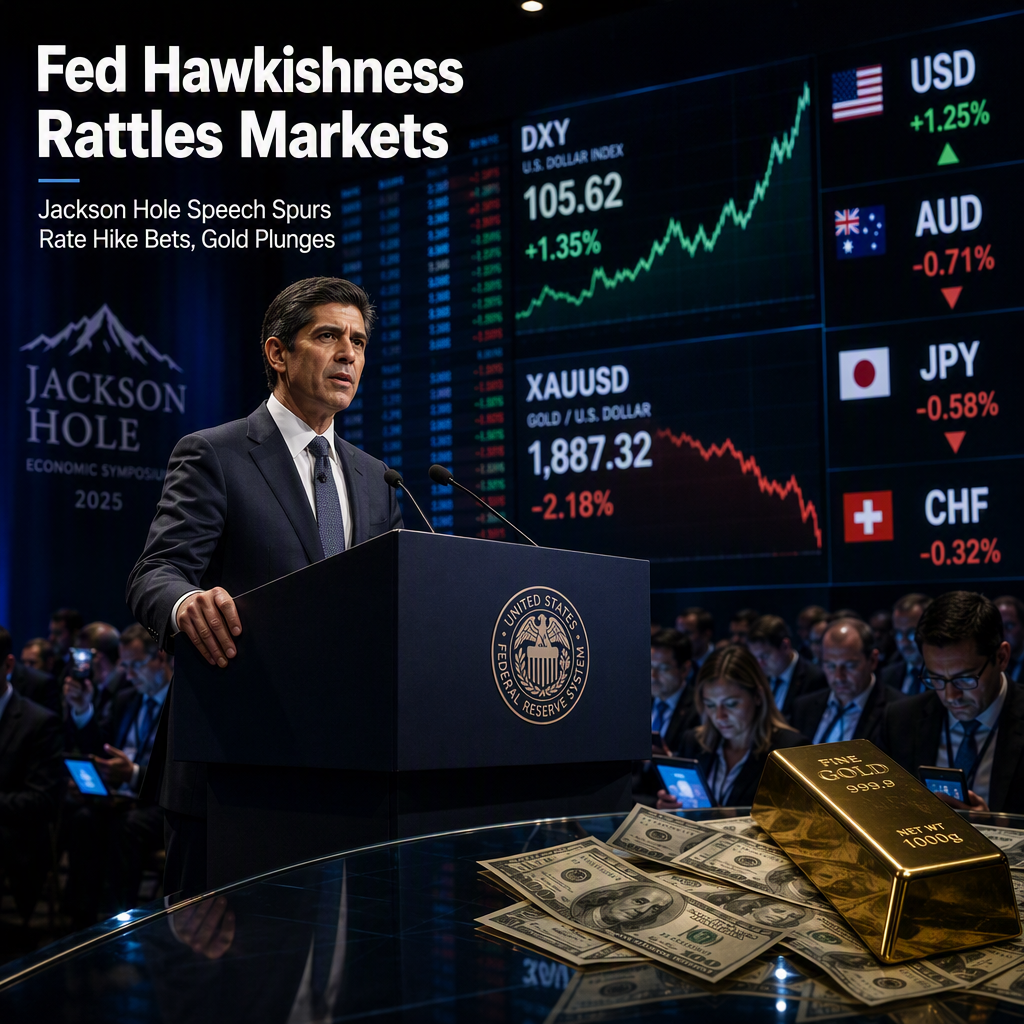
Federal Reserve Chair Kevin Warsh’s hawkish remarks at the Jackson Hole symposium have triggered a significant repricing of interest rate expectations and rippled across currency and commodity markets. Warsh acknowledged persistent inflationary pressures and indicated that interest rates may need to rise further if progress on inflation remains insufficient, stating the Fed must be confident that underlying inflation is moving toward the 2% PCE objective or 'we have work to do' [2][4]. Following his comments, traders are now pricing in a 60% chance of a Fed rate hike in September and an 88% probability of a December increase, according to CME Group’s FedWatch Tool [2]. Another source cites a nearly 57.5% chance of at least a 25 basis point hike in September, up from 35% before Warsh’s speech [4].
The US Dollar initially strengthened, reaching a two-week high on Friday, but subsequently traded with a mild negative bias as the week began [1][2][4]. The AUD/USD pair found support above 0.7150, stalling its recent slide but lacking strong bullish momentum, with technical indicators suggesting moderating upside pressure [1]. The USD was the strongest against the Australian Dollar among major currencies, though the percentage change was marginal at -0.01% for AUD/USD [1].
Gold (XAU/USD) dropped to a one-and-a-half-week low, falling over 3% after Warsh’s remarks, as rising Fed rate hike bets and escalating US-Iran tensions fueled inflation fears and undermined the non-yielding metal [2]. US forces struck Iranian positions in the Strait of Hormuz, prompting Iranian retaliation, and US Treasury Secretary Scott Bessent signaled new secondary sanctions against Iran, further stoking market volatility [2]. Despite these pressures, modest USD weakness and soft US Treasury yields helped gold trim some losses below the $4,400 mark [2].
In the FX space, the Swiss Franc gained against the US Dollar despite the Fed’s hawkish tone, as comments from Goldman Sachs’ Jan Hatzius suggested the Fed would only hike if upcoming CPI and PPI data surprise to the upside, which Goldman Sachs considers unlikely [4]. The Swiss National Bank held its policy rate at 0% and is expected to maintain this stance through at least 2027, with subdued inflation data reinforcing its position [4]. Meanwhile, AUD/JPY declined to near 114.50 as hotter Tokyo CPI data and hawkish BoJ commentary fueled expectations of a September rate hike in Japan, though the pair maintained a bullish tone above its 100-day SMA [3].
Looking ahead, markets are focused on upcoming US macro releases, including the Nonfarm Payrolls report, which could further influence Fed policy expectations [2]. Analysts at Societe Generale and Brown Brothers Harriman expect central banks in Japan and Switzerland to maintain their respective tightening and holding biases, shaped by evolving inflation dynamics [3][4].
CONCLUSION
Fed Chair Warsh’s hawkish remarks have sharply increased market expectations for US rate hikes, driving volatility across FX and commodity markets. The US Dollar’s initial strength has moderated, while gold and risk-sensitive currencies have faced pressure amid geopolitical tensions and inflation concerns. Market participants now await key US economic data for further policy direction.