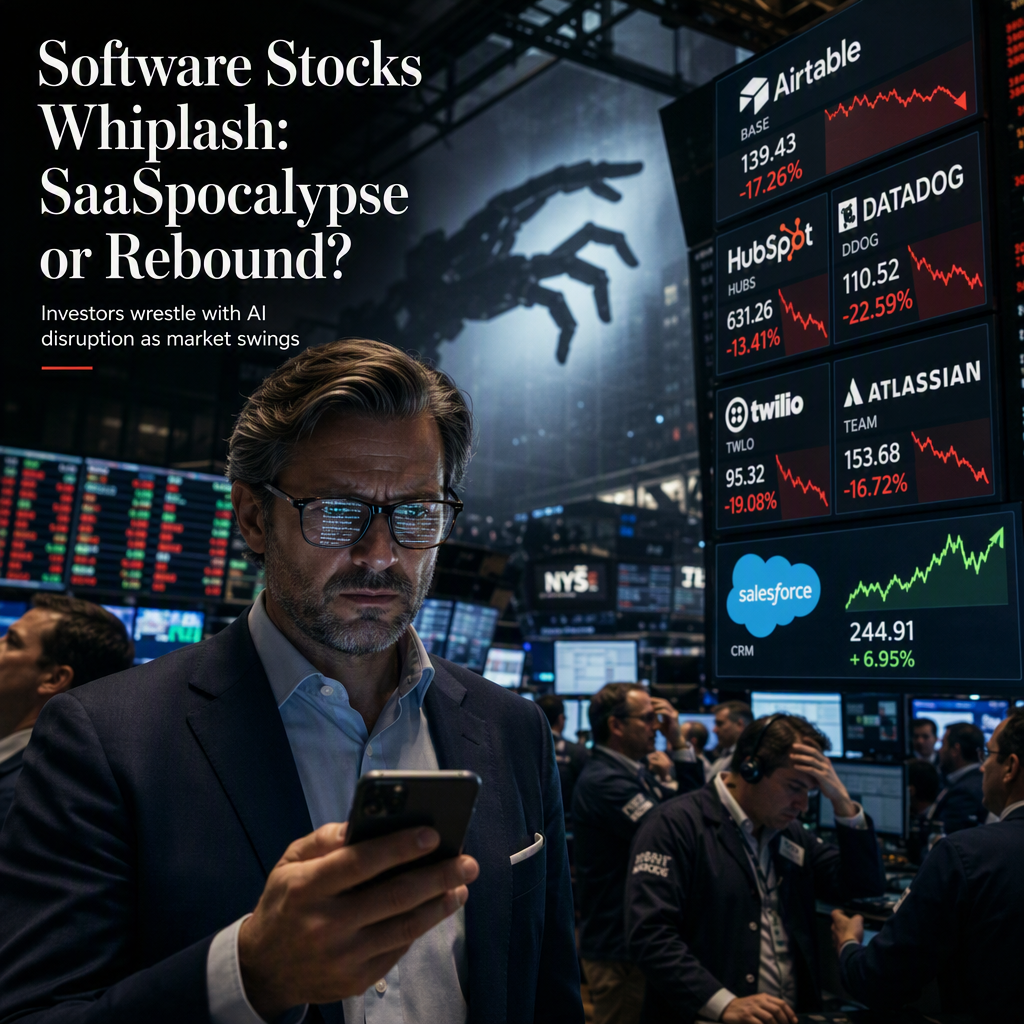
The software sector experienced extreme volatility over the past week, with investors grappling with concerns about artificial intelligence's impact on traditional software business models [1]. Airtable, once a highflyer among cloud software startups, agreed to be acquired for about one-tenth of its peak valuation, highlighting the severity of the downturn for some companies [1]. HubSpot and Datadog saw their stock prices tumble following earnings reports, while Figma also experienced declines, underscoring investor worries that AI models are eroding the value of expensive software products [1].
Despite the negative sentiment, the week ended with a notable rebound for certain companies. Twilio and Atlassian each saw historic stock price increases of well over 20% after reporting quarterly results, restoring some confidence in the sector [1]. Cloudflare also gained 5.6% [1]. Atlassian reported its most profitable quarter since 2021, which Box CEO Aaron Levie described as a "huge quarterly beat," suggesting that fears about AI's impact may be overstated for some software categories [1]. Levie noted that while AI agents could pressure renewals in some areas, many investors were misinterpreting the risks [1].
Salesforce CEO Marc Benioff has been actively defending his company's software offerings, arguing that longstanding products for sales, marketing, and customer service will not be replaced by AI. Despite this, Salesforce has lost more than 40% of its value since the end of 2024, even as it continues to deliver accelerating revenue growth and consistent margins [1]. The broader software sector has been under pressure due to the belief that AI tools like OpenAI's Codex and Anthropic's Claude Code could undermine their economics [1].
The iShares Expanded Tech-Software Sector ETF experienced a sharp 24% decline in the first quarter, marking its worst performance since 2008. However, the ETF has rebounded and is now down just 3% for the year, while the Nasdaq is up 15% [1]. Analyst Matt Hedberg from RBC Capital Markets commented that companies will likely use coding agents to build functionality, which may exert pressure on software renewals [1].
CONCLUSION
The software sector is facing significant challenges as investors reassess the impact of artificial intelligence on traditional business models. While some companies have suffered steep declines, others like Twilio and Atlassian have demonstrated resilience and strong performance. The market remains highly volatile, with ongoing debates about which software firms can withstand AI disruption.