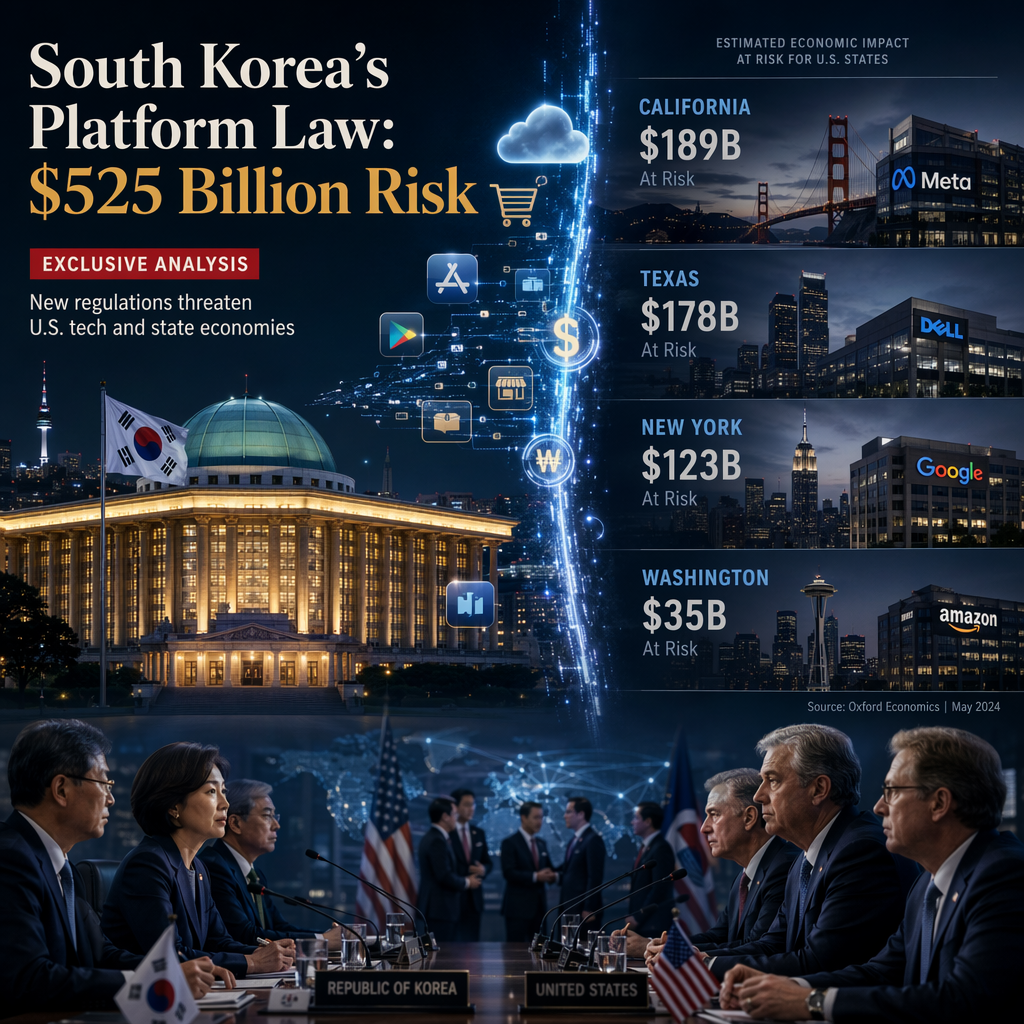
A new model estimates that U.S. states could lose $525 billion in economic activity over the next decade if South Korea enacts the Online Platform Fairness Act, a proposed law that would regulate transactions with certain American firms. The Competere Foundation's analysis breaks down the projected losses by state, including $123 billion for California, $48.7 billion for Texas, $33.9 billion for New York, and $27.4 billion for Washington [1].
More than 50 U.S. House lawmakers, led by Rep. Darrell Issa, have expressed concern over what they describe as discriminatory South Korean policies that disadvantage American tech companies and favor competitors linked to China. Rep. Issa criticized South Korea's regulatory environment, referencing the country's 20-year ban on Google Maps and comparing the Korea Fair Trade Commission (KFTC) to the U.S. Federal Trade Commission under Lina Khan [1].
The proposed legislation, which is still pending in South Korea's National Assembly, would expand the KFTC's authority. Lawmakers and experts warn that these regulations could further deteriorate the business climate for U.S. companies in South Korea. Shanker Singham, CEO of the Competere Foundation, stated that Korea is already an 'increasingly unfriendly place for U.S. companies to do business' and that the new regulations would exacerbate this situation [1].
Political shifts in South Korea have also been highlighted, with the Democratic Party now holding a substantial majority in the National Assembly and President Lee Jae-myung, described as 'far-left,' supporting the bill. Former Rep. Chris Stewart warned that South Korea's regulatory approach could have devastating effects beyond the tech sector and argued that it strategically benefits China [1].
CONCLUSION
The proposed Online Platform Fairness Act in South Korea has prompted strong warnings from U.S. lawmakers and analysts, who cite a potential $525 billion economic loss for U.S. states over the next decade. The pending legislation and South Korea's current regulatory trajectory are seen as significant threats to American business interests, with broader strategic implications for U.S.-China competition.