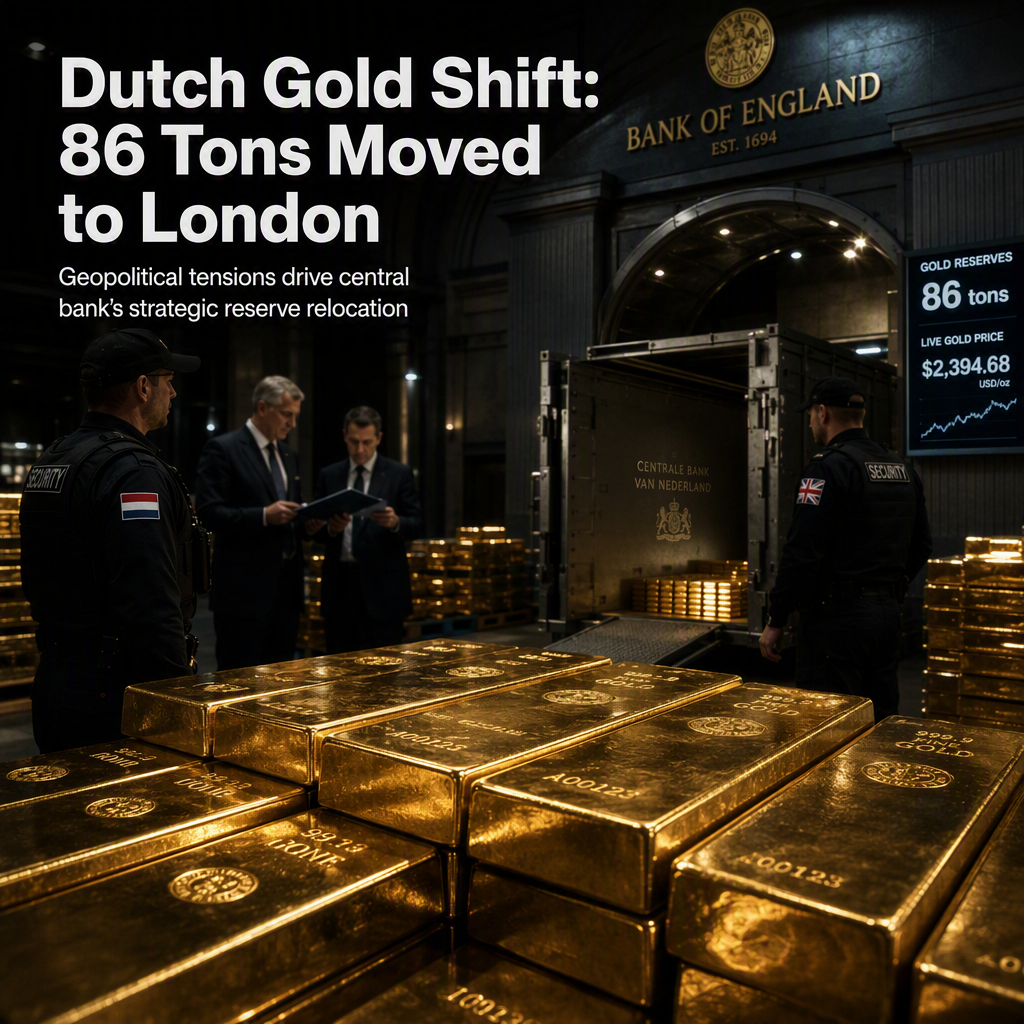
The Dutch central bank (DNB) has transferred approximately 86 tons of gold from the United States and Canada to the United Kingdom, citing the need to enhance crisis preparedness in the face of rising geopolitical risks [1]. This relocation, which took place between March and August, represents just over one-quarter of the DNB's gold reserves previously held in New York and Ottawa [1]. The gold is now stored with the Bank of England, which DNB described as holding 'the world's most easily tradable gold' due to its compliance with international trade standards [1].
DNB Governor Olaf Sleijpen stated, 'With this relocation, we have improved the tradability of our gold reserves. We expect that we will never need to use them, but we do need to strengthen our resilience and preparedness' [1]. The central bank emphasized that gold stored in the U.S. and Canada could not be utilized as quickly and directly in a crisis situation compared to gold in London [1].
This move comes during a period of significant gold price appreciation, with the metal up nearly 25% over the past 12 months and currently trading at $4,429.61 per ounce, a nearly 1% increase for the session [1]. The transfer also follows a similar action by the French central bank, which relocated 129 tons of gold from the New York Federal Reserve to other locations between July 2025 and January 2026 [1].
Following the latest transfer, the DNB reported a more balanced geographical distribution of its gold reserves: London now holds 32.1%, the DNB's cash center in Zeist, Netherlands holds 30.8%, and New York and Ottawa each hold 18.5% [1]. The central bank's actions reflect ongoing concerns about geopolitical tensions, particularly those involving the U.S. and Iran over the Strait of Hormuz, and the importance of maintaining liquid and accessible reserves [1].
CONCLUSION
The Dutch central bank's decision to relocate a significant portion of its gold reserves to London underscores heightened concerns over geopolitical risks and the need for enhanced crisis preparedness. The move, set against a backdrop of surging gold prices and similar actions by other European central banks, signals a strategic shift toward more liquid and accessible reserve management.