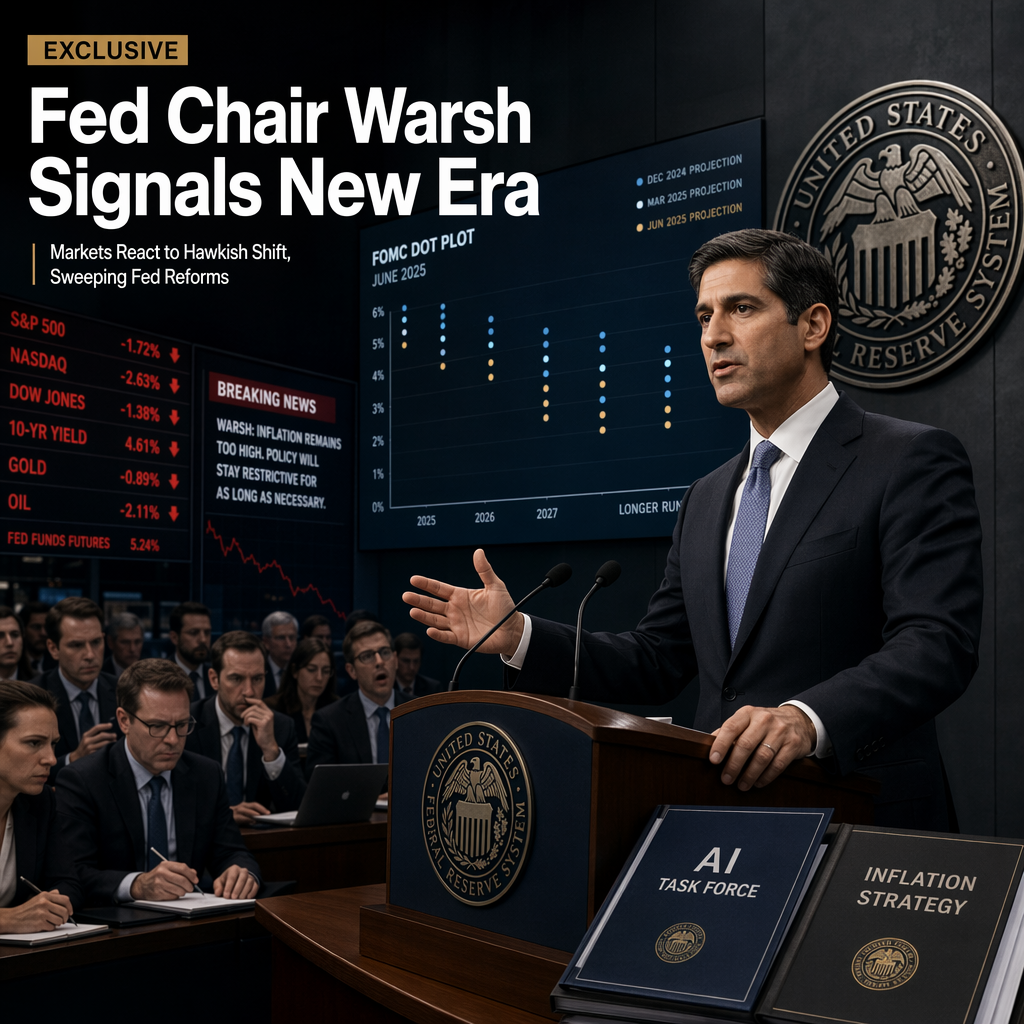
At his first meeting as Federal Reserve chairman, Kevin Warsh and the Federal Open Market Committee (FOMC) voted to keep the benchmark federal funds rate steady in a target range of 3.5%-3.75%, with no apparent dissents among committee members [1]. However, the FOMC's 'dot plot' revealed a split outlook: nine members expect rates to remain steady or see one cut, while nine anticipate at least one hike, with the median projection pointing to a quarter percentage point increase later this year [1].
Warsh confirmed he did not submit his own dot plot projection, consistent with his previously stated skepticism toward forward guidance, stating, 'I have refrained from offering any projections of my own consistent with my long-held views on the SEP, at least as currently structured' [1]. He encouraged other committee members to continue submitting their projections [1].
In a move to reshape the Fed's approach, Warsh announced the formation of five task forces focused on communication, the Fed's balance sheet, data sources, productivity and jobs, the impact of artificial intelligence and transformative technologies, and the central bank's inflation strategy [1]. Warsh emphasized 'price stability' repeatedly during his press conference, signaling a hawkish stance and the committee's 'unambiguous and unanimous' resolve to control inflation [1]. This rhetoric contributed to a sharp market reaction, with the policy-sensitive 2-year Treasury yield rising by 14.4 basis points and major stock averages declining after the meeting and Warsh's remarks [1].
Warsh also initiated a revamp of Fed communications, issuing a notably concise post-meeting statement of just 130 words, compared to the previous norm of over 300 words [1]. Rick Rieder, head of fixed income at BlackRock, commented, 'Today we believe that the Federal Reserve's FOMC ushered in a new era of monetary policy in the United States' [1].
CONCLUSION
Kevin Warsh's first meeting as Fed chairman marked a significant shift in both policy tone and operational approach, with no rate change but clear signals of possible tightening ahead. Markets reacted negatively to the hawkish messaging and uncertainty, as evidenced by falling stock averages and a spike in Treasury yields. Warsh's reforms and emphasis on inflation control suggest a new, more disciplined era for the Federal Reserve.