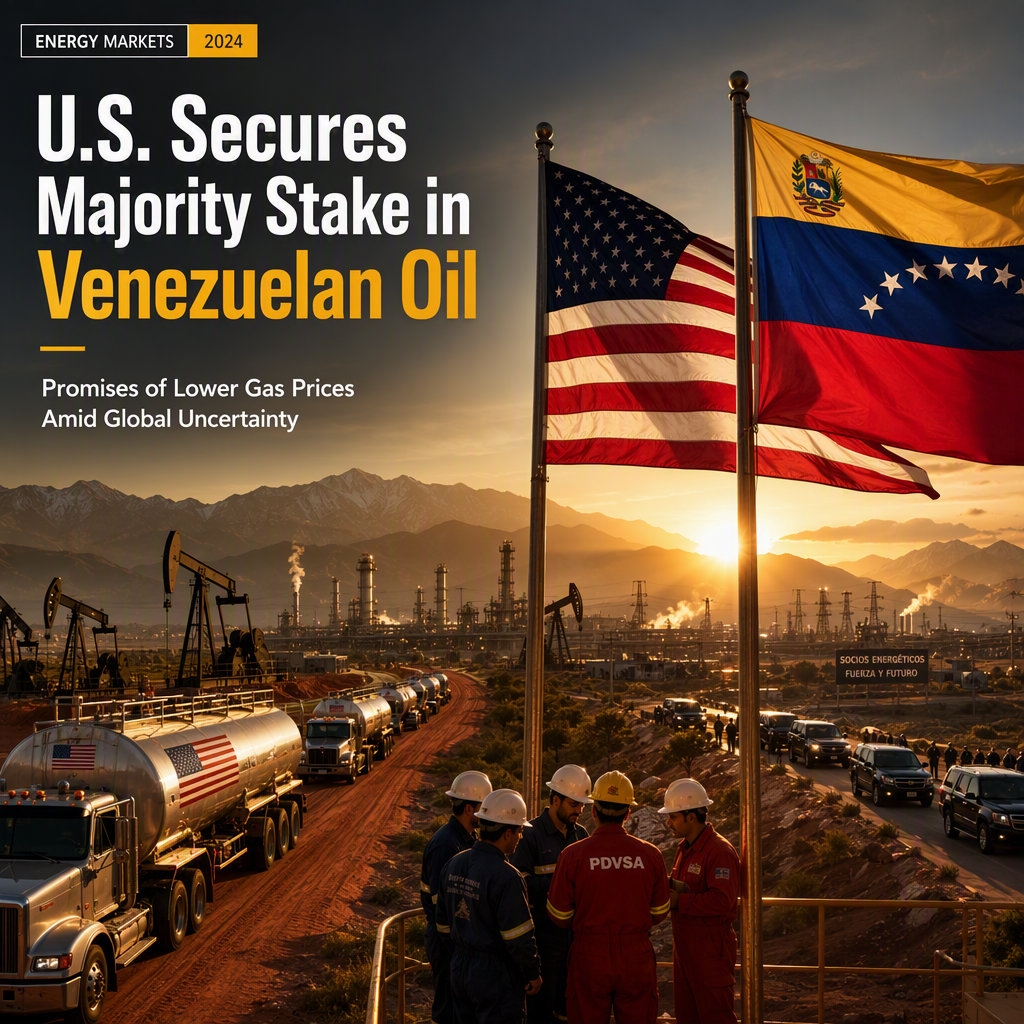
President Donald Trump announced on Friday a new agreement with Venezuela that grants the United States majority control over 65 billion barrels of oil from Venezuela's proven reserves, a move he claims will significantly reduce gas prices for Americans [1]. The deal provides the U.S. with a 55% effective interest in the output of a newly formed private company managing these reserves, though immediate access to 35.75 billion barrels is not included; the 55% interest applies to oil ultimately produced from 17 Venezuelan fields covered by the agreement [1].
The agreement comes amid ongoing disruptions in global energy markets due to the Iran war, which has driven the average price of regular gasoline in the U.S. to $4.08 per gallon, up from $3.20 a year ago, according to AAA [1]. A key provision of the deal allows the U.S. to purchase Venezuelan oil at cost, potentially providing American buyers with cheaper crude once production ramps up [1].
Despite the announcement, experts caution that the deal is unlikely to result in an immediate drop in U.S. gasoline prices. Significant increases in Venezuelan crude production will require years of infrastructure development and billions of dollars in investment [1]. Rystad Energy projected in July that Venezuelan oil production could rise by 17% by 2028, but only with substantial improvements in drilling activity, infrastructure, and rig availability [1]. Additionally, Venezuela's heavy and viscous crude requires a steady supply of diluents to facilitate transport and refining [1].
Secretary of State Marco Rubio stated that the agreement is expected to bring nearly $100 billion in private investment to Venezuela and lower U.S. gas prices [1]. However, U.S. oil companies have remained cautious about investing in Venezuela due to the country's history of underinvestment and mismanagement, as noted by the U.S. Energy Information Administration in October 2023 [1]. The Trump administration is optimistic that U.S. involvement and private investment will reverse Venezuela's oil sector decline [1].
CONCLUSION
The U.S.-Venezuela oil agreement marks a significant shift in energy policy, with promises of increased supply and lower gas prices in the long term. However, experts highlight that immediate market impacts are unlikely due to the need for extensive investment and infrastructure upgrades. The deal's success will depend on overcoming operational challenges and attracting private investment.