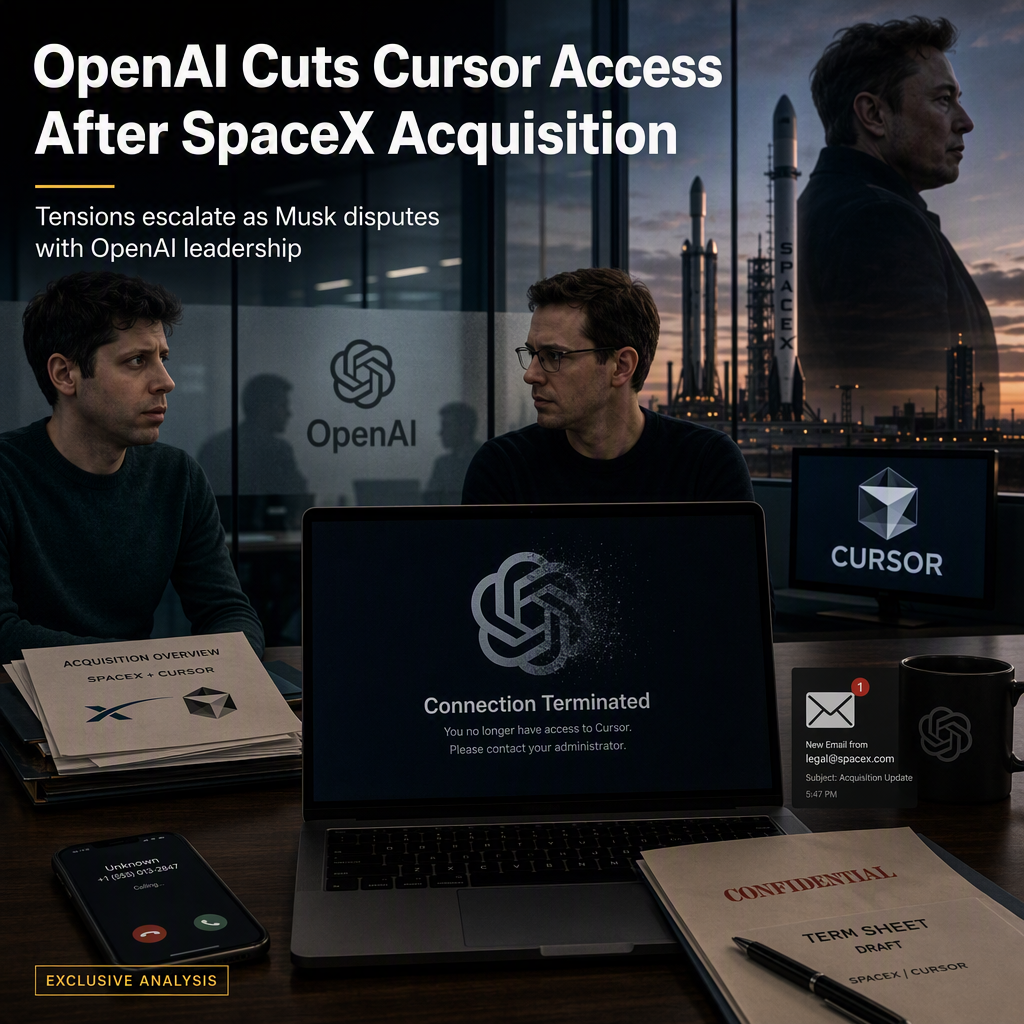
OpenAI announced that it will terminate developers' access to its models on Cursor, following SpaceX's $60 billion acquisition of the AI coding startup earlier this month [1]. The proposed shutoff date for OpenAI models via Cursor is November 12, 2026, and OpenAI stated it will not provide future models to Cursor as it winds down the agreement [1]. OpenAI cited concerns over contract compliance, referencing prior experiences with Elon Musk's companies allegedly violating contracts, as the reason for this decision [1].
Cursor CEO Michael Truell acknowledged that OpenAI models account for about 5% of Cursor user traffic and indicated ongoing discussions with OpenAI to resolve the issue [1]. Truell emphasized Cursor's longstanding relationship with OpenAI and expressed hope for a neutral infrastructure solution [1].
The move comes amid a broader and contentious dispute between Elon Musk and OpenAI leadership, including CEO Sam Altman and President Greg Brockman [1]. Musk, who co-founded OpenAI in 2015 and left its board in 2018, has been a vocal critic of the company's direction and structure, previously suing OpenAI, Altman, and Brockman in 2024 over alleged violations of founding commitments [1]. Although Musk lost the lawsuit earlier this year, he has vowed to appeal [1]. In response to OpenAI's latest action, Musk posted disparaging remarks about Altman and Brockman on X, reiterating his criticisms [1].
The decision to end Cursor's access to OpenAI models highlights intensifying competition in the AI-assisted coding tools market, with OpenAI preparing for a potential IPO next year and rival Anthropic reportedly considering an IPO at a valuation as high as $2 trillion [1]. OpenAI's action is not unprecedented in the industry; last June, Anthropic also restricted access to its models for certain partners [1].
CONCLUSION
OpenAI's decision to cut off Cursor's model access following SpaceX's acquisition underscores ongoing tensions between Elon Musk and OpenAI leadership. The move has significant implications for the competitive landscape of AI coding tools and raises questions about future collaborations between major AI and technology firms.