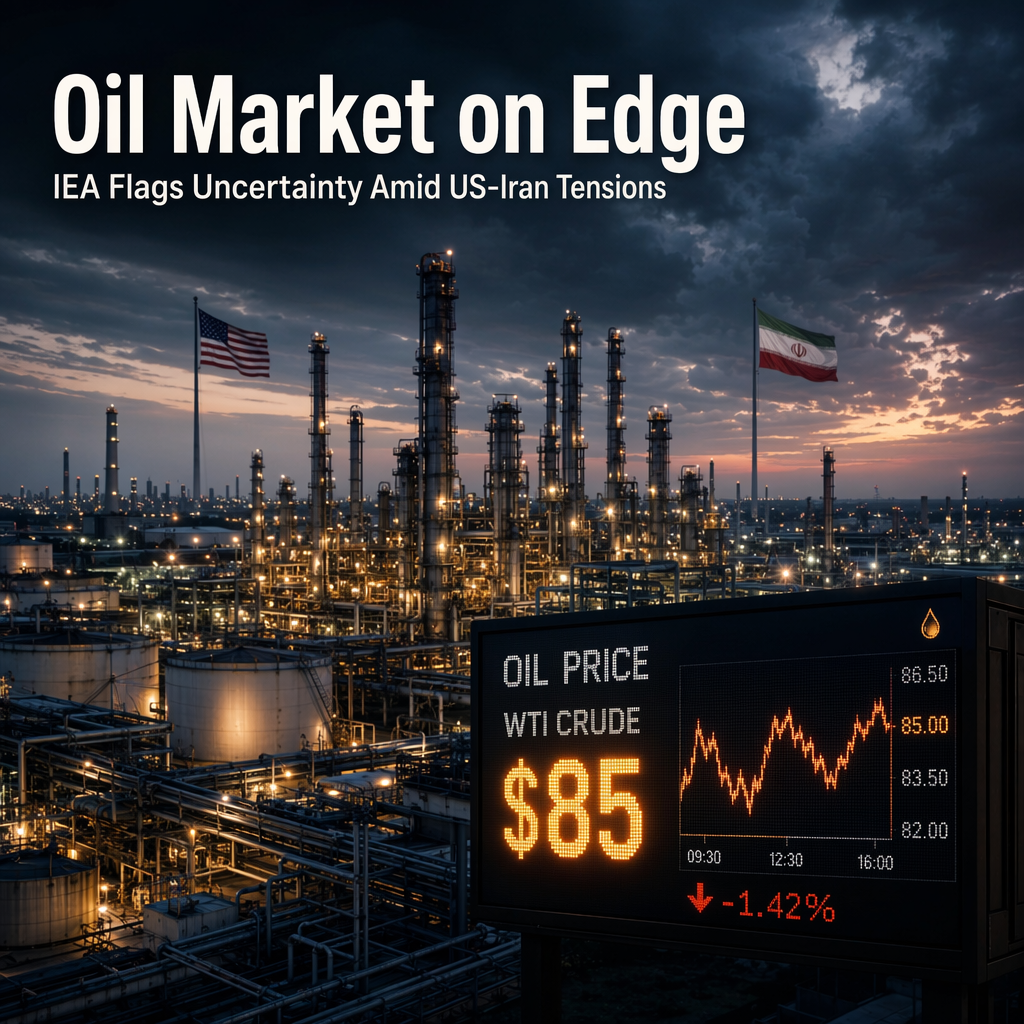
The International Energy Agency (IEA) has reported that global oil supply is increasing, with the first half of 2026 seeing crude oil supply reach approximately 100 million barrels per day, marking a rise compared to the same period in the previous year. This growth is primarily attributed to expanded production from non-OPEC countries such as the United States and Brazil [1].
Despite the supply increase, the IEA highlighted significant uncertainty in the oil market outlook due to escalating tensions between the United States and Iran. The agency expressed concern that heightened geopolitical risks in the Middle East are creating substantial unpredictability for the crude oil market [1].
Regarding prices, the IEA noted that the rise in geopolitical risks could lead to sharp short-term fluctuations. West Texas Intermediate (WTI) crude futures temporarily climbed into the $85 per barrel range, reflecting increased investor caution. Technical analysis indicates that the low $80s serve as a key support level for WTI futures, while the $85 range is seen as a near-term resistance point [1].
The IEA emphasized the need to closely monitor Middle East developments and the actions of major oil-producing countries, warning that market volatility could intensify. Market participants have suggested that if US-Iran tensions escalate further, crude prices could temporarily surge into the $90 range, drawing significant attention to future price movements [1].
CONCLUSION
The IEA's latest report underscores both the recent growth in global oil supply and the heightened uncertainty stemming from US-Iran tensions. With WTI crude futures already reacting to geopolitical risks, the market remains highly sensitive to further developments in the Middle East. Investors and analysts are closely watching for any escalation that could drive prices higher and increase volatility.