
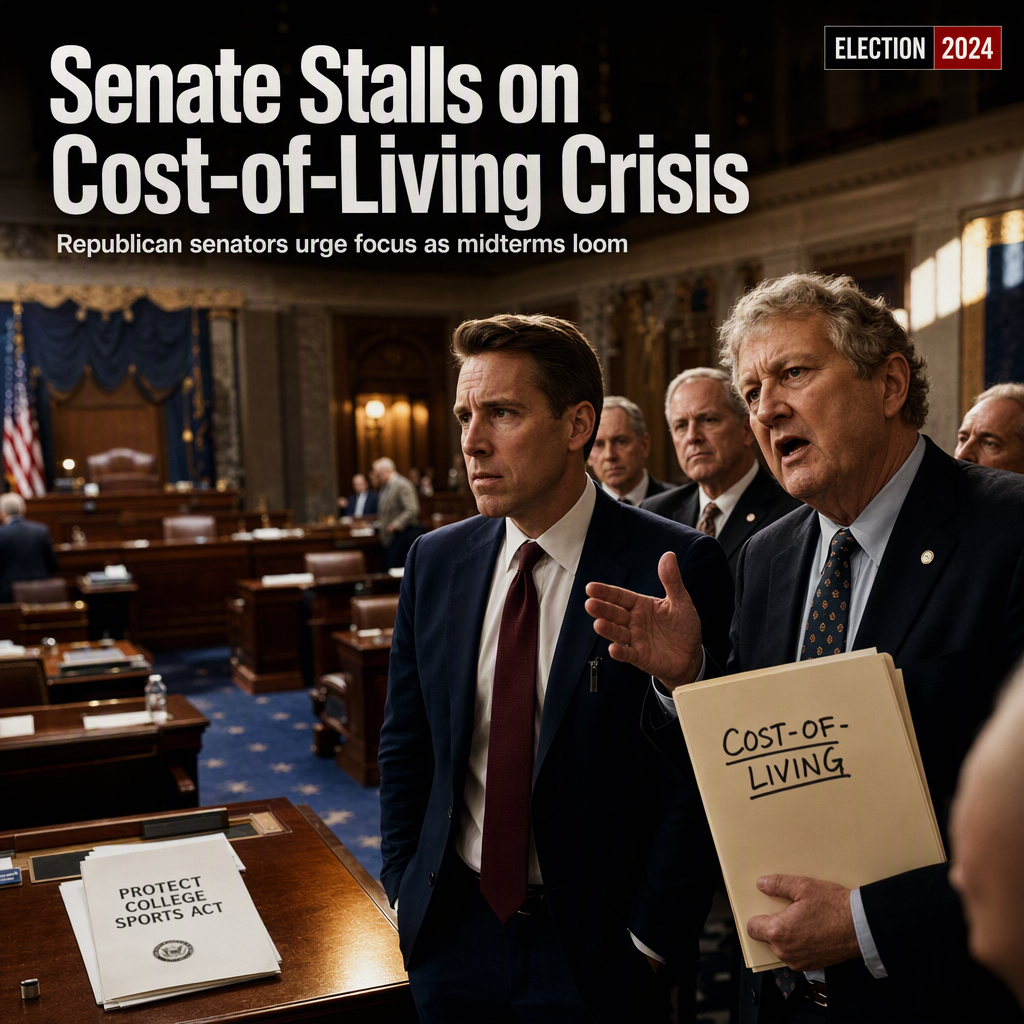
Republican senators are voicing concerns that the Senate has not taken sufficient action to address rising costs and affordability issues as the midterm elections approach, with the economy remaining a central focus for voters [1]. Despite these concerns, the Senate has recently devoted significant time to passing the Protect College Sports Act, sponsored by Sen. Ted Cruz, R-Texas, which passed the upper chamber late Monday night [1].
Sen. Josh Hawley, R-Mo., expressed frustration over the Senate's priorities, stating, 'I'm just hoping that this will be the best bill ever passed by the United States Senate considering the ungodly amount of time we've spent on it,' and highlighted the need to address costs related to fuel, prescription drugs, health care, and the financial burden of the artificial intelligence boom [1]. Sen. John Kennedy, R-La., echoed these sentiments, emphasizing that voters are more concerned about affordability than college sports, and noted that he and others have been pressuring Senate Majority Leader John Thune, R-S.D., to focus on legislation targeting cost-of-living issues [1].
Republicans have pointed to their 'big, beautiful bill' from the previous year as a key accomplishment in tackling affordability, a message that was prominent during the recent midterm convention in Dallas and continues to be emphasized as the November 3 election nears [1]. However, the lack of recent legislative action on economic issues has intensified concerns among some Republicans, especially as the Senate prepares to adjourn for the campaign trail [1].
No specific market reactions or analyst opinions were discussed in the article. The ongoing focus on affordability and cost-of-living issues suggests that these topics may remain central to political and economic discourse as the elections approach [1].
CONCLUSION
Republican senators are increasingly worried that the Senate's recent focus on college sports legislation has come at the expense of addressing voters' concerns over rising costs. As the midterm elections draw near, affordability remains a key issue, and calls for renewed legislative action on economic matters are growing within the party.