
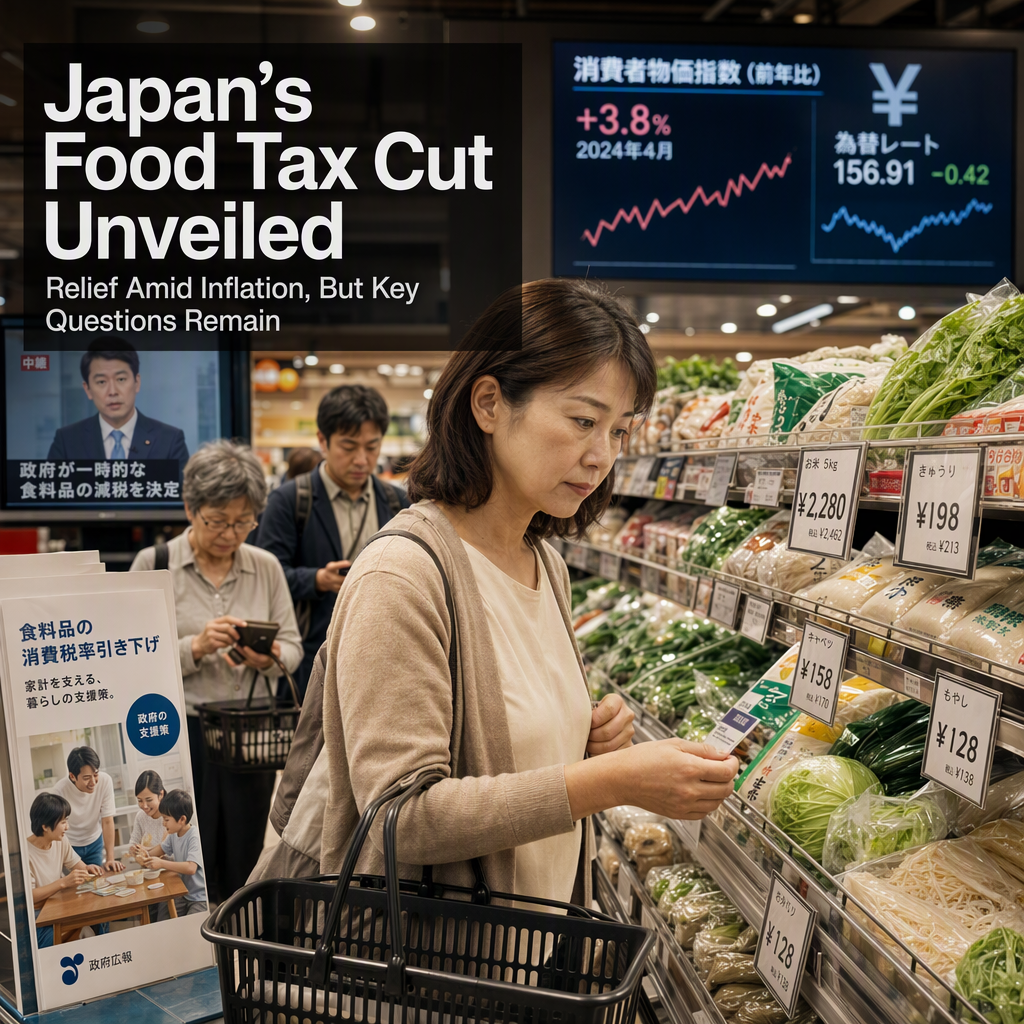
Japan's cabinet has approved a temporary consumption tax cut on food, aiming to provide relief to consumers facing inflationary pressures. However, the measure leaves several critical questions unresolved, including how the government will finance the tax cut and which food items and consumer groups will be eligible for the relief. These unresolved issues are expected to be the subject of intense parliamentary debate in the coming weeks, as lawmakers and business leaders express concern over the lack of specifics [1].
The cabinet's decision comes as Japan experiences an inflation wave that has raised prices on 3,000 food and drink items. The government's move is seen as a response to growing public frustration over rising living costs. Despite this, the absence of a concrete funding plan has drawn criticism from opposition parties and fiscal conservatives, who are concerned about the impact on government revenues and fiscal discipline [1].
Business leaders are also debating the duration of the tax cut, with a recent Nikkei poll indicating that most favor a strict two-year limit on the measure. Prime Minister Sanae Takaichi has attempted to reassure markets by emphasizing the temporary nature of the tax cut and promising that further details will be provided during parliamentary deliberations [1].
Lawmakers will need to strike a balance between providing relief for consumers and maintaining fiscal discipline, as the specifics of the tax cut—including its funding and eligibility criteria—remain to be determined [1].
CONCLUSION
Japan's cabinet approval of a temporary food tax cut signals a response to inflation and public concern over rising prices, but leaves key details unresolved. The lack of clarity on funding and eligibility has sparked debate among lawmakers and business leaders, with market participants awaiting further details from parliamentary discussions. The measure's temporary nature and fiscal implications will be central to upcoming policy debates.