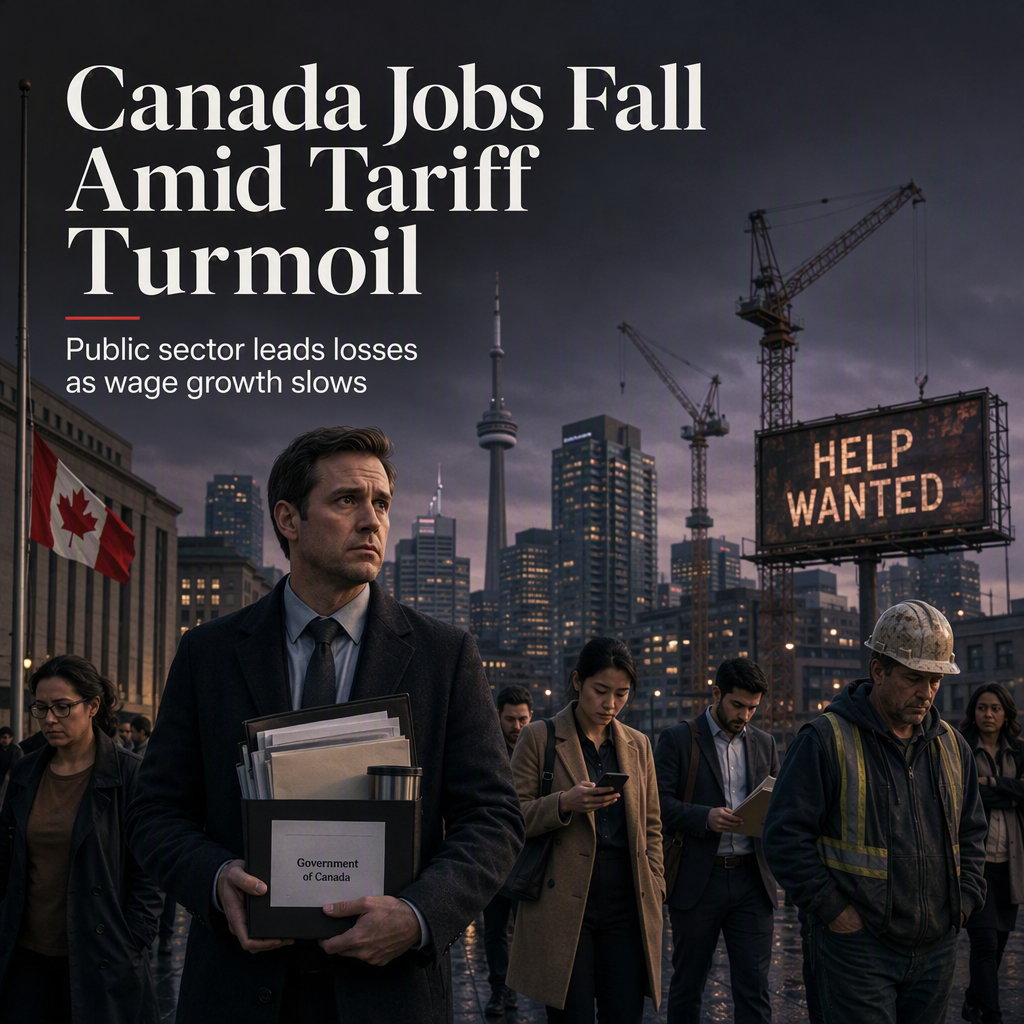
Canada experienced a significant employment decline in August 2026, losing 42,000 jobs according to the Statistics Canada Labour Force Survey, a sharp miss compared to economists' forecasts of a 15,000 gain [1]. The unemployment rate remained steady at 6.4%, following three consecutive monthly drops from May to July [1]. This downturn reverses part of the strong job growth seen in the spring, when the economy added 181,000 jobs from April to July [1].
The public sector was the primary contributor to job losses, shedding 20,000 positions for its third straight monthly decline. Since May, government payrolls have decreased by 78,000 (-1.7%) [1]. Other sectors facing losses included business and building support services (-20,000), public administration (-8,800), natural resources (-7,700), and utilities (-5,600) [1]. Manufacturing was the exception, adding 22,000 jobs (+1.2%), mostly in Ontario [1]. Youth employment also dropped by 19,000, though the youth jobless rate remained near 12.9% [1].
Wage growth slowed markedly, with average hourly pay rising just 2.0% year over year in August, down from 2.8% in July and 3.3% in June. This represents the weakest wage growth since 2017, excluding the pandemic period [1]. Lower-paid workers were particularly affected, as pay for the bottom quarter of earners increased only 1.1%, while the top quarter saw 2.1% gains [1].
Trade tensions with the US have intensified, with fresh US tariffs impacting industries tied to export demand and leading to a rising layoff rate. Talks between Canada and the US broke down last month, prompting Ottawa to prepare counter-tariffs [1]. The Bank of Canada held its policy rate at 2.25% two days prior, citing tariff-driven inflation risks [1].
CONCLUSION
Canada's August 2026 employment report revealed a sharp job loss and slowing wage growth, largely driven by public sector cuts and escalating US tariffs. The steady unemployment rate and manufacturing gains offer some resilience, but the overall sentiment is negative, with inflation risks flagged by the Bank of Canada. Market participants are likely to view these developments as a sign of mounting economic headwinds.