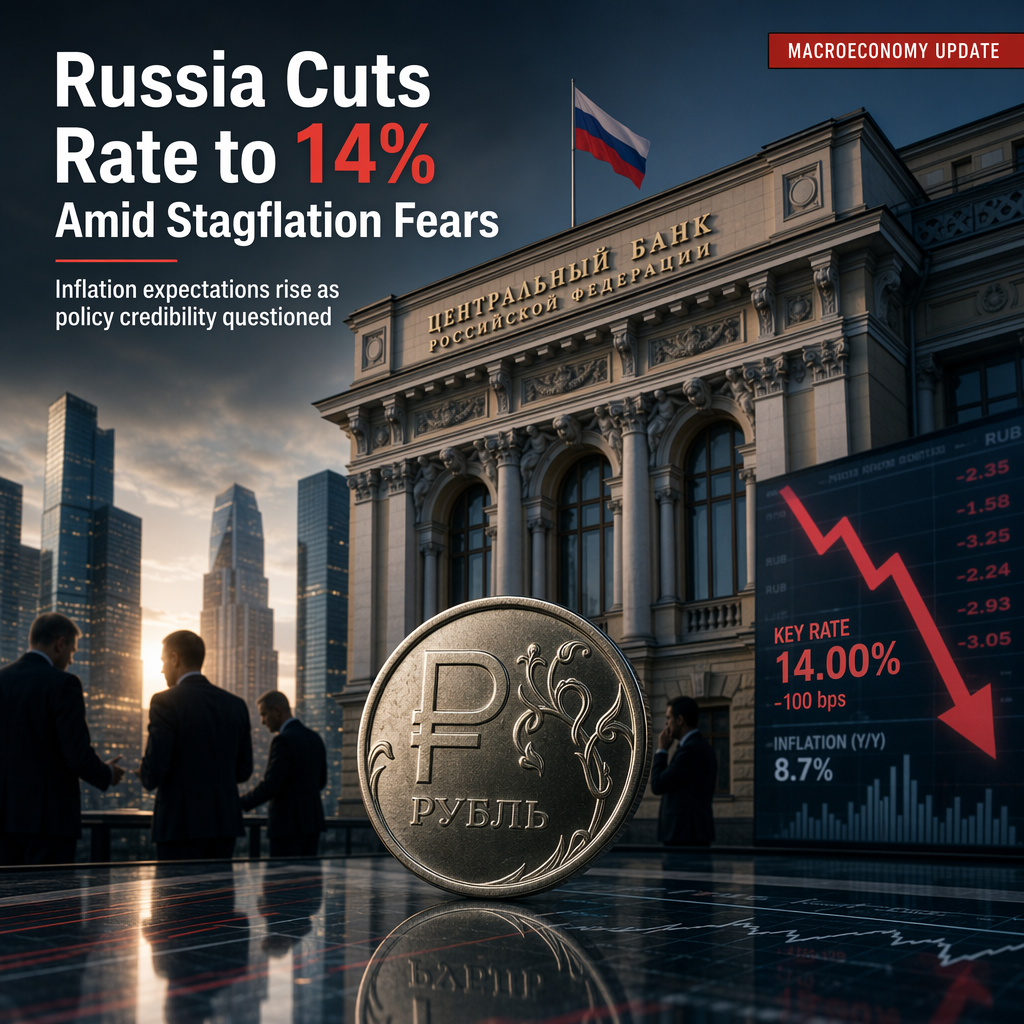
The Russian central bank (CBR) cut its key interest rate by 25 basis points to 14.0% on Friday, a move that was not expected by the majority but was within the range of possible scenarios, according to Commerzbank’s Tatha Ghose [1]. This decision comes despite the CBR raising its 2026 inflation forecast to 6.0%-7.0% from the previous 4.5%-5.5%, citing a considerable rise in fuel prices. The central bank still maintains that inflation will return to its 4% target in 2027 [1].
In addition to the higher inflation outlook, the CBR lowered its 2026 GDP forecast to 0.0%-1.0% from 0.5%-1.5%, reduced its oil-price assumption for taxation to USD 60 per barrel from USD 65, and cut its current-account surplus projection to USD 48 billion from USD 72 billion. These revisions point to a stagflationary macroeconomic outlook for Russia [1].
The CBR justified the rate cut by arguing that underlying inflation is being contained, noting that seasonally adjusted annualized inflation averaged 5.0% in Q2 after 8.7% in Q1, with core inflation slowing to 4.2% from 6.2%. However, recent data shows inflation accelerated in June-July, reaching 5.9% as of July 20, and inflation expectations among households, businesses, and financial market participants have increased. The CBR itself acknowledges that if these expectations remain elevated, it may impede a sustainable slowdown in inflation [1].
Commerzbank’s analysis suggests that the easing cycle indicates possible political pressure on the central bank, which would typically undermine credibility and hurt FX valuation. However, due to the artificial nature of USD/RUB and EUR/RUB exchange rates, the decision is not expected to significantly affect the Ruble’s market value [1].
CONCLUSION
The Russian central bank’s unexpected rate cut amid rising inflation and stagflation risks raises questions about its policy credibility. While such a move would normally pressure the Ruble, the artificial nature of Russia’s FX market limits the immediate impact on currency valuation. Market participants remain cautious as inflation expectations climb and macroeconomic forecasts deteriorate.