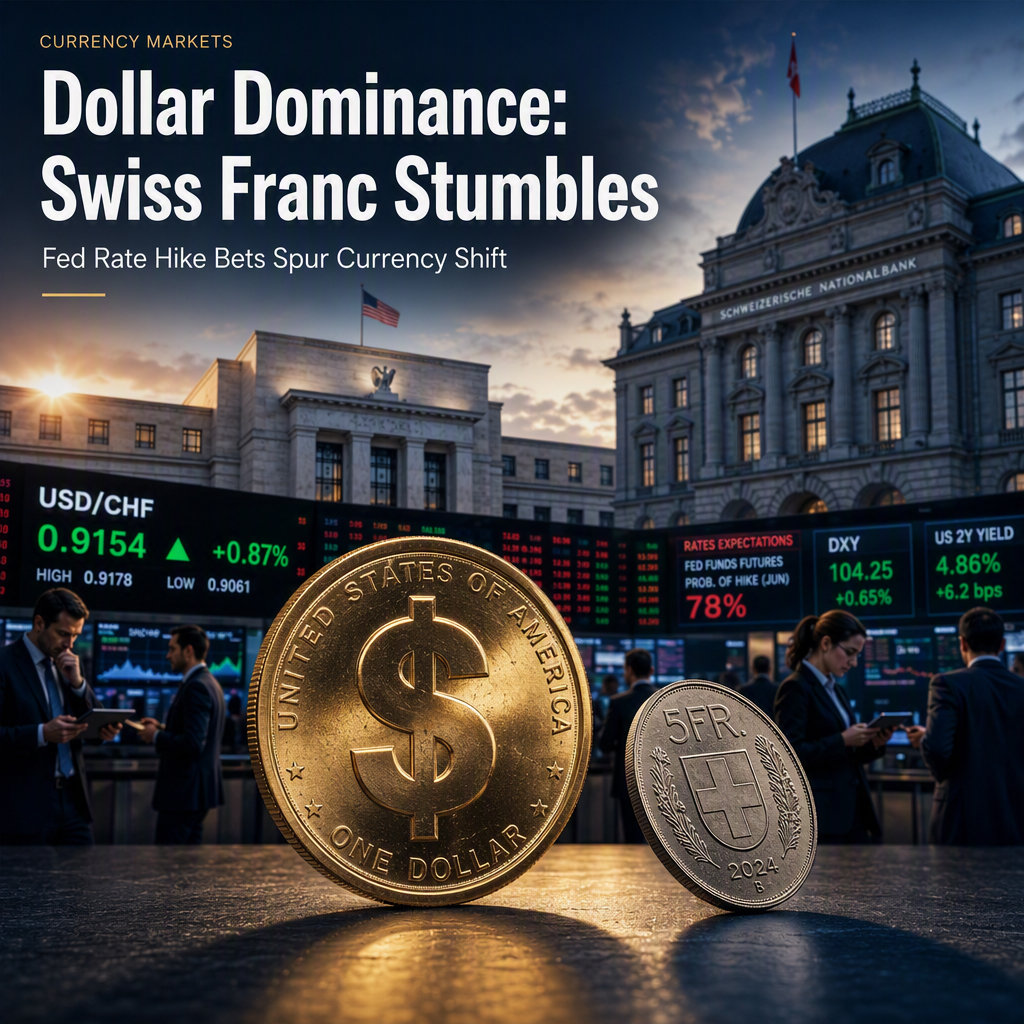
The Swiss Franc (CHF) weakened against the US Dollar (USD), with the USD/CHF pair extending its winning streak for the fourth consecutive day and trading around 0.8180 during Asian hours on Monday [1]. This appreciation of the US Dollar is attributed to aggressive Federal Reserve (Fed) rate-hike bets ahead of Wednesday’s policy decision, following hotter-than-expected US inflation data. Financial markets have priced in nearly an 87% probability of a quarter-point rate hike at the Fed's September meeting, a significant increase from 59% a week ago, as per the CME FedWatch tool [1].
The US Consumer Price Index (CPI) rose 0.4% month-over-month in August, resulting in a 12-month increase of 3.4%, both figures aligning with market expectations. The core CPI, which excludes food and energy, increased by 0.3% on a monthly basis, surpassing the previous 0.2% and beating the forecast of 0.2% [1]. These inflation readings have reinforced expectations for a Fed rate hike, contributing to the US Dollar's strength.
On the other hand, the Swiss Franc is under pressure due to a potentially widening interest rate differential with the US, as the Swiss National Bank (SNB) is widely expected to keep its key policy rate unchanged at 0% through year-end, maintaining the lowest rate among major economies [1]. Additionally, a shift in carry-trade strategies—prompted by a hawkish Bank of Japan (BoJ) and joint yen-buying interventions by Washington and Tokyo—has led traders to favor the CHF as a funding currency, resulting in selling pressure on the Swiss Franc as investors seek higher-yielding assets [1].
Strategists at UOB Group note that their previously neutral stance on USD/CHF is turning more bullish as the pair tests the top of its recent range. They highlight that if USD/CHF breaks and closes above 0.8155, it could continue to rise toward 0.8175, with upward momentum building as long as the USD holds above key support levels [1].
CONCLUSION
The Swiss Franc's decline against the US Dollar is driven by rising Fed rate hike expectations and a shift in global carry-trade dynamics. With the SNB expected to keep rates unchanged and the Fed likely to hike, the interest rate differential may continue to pressure the CHF. Market strategists see further upside potential for USD/CHF if key resistance levels are breached.