
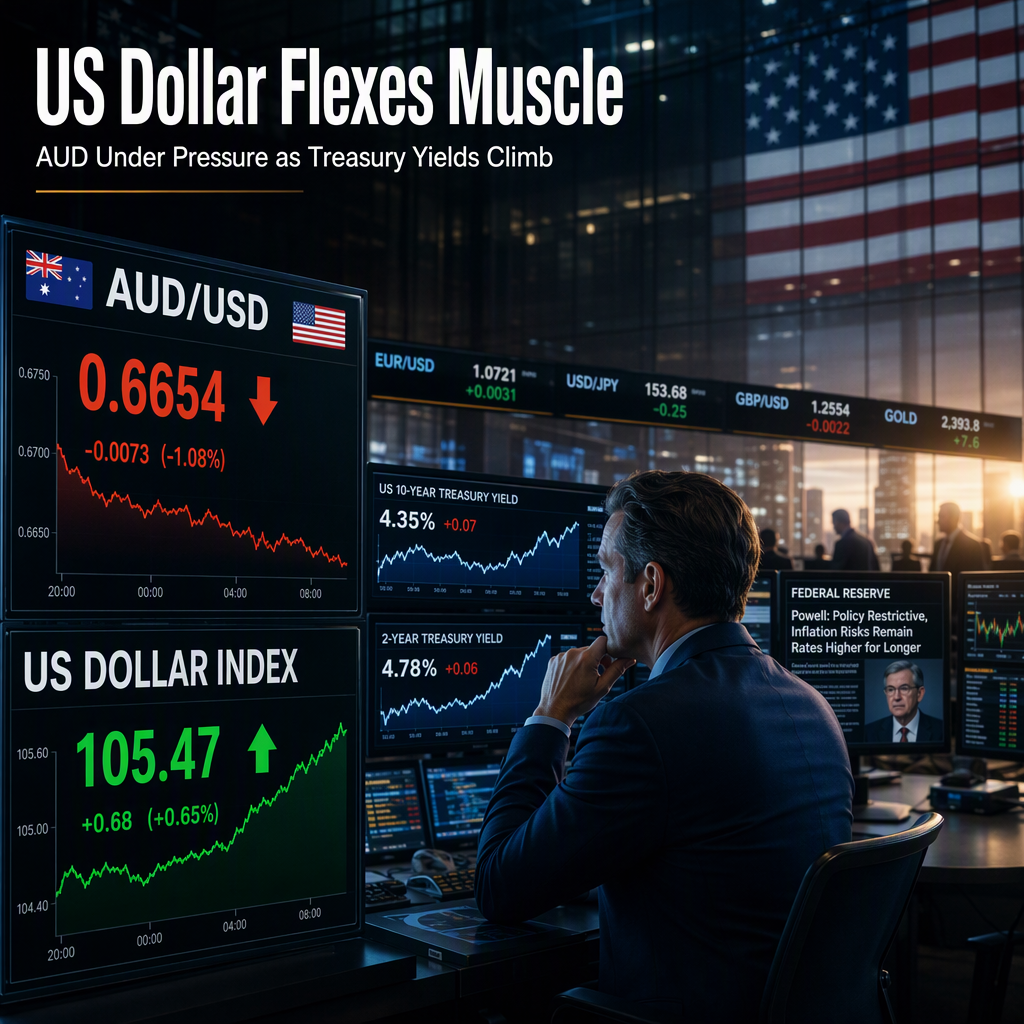
The Australian Dollar (AUD) reversed its early gains against the US Dollar (USD), falling from near 0.6975 to around 0.6964 during the European trading session on Tuesday, as the US Dollar strengthened in response to rising US bond yields [1]. The US Dollar Index (DXY), which measures the Greenback against six major currencies, climbed 0.15% to approximately 102.25, approaching its annual high of 102.54 set on Monday [1]. According to a heat map of major currencies, the USD was the strongest against the Canadian Dollar, gaining 0.15%, and rose 0.10% against the AUD [1].
The rally in US-backed securities is attributed to persistent inflation projections, despite a recent correction in oil prices [1]. Several Federal Reserve officials have highlighted that high inflation remains a significant challenge, though they have downplayed the urgency for additional interest rate hikes [1]. Specifically, Fed’s Williams delivered a moderately hawkish message, with a FXS Speechtracker score of 6.4, slightly above the historical average of 6.2, indicating a tone just firmer than the established baseline [1]. Williams emphasized there is "no need for urgency" following the September rate hike but left open the possibility of one further hike this year if economic conditions warrant it, reinforcing a data-dependent approach [1].
Fed projections include inflation at 3.5% for this year, with the 2% target not expected to be reached until 2028. The outlook also features solid GDP growth, stable unemployment, and ongoing investment pressures related to artificial intelligence, all contributing to the narrative of persistent inflation risks [1].
Market participants are closely watching the Fed’s stance, as the combination of elevated yields and a firm US Dollar continues to weigh on the AUD/USD pair. The lack of urgency for further rate hikes, coupled with conditional guidance for another increase, suggests the Fed remains vigilant but cautious in its approach to monetary policy [1].
CONCLUSION
The AUD/USD pair is under pressure as the US Dollar strengthens on the back of rising Treasury yields and a persistently hawkish Federal Reserve tone. While the Fed signals no immediate urgency for further rate hikes, ongoing inflation risks and robust US economic projections are likely to keep the Greenback supported in the near term.