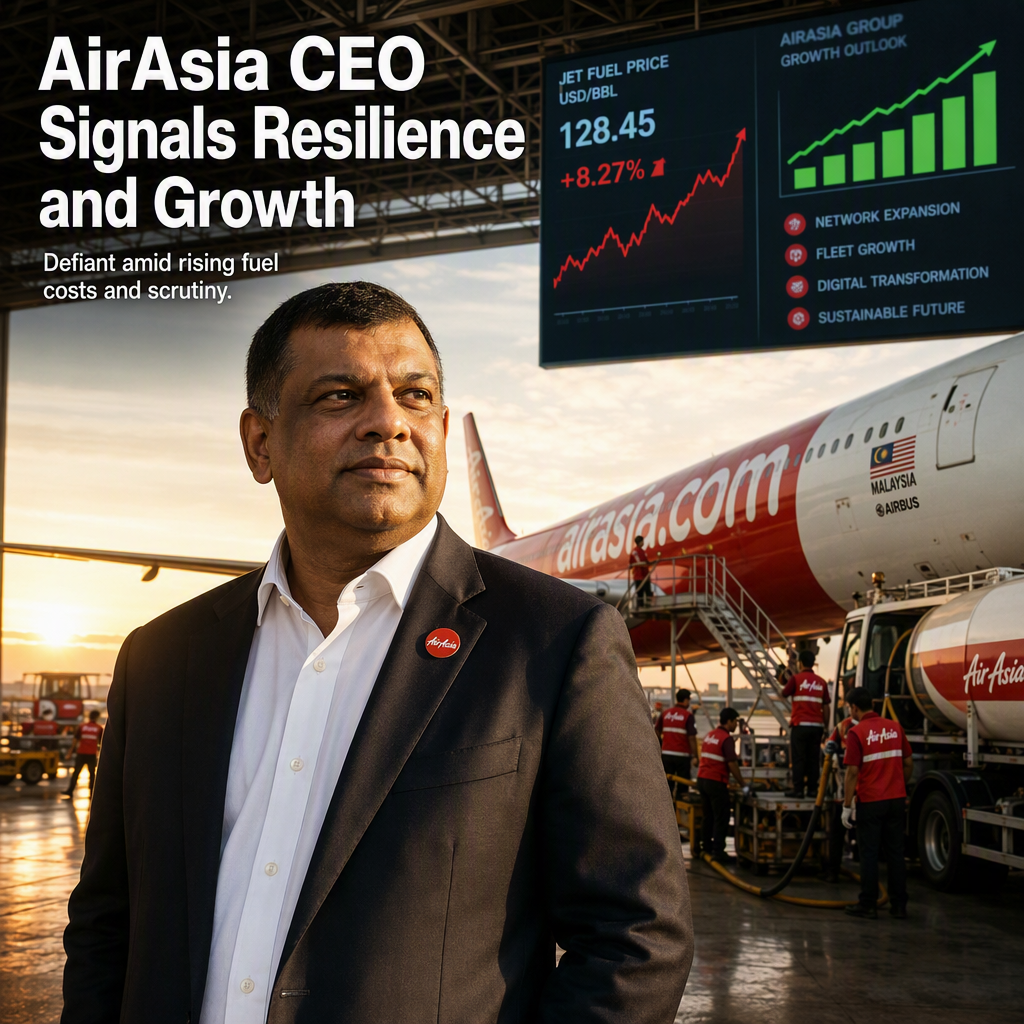
AirAsia co-founder Tony Fernandes has publicly refuted recent media reports suggesting financial instability at the Malaysia-based budget airline, asserting that AirAsia is 'sustainable' and does not require a government rescue [1]. Reuters had reported that the Malaysian government was monitoring AirAsia's financial health and had asked Malaysia Airlines and Batik Air about potentially taking over AirAsia's domestic market share as part of scenario planning, with discussions intensifying due to mounting concerns [1]. Fernandes responded at a media briefing, stating, 'We're OK. We're sustainable. There is no chance of non-sustainability. Zero chance.' [1]
Fernandes detailed that AirAsia has adjusted its cost and revenue structure to address the impact of soaring fuel prices, which have surged 58% from the previous year, with average jet fuel prices reaching $183 per barrel [1]. The airline's planned fundraising, announced earlier this month, includes up to $1 billion in international debt markets and 700 million ringgit ($171.5 million) in local credit facilities. Fernandes clarified that the fundraising is targeted towards refinancing and debt restructuring, not operational shortfalls, emphasizing, 'It's $1 billion, not $3 billion. We do not need $3 billion.' [1]
He also rejected the notion that AirAsia's operations could be easily replaced by competitors, citing the airline's fleet of roughly 100 aircraft in Malaysia and its unique cost structure, network, and brand [1]. Looking ahead, Fernandes revealed that AirAsia will make a significant announcement regarding its growth strategy with Airbus within the next month, describing the relationship with the aircraft manufacturer as 'fantastic' [1].
AirAsia is increasingly leveraging artificial intelligence, already achieving approximately 3% in fuel savings and planning to introduce new customer-facing AI features in the next three months [1]. The airline has also cut capacity by 11% during the quarter, suspended underperforming long-haul routes, and reduced fleet allocations in the Philippines and Indonesia [1]. Fernandes highlighted AirAsia's ongoing expansion efforts, including its partnership with Turkey's Pegasus Airlines, which could serve as a model for further growth, and noted interest from European low-cost carriers in potential partnerships [1].
CONCLUSION
AirAsia's leadership has firmly denied rumors of financial distress, outlining strategic initiatives to strengthen its balance sheet and drive future growth. Despite rising fuel costs and government scrutiny, the airline is focused on refinancing, operational efficiency, and expansion through technology and partnerships. The market takeaway is cautiously optimistic, with AirAsia signaling resilience and forward momentum.