
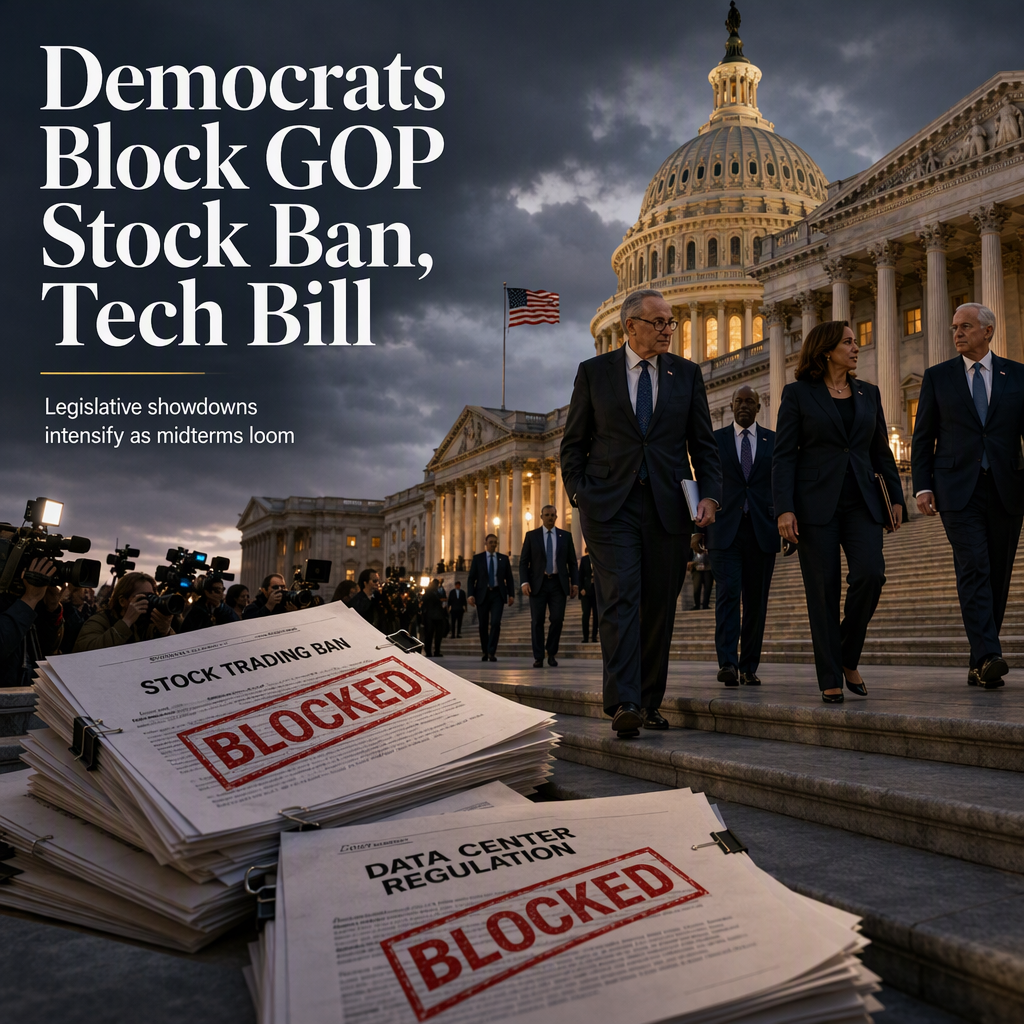
Senate Democrats have blocked two Republican-led bills aimed at addressing voter concerns ahead of the midterm elections: a ban on lawmakers trading stocks using insider knowledge and a regulatory framework for AI data centers to cover their own energy costs [1][2]. The Stop Insider Trading Act, which passed the House earlier this month, faced opposition from a majority of House Democrats who argued the stock trade ban was not strong enough, while Republicans attempted to tie it to a nationwide voter ID policy, a move Democrats considered too aggressive [1]. According to a University of Maryland poll published in 2023, 86% of Americans support banning lawmakers from trading stocks, and a 2025 Pew Research Center poll found 83% favor requiring government-issued photo ID to vote [1].
Senate Minority Leader Chuck Schumer, D-N.Y., criticized the Republican strategy, stating that the inclusion of the voter ID provision was a 'poison pill' designed to ensure the bill's failure, calling it 'trickery' and 'skullduggery' [1]. Schumer also labeled the data center bill, known as the Ratepayer Protection Act, a 'toothless messaging bill,' arguing that its regulatory framework is merely optional and lacks enforcement power [2]. The Ratepayer Protection Act passed the House with overwhelming support (417-3), but Senate Democrats, including Sen. Martin Heinrich of New Mexico, blocked its passage, citing concerns about insufficient guardrails for developers [2].
Sen. Pete Ricketts, R-Neb., who is facing a tightening reelection race, pushed the stock trading ban, while Sen. Jon Husted, R-Ohio, advocated for the data center bill, which has become a significant campaign issue in battleground states [1][2]. Husted is in a 'toss up' race for reelection against former Democratic Sen. Sherrod Brown, who has criticized Husted's role in bringing data centers to Ohio [2]. Both bills are unlikely to overcome the Senate's 60-vote filibuster threshold, and Wednesday could be the Senate's last day in session before a month-long pre-election recess [2].
Republicans hoped to use these bills to score messaging wins ahead of the 2026 midterm elections, but Democrats have consistently blocked similar efforts throughout the year, including multiple iterations of the SAVE America Act and previous attempts at voter ID and stock trading bans [1][2].
CONCLUSION
Senate Democrats have successfully blocked two Republican-led bills targeting stock trading by lawmakers and AI data center regulation, citing concerns over bill strength and enforcement. Despite broad public support for both issues, neither bill is expected to pass before the Senate's pre-election recess. The outcome underscores ongoing partisan divides and the use of legislative strategy as both parties vie for voter support ahead of the midterms.