
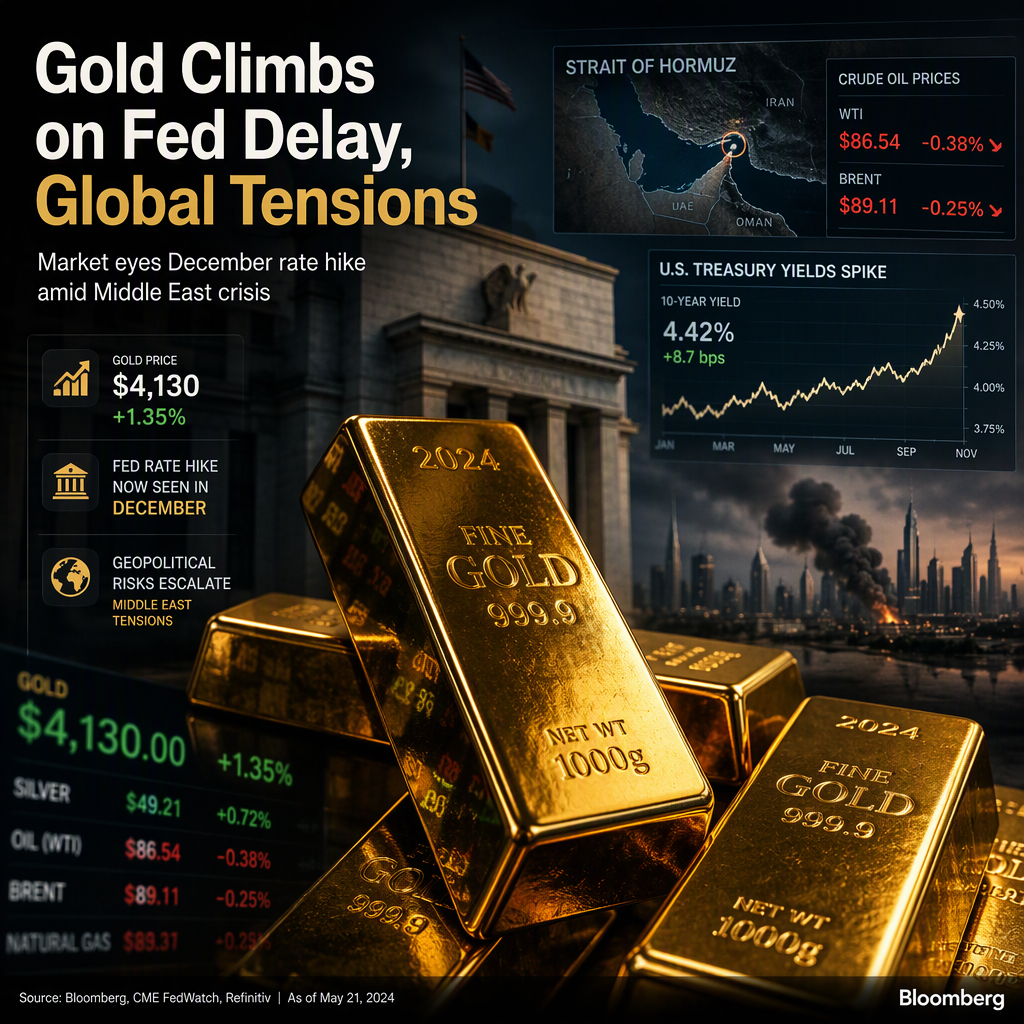
Gold (XAU/USD) edged higher on Thursday, trading at $4,130, up 0.48% after bottoming near $4,103, supported by lower US Treasury yields and a weaker US Dollar, despite hawkish comments from Federal Reserve officials regarding further tightening of monetary policy [1]. The ongoing Middle East crisis, particularly explosions around the Strait of Hormuz, has kept energy prices elevated, with West Texas Intermediate (WTI) crude trading at $90.85, up over 2% [1]. These geopolitical tensions are contributing to inflationary pressures and have pushed global bond yields to multi-year highs [1].
Federal Reserve policymakers, including St. Louis Fed President Alberto Musalem and Governor Christopher Waller, emphasized the need to address high inflation, with Waller noting that additional rate hikes may not need to be consecutive, effectively ruling out an October hike [1]. Money markets reflect this sentiment, showing that a rate hike at the October 27-28 meeting is unlikely, while the probability of a 25 basis point increase in December stands at nearly 81% [1].
On the economic data front, Initial Jobless Claims for the week ending October 3 were reported at 197,000, below both the forecast of 200,000 and the prior week's 199,000, indicating a persistently tight labor market [1]. Looking ahead, traders are advised to monitor geopolitical developments, US Treasury yields, the US Dollar, and upcoming data such as the University of Michigan Consumer Sentiment survey for October, which may provide further insights into household economic and inflation expectations [1].
From a technical perspective, gold maintains a bearish bias below $4,200, with the Relative Strength Index (RSI) also signaling potential downside. Key support levels are identified at $4,100, $4,000, and the year-to-date low of $3,941, while a move above $4,200 could signal a shift to a more bullish outlook [1].
CONCLUSION
Gold prices are currently supported by geopolitical risks and shifting expectations for Federal Reserve rate hikes, with the market now focused on a potential move in December. Despite the recent uptick, technical indicators suggest a bearish bias remains unless gold decisively breaks above $4,200. Traders should continue to monitor geopolitical events, US yields, and upcoming economic data for further direction.