
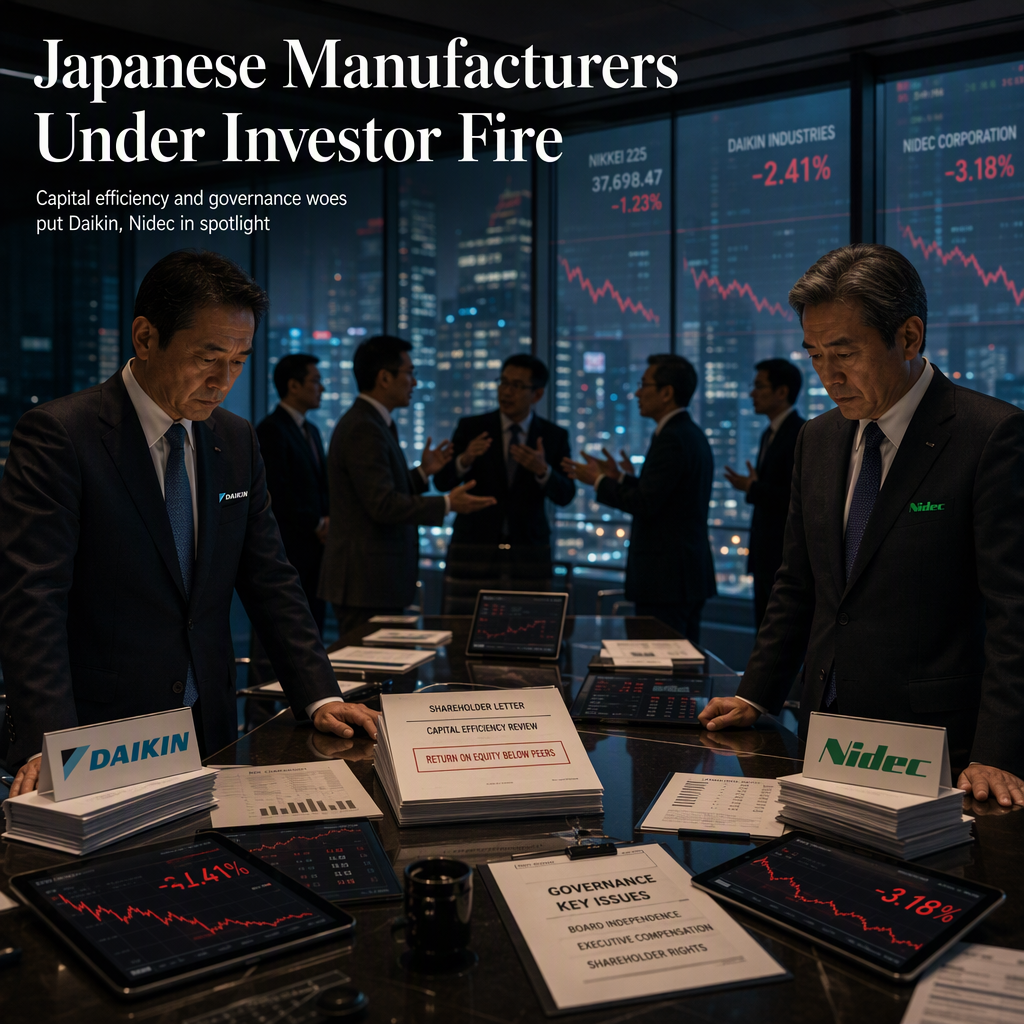
Daikin Industries, a leading Japanese air conditioner manufacturer, is under scrutiny from investors due to its lagging capital efficiency compared to U.S. rivals Carrier and Trane. Despite benefiting from increased sales driven by global heat waves, Daikin's asset base has grown faster than its profits, resulting in a return on equity (ROE) that falls short of its competitors. Investors and analysts are urging Daikin to divest underperforming businesses and streamline operations to improve asset turnover and profitability. Technical analysis shows Daikin's share price is supported by strong sales but faces resistance amid concerns about capital efficiency, with market sentiment remaining cautious and a consensus to monitor upcoming quarterly reports for signs of improvement [1].
Meanwhile, Nidec, another Japanese manufacturer, has reported a $3.6 billion loss primarily due to massive impairment losses on its electric vehicle motor business. The new chief executive attributed these losses to an aggressive expansion drive and a focus on short-term profits, which neglected long-term sustainability. Nidec is now pivoting toward energy solutions and artificial intelligence to rebuild profitability and stability. The company is also addressing governance issues after its auditor withheld sign-off on earnings and has replaced its chief executive, Kishida, with its technology head. Additionally, Nidec plans to exit Cambodia production in response to the Thailand-Cambodia border conflict and has uncovered hundreds of cases of quality control misconduct, highlighting further operational challenges. Market sentiment remains cautious as investors await tangible results from Nidec's restructuring and new strategic focus [2].
Both companies are facing significant investor pressure to improve capital efficiency and governance. Daikin is being urged to optimize its business portfolio and focus on core profitable segments, while Nidec is undergoing a leadership change and strategic pivot to address its financial and operational setbacks. Analysts recommend monitoring both companies' restructuring initiatives and upcoming financial reports for signs of progress [1][2].
CONCLUSION
Daikin and Nidec are grappling with investor concerns over capital efficiency and governance, prompting calls for strategic restructuring and operational improvements. Market sentiment is cautious, with both companies expected to deliver clearer progress in their upcoming financial disclosures. The outcome of these initiatives will be critical for restoring investor confidence and stabilizing share performance.