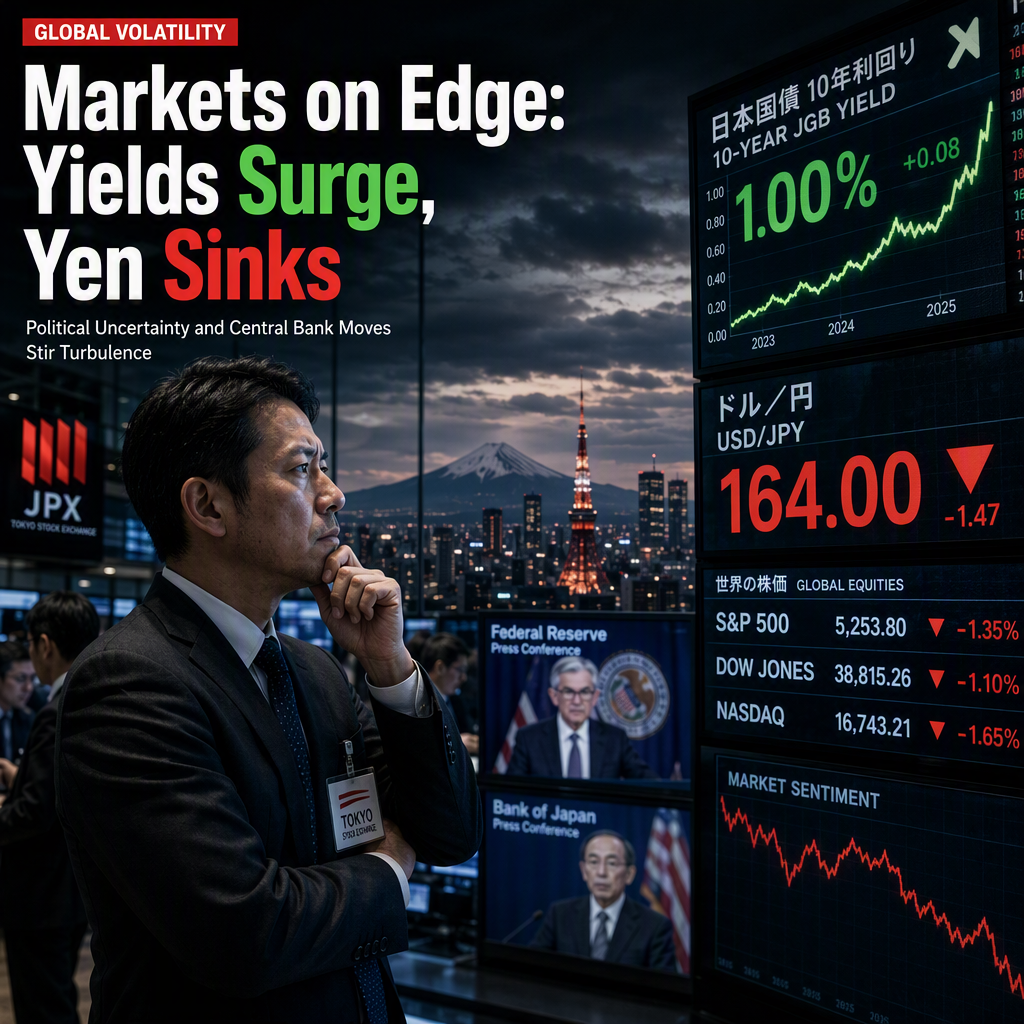
Japanese financial markets are experiencing heightened volatility as Prime Minister Sanae Takaichi's falling approval ratings fuel concerns over expansionary fiscal policies and their impact on government bond yields. Takaichi has indicated plans to submit legislation to cut the consumption tax, a move interpreted by analysts as an attempt to bolster her public image amid speculation of a cabinet reshuffle. Market participants fear that such populist measures could further strain Japan's fiscal position, leading to a rise in long-term government bond yields. The 10-year Japanese government bond yield has edged higher in recent sessions, with analysts warning that a further decline in cabinet approval could prompt additional fiscal expansion and increase supply pressure in the bond market. Technical resistance is being watched at the 1.0% level on the 10-year yield, with a break above this threshold likely to trigger further selling [1].
Currency markets are also on edge, with traders closely monitoring upcoming central bank meetings in both Japan and the U.S. The yen is nearing 164 per dollar, and yields are rising as oil prices reach $100 per barrel. Analysts note that foreign M&A activity in Japan is contributing to yen weakness. The consensus is that both the Bank of Japan (BOJ) and the Federal Reserve are unlikely to raise rates this week, but any hints of future policy shifts could trigger increased volatility. The tone set by the BOJ and Fed during their news conferences is seen as crucial in shaping expectations for monetary policy going forward. Technical indicators suggest the yen carry trade remains resilient, but traders are bracing for possible shifts in sentiment following the meetings [2].
Meanwhile, the Federal Reserve held interest rates steady at its latest meeting, but a hawkish tone and dissent from three policymakers have led investors to anticipate a possible rate hike in the near future. This marks the highest number of dissenters since September 2016. Fed funds futures now suggest a more than 57% likelihood of a quarter-point increase at the September meeting, and about 53% of Kalshi traders predict a hike. The S&P 500 fell 1.5% and the Dow Jones Industrial Average dropped more than 2% on Wednesday, reflecting investor unease about potentially tighter monetary policy. Fed Chairman Kevin Warsh emphasized the central bank's focus on reducing inflation to its 2% target, with some analysts arguing that further rate increases may be necessary to achieve this goal [3].
In summary, Japanese bond and currency markets are being buffeted by domestic political uncertainty and global central bank policy signals. The combination of rising yields, a weakening yen, and risk-off sentiment in global equities underscores the sensitivity of markets to both fiscal and monetary policy developments.
CONCLUSION
Markets are reacting strongly to political and monetary policy uncertainty, with Japanese bond yields rising and the yen weakening amid concerns over fiscal expansion and central bank decisions. The Federal Reserve's hawkish stance and dissenting voices have increased expectations for a rate hike, contributing to a risk-off mood in global equities. Investors remain highly attentive to upcoming policy signals from both the BOJ and the Fed, as further volatility is anticipated.