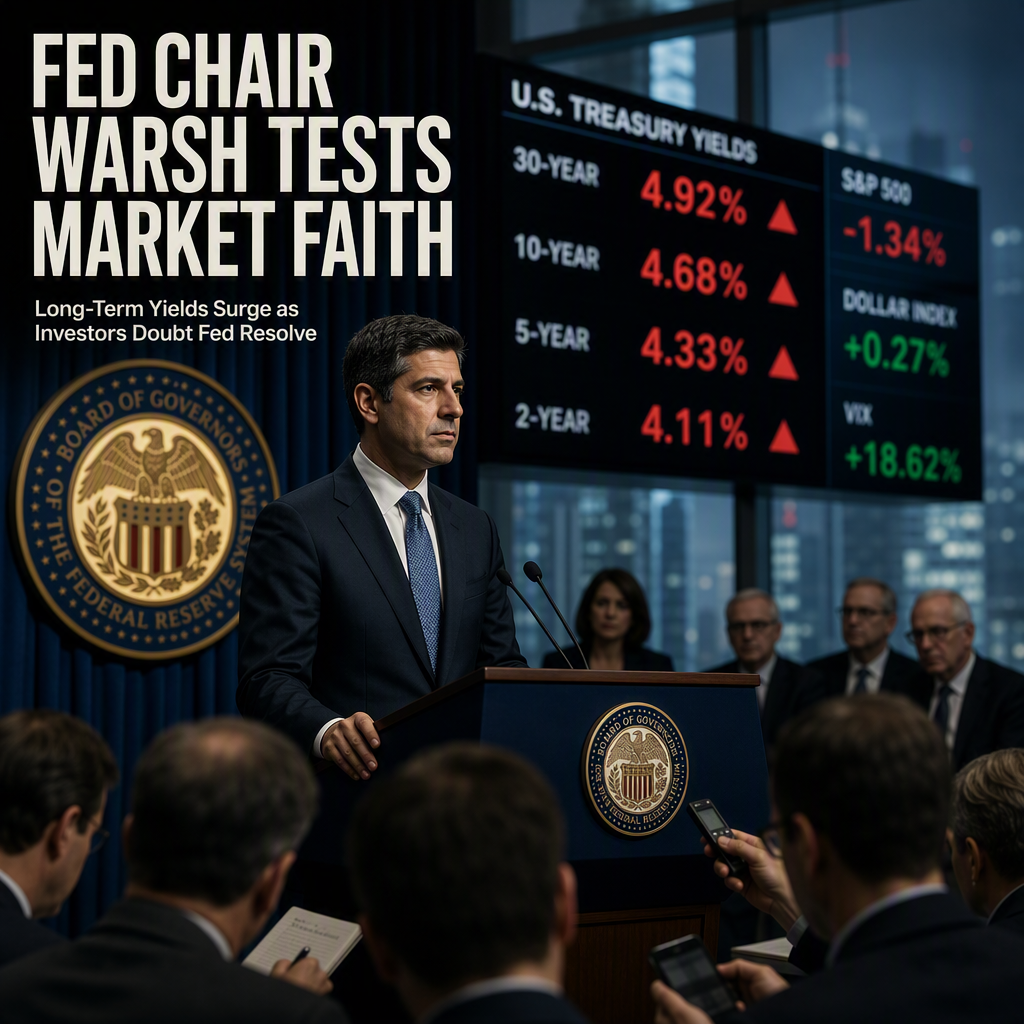
Federal Reserve Chairman Kevin Warsh presided over his second meeting of the Federal Open Market Committee (FOMC), where officials voted 9-3 to leave interest rates unchanged at 3.5-3.75%, a level maintained for several months [1]. Following the announcement and Warsh's subsequent press conference, investors sharply lowered the probability of a near-term rate hike, with the chances of the Fed leaving rates unchanged at its next meeting rising by 20 percentage points to 45%, according to CME FedWatch [1].
Despite the unchanged rates, the bond market reacted strongly: the yield on the 30-year Treasury surged to its highest level since 2007, while the yield on the 2-year Treasury declined [1]. This divergence suggests that investors believe the Fed will not act immediately on inflation, which Warsh noted has been above the Fed's 2% target for at least 63 months, and that more aggressive action may be required in the future as the economy continues to heat up [1].
Warsh's approach marked a departure from previous Fed chairs by ending the practice of forward guidance, opting instead to avoid signaling future rate moves. He declined to specify what would prompt him to raise rates, stating that forward guidance made the Fed inflexible and obscured market signals [1]. However, this lack of clarity led to market skepticism regarding Warsh's credibility on inflation and his ability to lead a divided Fed. Jon Hilsenrath, a noted Fed watcher, commented that "Warsh didn't convey the message clearly or explicitly, and the bond market puked on him" [1].
Warsh also suggested that recent increases in long-term interest rates could reflect positive economic developments, such as strong business investment, but this view was not widely shared by market participants [1]. Warsh's refusal to answer detailed questions about the FOMC's decision further fueled uncertainty [1].
CONCLUSION
Chairman Warsh's decision to hold rates steady and his move away from forward guidance have raised doubts about his credibility and the Fed's inflation-fighting resolve. The market's reaction—higher long-term yields and increased skepticism about near-term rate hikes—signals concern over the Fed's policy direction and communication strategy.