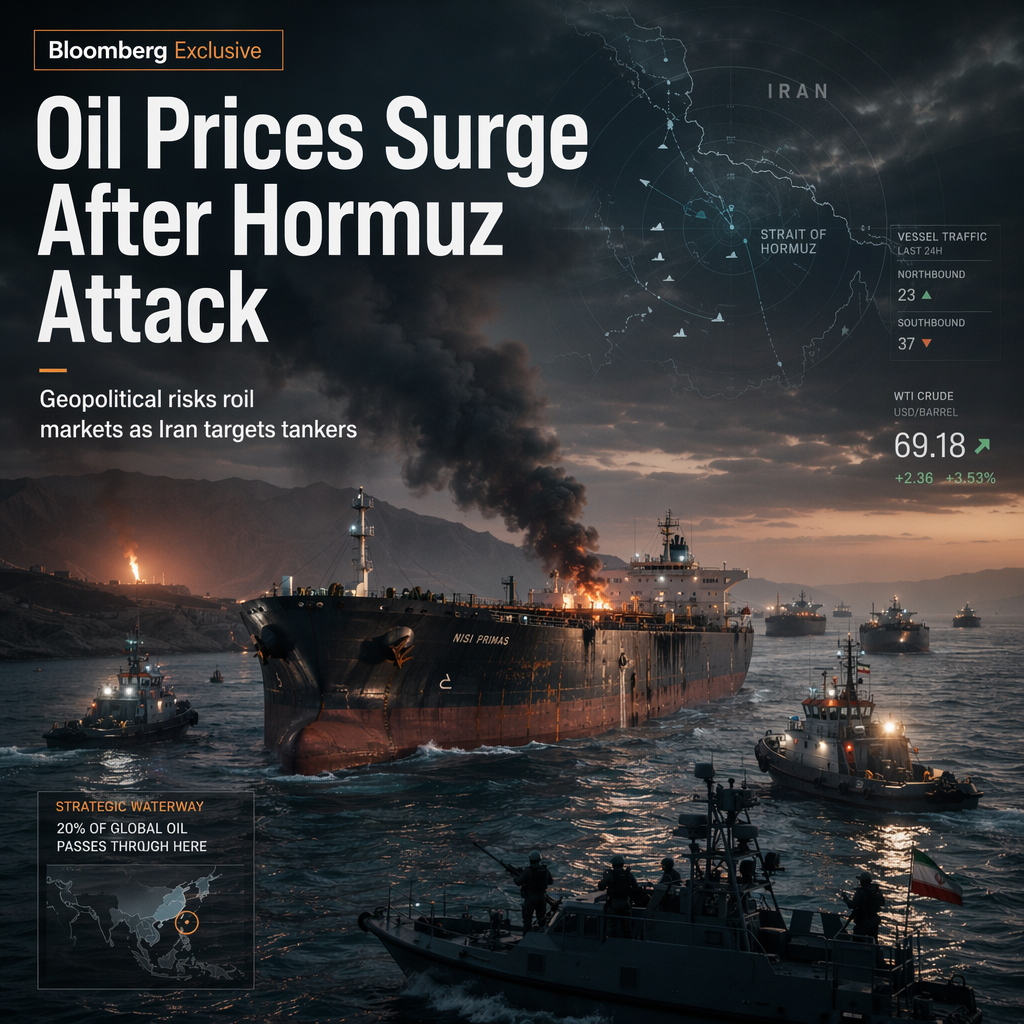
West Texas Intermediate (WTI) crude oil prices rebounded above $69.00 per barrel, trading around $69.20 during Asian hours on Tuesday, following renewed geopolitical tensions in the Strait of Hormuz [1]. According to a Bloomberg report cited by a US official, Iran fired at least two missiles at commercial vessels transiting the strategic waterway late Monday, resulting in significant damage to two ships but no reported casualties [1]. The UK Maritime Trade Operations (UKMTO) separately confirmed that a southbound tanker was struck by an unknown projectile, igniting a fire on board [1].
Despite these security risks, WTI prices remained anchored near a four-month low, pressured by signs of expanding global supply [1]. Vessel traffic through the Strait of Hormuz has begun to recover, with recent data showing at least eight Japan-linked vessels, including five supertankers capable of carrying two million barrels each, successfully exiting the waterway via a route near Iran [1].
Adding to the bearish outlook, Saudi Aramco implemented an aggressive price cut for its flagship Arab Light crude for Asian buyers, reducing prices by $11 a barrel and placing it at a $1.50 discount against the regional benchmark [1]. This pricing strategy, previously used only during the oil price wars of 2015 and 2020, reflects increasingly soft market conditions [1]. The discount followed a weekend OPEC+ agreement to raise production quotas for next month, reinforcing expectations of a heavily supplied global market [1].
CONCLUSION
While geopolitical tensions in the Strait of Hormuz temporarily boosted WTI prices, the market remains weighed down by signs of expanding supply and aggressive pricing strategies from Saudi Aramco. The recovery of vessel traffic and OPEC+'s decision to raise production quotas suggest continued downward pressure on oil prices. Overall, the market reaction is mixed, with short-term volatility offset by longer-term bearish supply dynamics.