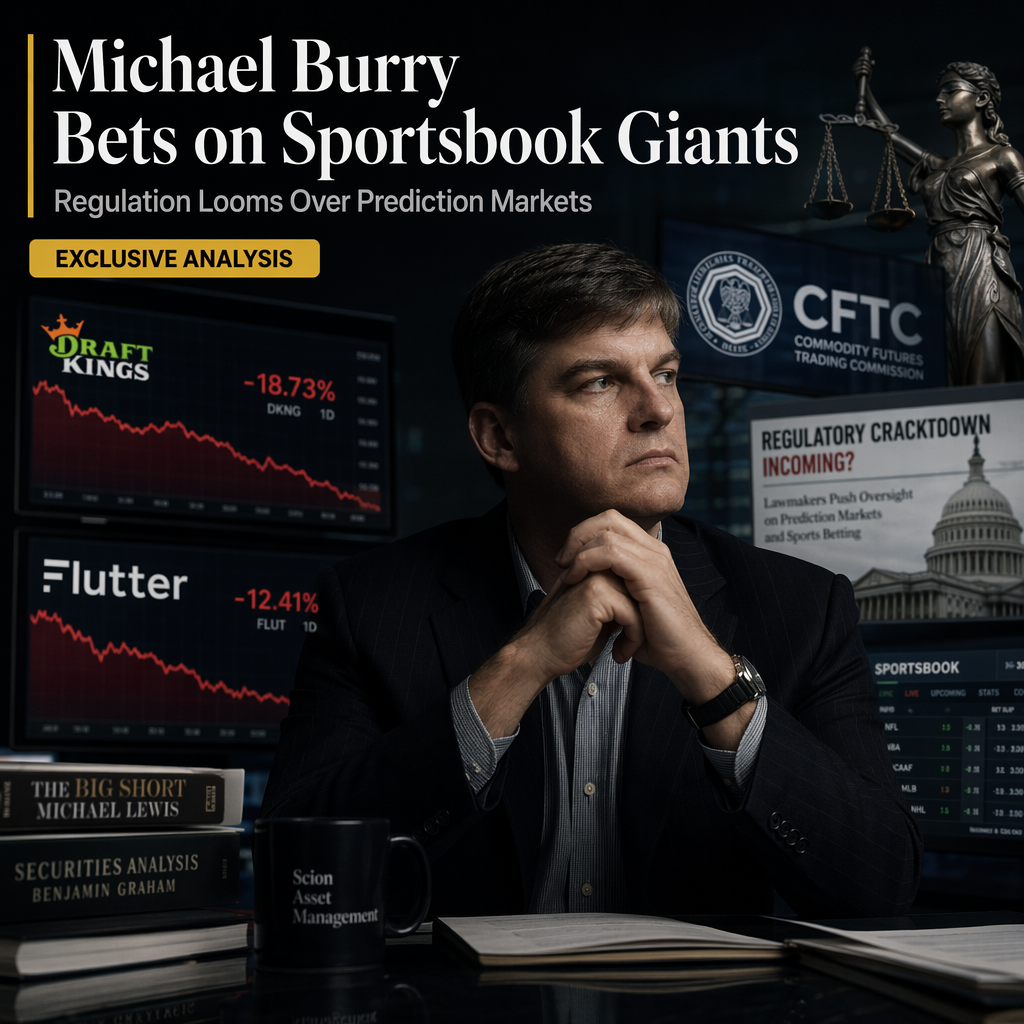
Michael Burry, known for his role in predicting the 2008 U.S. housing crash, announced that he has taken significant positions in regulated sports-betting operators DraftKings and Flutter Entertainment. Burry disclosed that his investment is split approximately 60% in Flutter, purchased at about $107 per share, and 40% in DraftKings, acquired in the low $26 range. He indicated the possibility of increasing each holding into a full standalone position in the future [1].
Burry's investment thesis centers on the belief that the rapid growth of prediction markets has pressured the stocks of traditional sportsbook operators. He noted that these upstart platforms offer event-based contracts, which the U.S. Commodity Futures Trading Commission (CFTC) claims fall under its regulatory jurisdiction. The CFTC is currently involved in legal disputes with multiple states over the regulation of prediction markets, as these contracts have largely avoided state gaming taxes [1].
Burry stated, "I believe that the political climate will not tolerate this. Prediction markets exist in a loophole adjacent to a heavily regulated and taxed industry. In time, prediction markets will be subsumed into regulation and taxation." He highlighted that shares of DraftKings have declined about 45% from their 52-week high in September, while Flutter has dropped 65% from its August peak [1].
Despite these declines, Burry expressed optimism about both companies. He described DraftKings as "inflecting as an operating business" and sees value in its anticipated transition. Regarding Flutter, he acknowledged past issues with capital misallocation but emphasized its strong fundamentals and scale. Both companies are also exploring their own prediction-market offerings, which Burry believes could position them to benefit regardless of future regulatory changes [1].
CONCLUSION
Michael Burry's investment in DraftKings and Flutter is driven by his expectation that regulatory scrutiny will eventually curb the growth of unregulated prediction markets, potentially benefiting established sportsbook operators. Despite recent share price declines, Burry sees strong fundamentals and strategic positioning in both companies. The market impact is medium, with potential upside if regulatory actions unfold as Burry anticipates.