
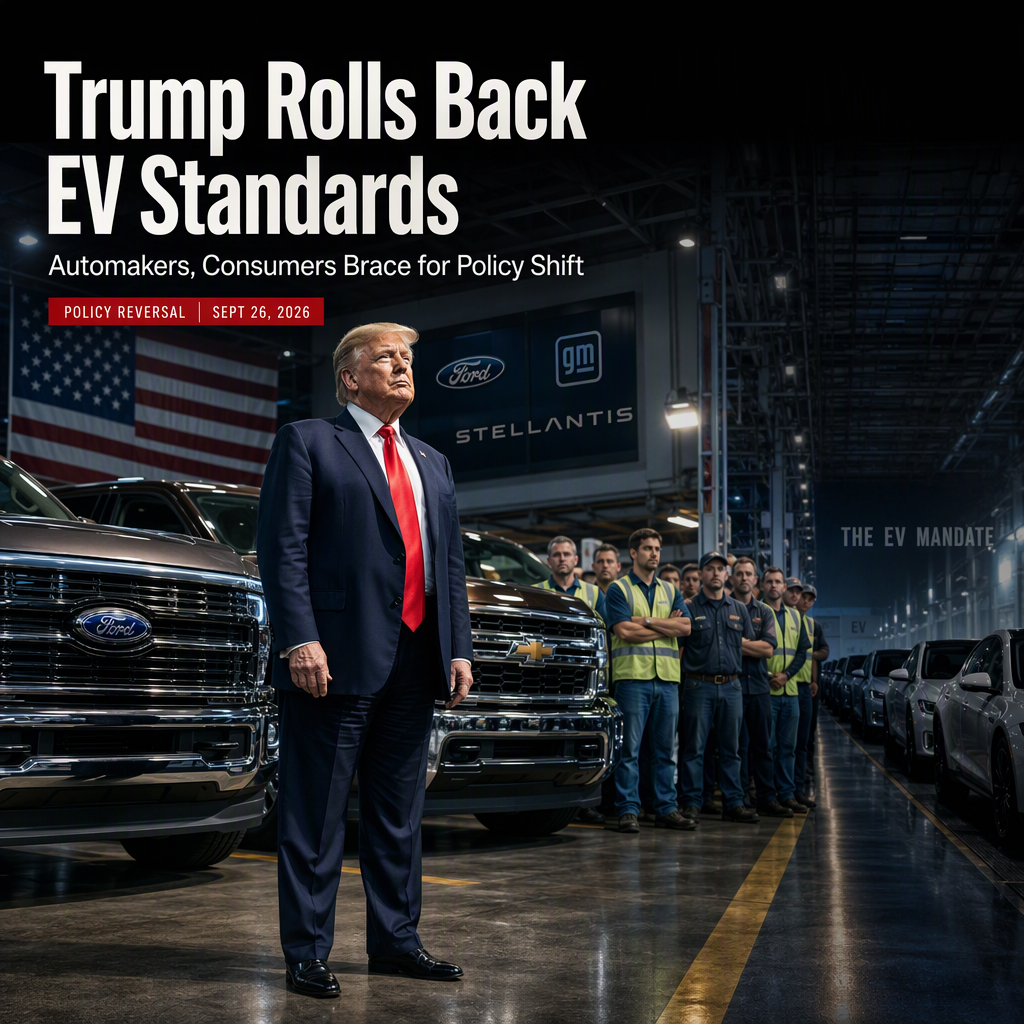
President Donald Trump announced on September 26, 2026, that he has approved new fuel economy standards, effectively rolling back the stricter policies implemented under former President Joe Biden that were designed to promote electric vehicle (EV) adoption in the United States [1]. Biden's standards would have required automakers to increase the fuel efficiency of passenger cars and light trucks to approximately 50 miles per gallon by 2031, incentivizing the production and sale of EVs [1].
Trump characterized the policy reversal as beneficial for both automakers and consumers, stating that the new standards will reduce manufacturing waste and lower car prices, potentially saving families thousands of dollars on new vehicles [1]. He claimed that major manufacturers, including General Motors, Ford, and Stellantis, have expressed interest in building vehicles in the U.S. under the new regulatory environment [1].
While the final details of the new fuel economy standards have not yet been publicly released, Transportation Secretary Sean Duffy previously indicated that the standards would be significantly less stringent than those set by the Biden administration [1]. The change is expected to allow automakers to produce more pickup trucks and SUVs, which are more profitable but less fuel-efficient than smaller cars [1]. This shift may reduce the attractiveness of electric vehicles for automakers, although companies like General Motors have stated they will continue to manufacture EVs [1].
The regulatory change fulfills a campaign promise from Trump to rescind policies that encouraged or incentivized electric vehicles [1].
CONCLUSION
Trump's approval of new, less stringent fuel economy standards marks a significant policy shift away from Biden-era regulations that promoted electric vehicles. The move is expected to benefit traditional automakers and consumers through lower prices and increased production of profitable pickup trucks and SUVs. However, the final standards and their full market impact remain unclear, with some automakers indicating continued commitment to EV production.