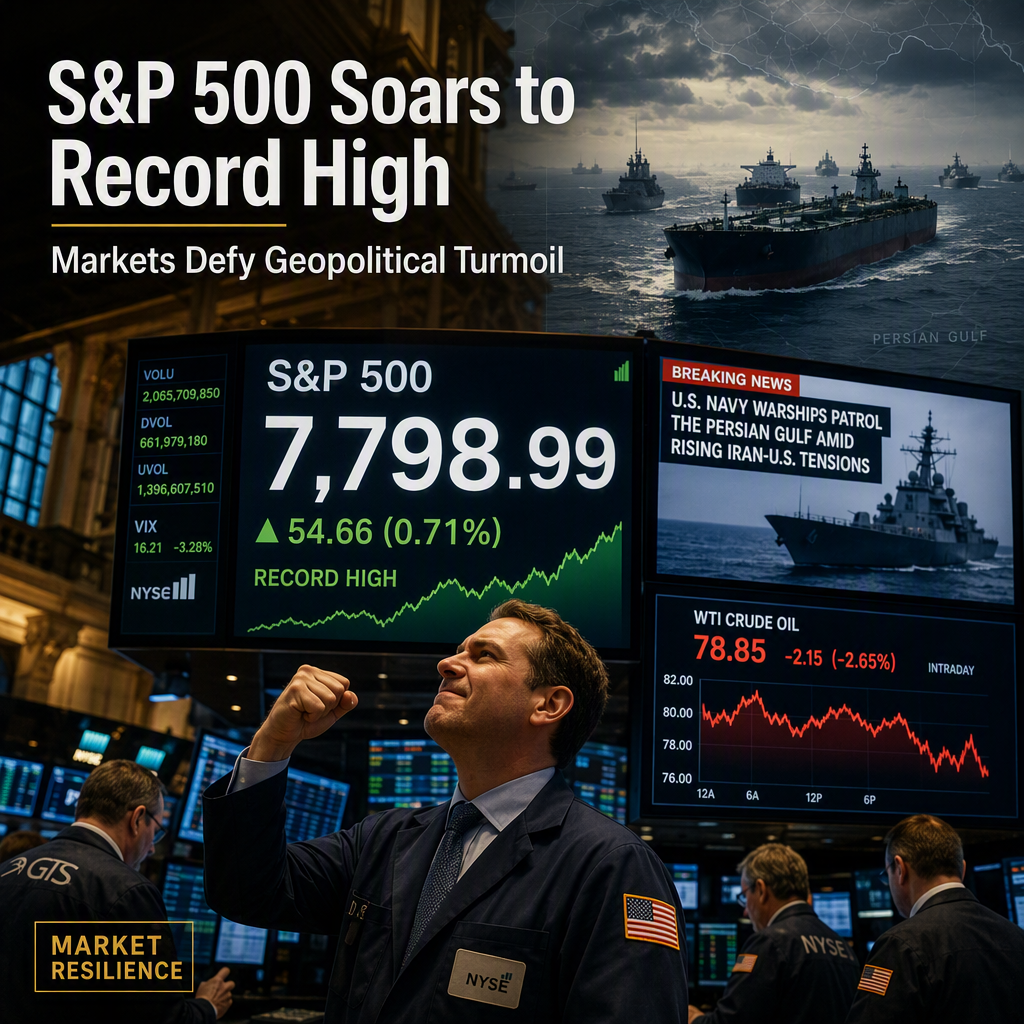
The ongoing Iran-U.S. conflict has escalated, with U.S. Defense Secretary Pete Hegseth stating that the U.S. Navy can maintain its blockade of Iranian ports indefinitely by rotating warships in and out of the region as needed [1]. Despite these heightened geopolitical tensions and the potential for prolonged conflict, Wall Street responded positively, with the S&P 500 setting an intraday record above 7,800 and closing at a record high of 7,798.99 [1]. The Nasdaq Composite also advanced, adding 0.81% to close at 26,803.03, and two of the three major benchmarks are on track for a third consecutive weekly gain [1].
In the commodities market, Brent crude for October delivery, which had fallen more than 2% to settle at $87.07 a barrel on Thursday, was trading slightly higher in early Asia trading on Friday. Similarly, U.S. West Texas Intermediate futures, after dropping to $81.25 overnight, were also marginally higher [1]. These modest gains in oil prices followed Hegseth's statement regarding the indefinite blockade [1].
The U.K. economy, meanwhile, is showing signs of a rebound, with GDP expanding 0.4% in the second quarter after a 0.6% increase in the first quarter, positioning it to be the G7's fastest-growing economy for a second straight quarter. However, the IMF has warned that the Iran war could damage Britain's growth more than any other advanced economy due to its reliance on oil and gas imports and rising pump prices [1].
In Asia, the Kospi index entered a technical bull market on Thursday, rebounding more than 20% from its July 30 low after a period of significant volatility driven by leveraged positions and forced selling [1]. This rapid turnaround highlights the volatility in tech stocks, particularly those linked to the AI hardware trade, according to Phillip Wool, head of research at Rayliant Global Advisors [1].
CONCLUSION
Despite escalating Iran-U.S. tensions and volatile oil prices, global equity markets, including the S&P 500 and Kospi, have shown resilience and even set new records. However, the ongoing conflict continues to pose risks, particularly for energy-importing economies like the U.K., and market volatility remains elevated, especially in tech-related sectors.