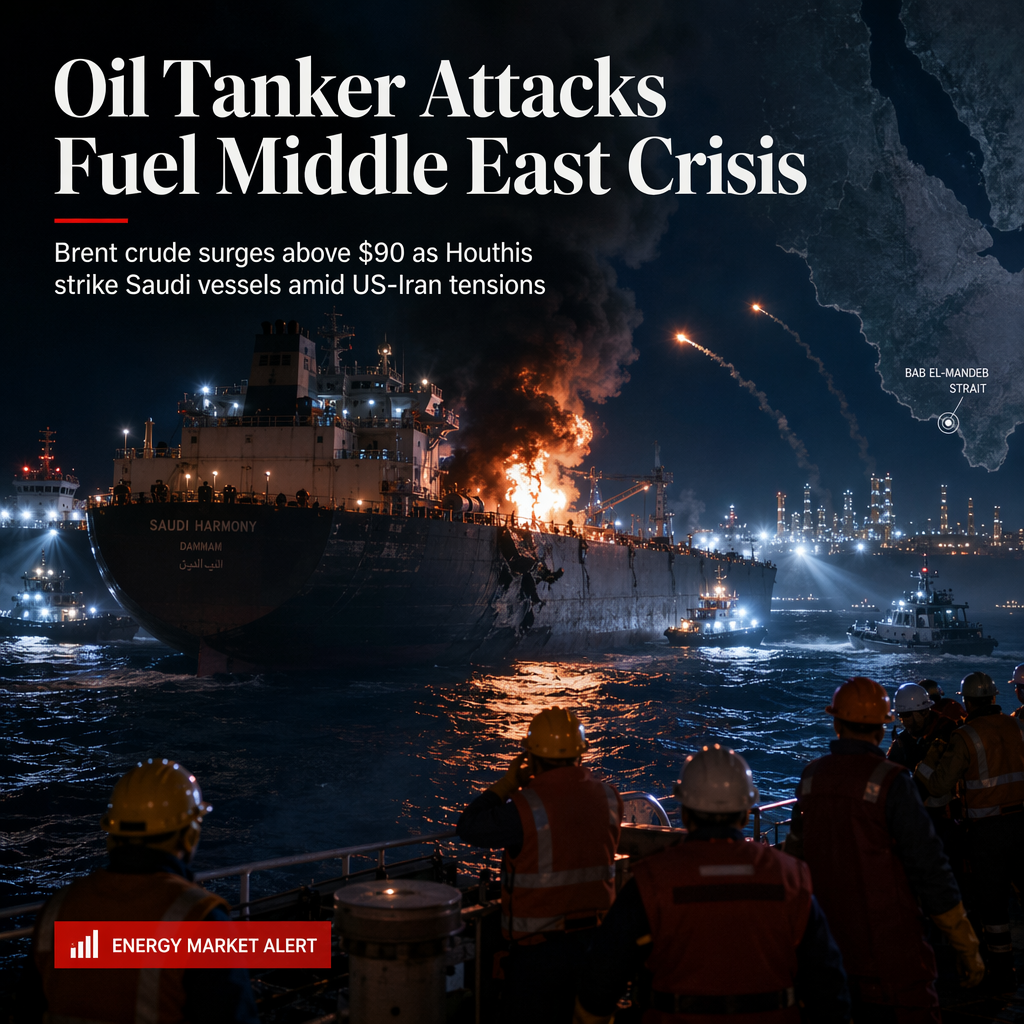
Tensions in the Middle East have escalated sharply, with both sources reporting attacks on Saudi Arabian oil tankers in the Red Sea amid intensifying US-Iran hostilities [1][2]. According to Lloyd Chan at MUFG, the Houthis have reportedly attacked two Saudi oil tankers in the Red Sea, threatening shipping through the Bab el-Mandeb Strait, which has become an increasingly important alternative route for regional oil exports [1]. CNBC reports that Yemen's Houthis claimed responsibility for targeting two Saudi Arabian oil tankers, Encelia and Layla, with drones and missiles for allegedly violating their maritime blockade [2]. The state-run Saudi Press Agency confirmed the Encelia was hit, resulting in a fire at the bow, though all crew were reported safe; no update was provided on the Layla [2]. The United Kingdom Maritime Trade Operations also reported an 'unknown projectile' striking a Saudi tanker near Al Shuqaiq, causing a fire but no casualties [2].
The attacks come as the US completed its 12th consecutive night of strikes against Iran, targeting military assets including maritime capabilities, missile and drone storage facilities, and air defense assets [2]. President Trump warned that the US would retaliate by destroying Iranian bridges and power infrastructure if Iran attacks vessels transiting the Strait of Hormuz [1][2]. In response, Iran threatened to strike power facilities across the Gulf region if its own infrastructure and energy assets are attacked [1]. Tehran has also warned shipping companies against using alternative routes around Hormuz, and since the collapse of the US-Iran ceasefire memorandum signed in June, there has been a sharp decline in tanker traffic through the Strait of Hormuz [1].
The heightened geopolitical risks have had a direct impact on oil markets. Brent crude prices have rebounded above USD90 per barrel this month, supported by rising conflict risk and concerns over potential disruptions to global energy supply [1]. Lloyd Chan at MUFG highlights that the key market risk is whether the conflict escalates further to trigger a broader global energy shock [1].
No specific analyst forecasts or forward-looking statements beyond the cited risks and warnings were provided in the articles.
CONCLUSION
The attacks on Saudi oil tankers and escalating US-Iran tensions have significantly increased supply risks in the global oil market, pushing Brent crude above $90 per barrel. Market participants are closely watching for further escalation, which could trigger a broader energy shock and heightened volatility.