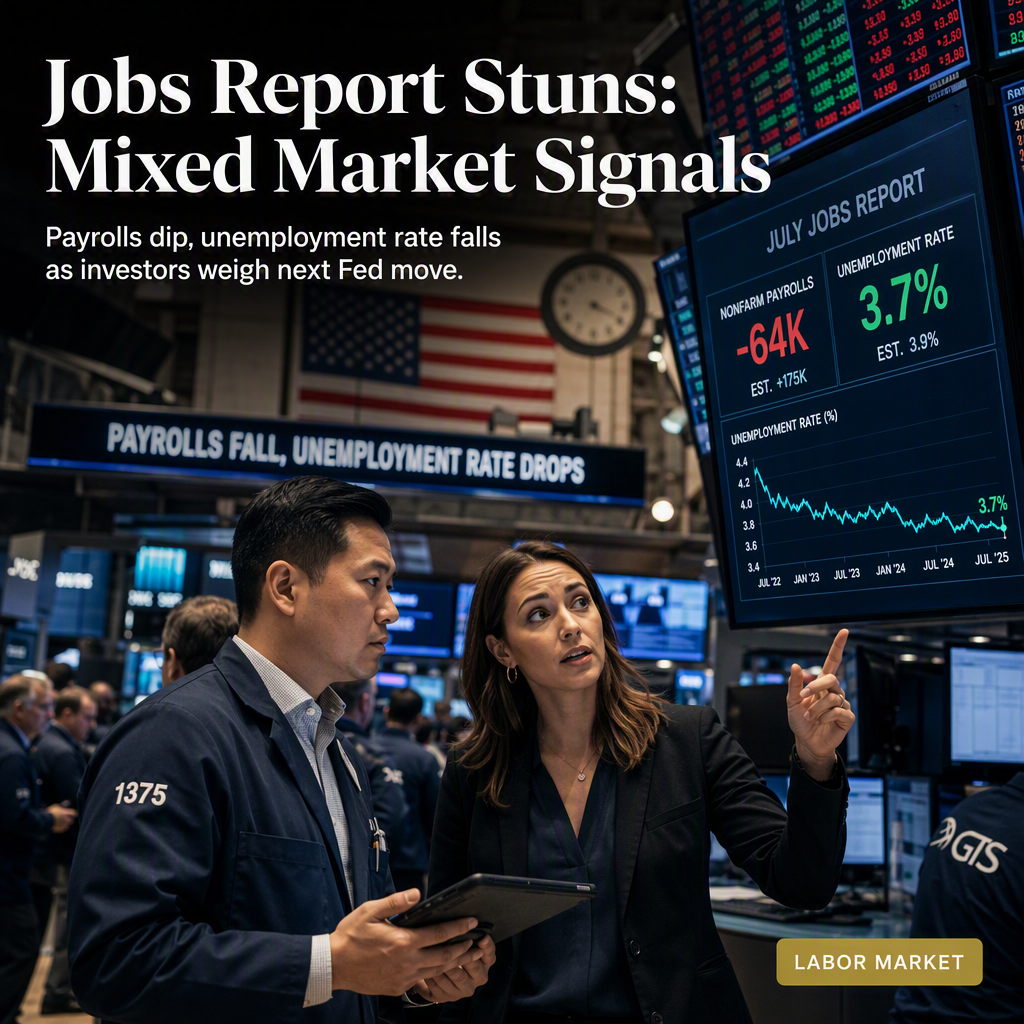
The U.S. July jobs report revealed an unexpected decline in nonfarm payrolls, which fell by 23,000, while the unemployment rate simultaneously dropped to 4.1% [1]. The headline payroll decline was primarily attributed to a loss of 53,000 government jobs, a figure economists suggest may be influenced by seasonal factors and could be revised in future reports. In contrast, private payrolls actually increased by 30,000 during the month [1]. The decrease in the unemployment rate was driven by a continued reduction in the labor force, as the participation rate edged down to 61.4%. This marks a 0.7 percentage point drop for the year, with nearly 1.4 million people exiting the workforce, bringing participation to its lowest level in 50 years outside of the Covid era [1].
Market reactions to the report were mixed. Initially, investors interpreted the data as reducing the likelihood of a Federal Reserve rate hike in September. However, analysts cautioned that central bank policymakers may focus more on the lower unemployment rate as a sign of labor market stability, and are likely to prioritize the upcoming consumer price index (CPI) inflation reading over the jobs numbers [1]. Kevin Gordon of the Schwab Center for Financial Research described the report as 'a hall of mirrors, tricking investors with different signals about whether labor's recovery is stalling.' Aditya Bhave, U.S. economist at Bank of America, noted that while the report was 'a bit dovish on net,' he expects the Fed to hike rates by 75 basis points this year, starting in September, with inflation remaining the primary concern [1].
Peter Graf, chief investment officer at Amova Asset Management Americas, warned that although the stock market may initially welcome the dovish implications of the report, investors should be cautious about the future growth prospects of an economy with declining workforce participation [1]. Overall, the report has left both investors and policymakers awaiting further data, particularly the upcoming CPI report, to gauge the direction of monetary policy and economic growth.
CONCLUSION
The July jobs report presented conflicting signals, with falling payrolls but a lower unemployment rate, largely due to a shrinking labor force. While markets initially saw the data as reducing the urgency for a Fed rate hike, analysts emphasized that inflation data will be more influential for future policy decisions. Investors are advised to remain cautious given the underlying weakness in labor force participation.