
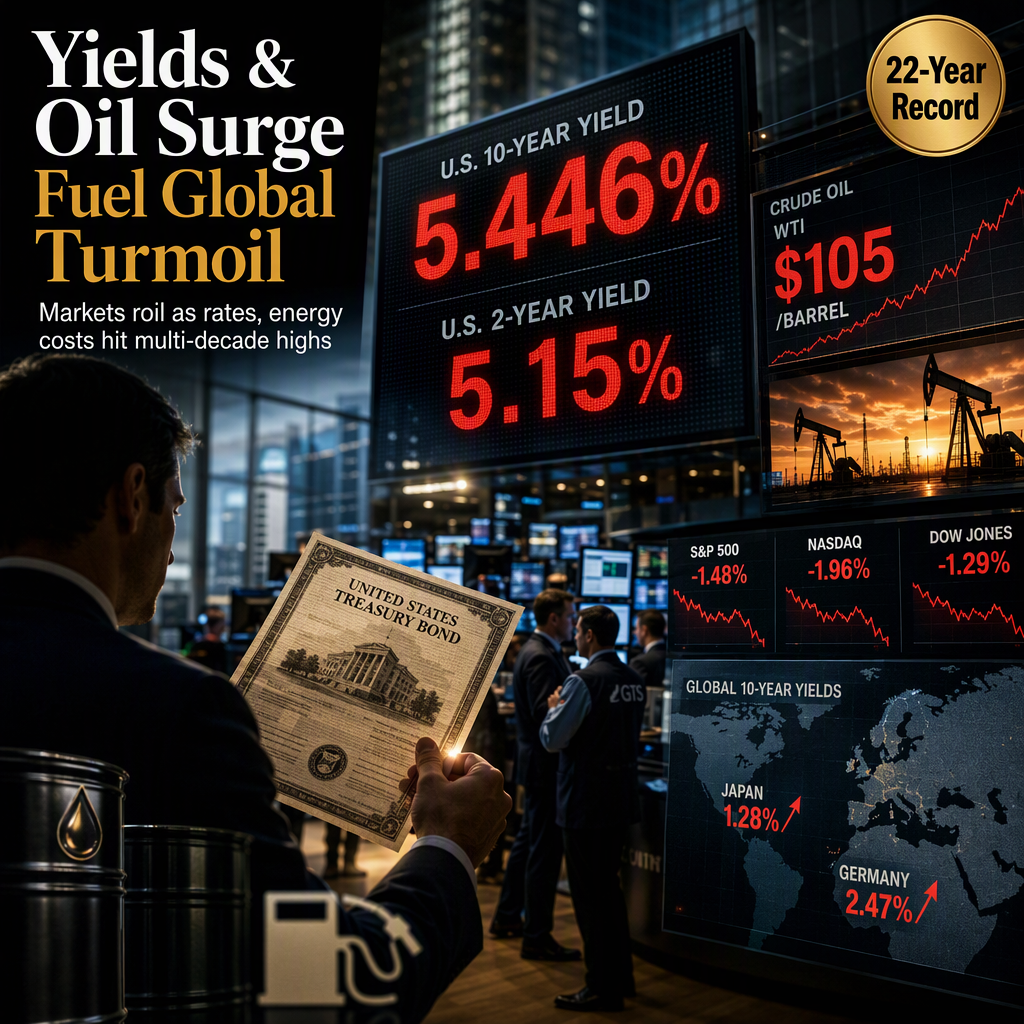
Key U.S. Treasury yields surged to their highest levels in over two decades on Thursday, driven by a spike in oil prices and persistent inflation concerns. The yield on the 30-year U.S. Treasury bond reached 5.446%, a level not seen in 22 years, while the 10-year yield climbed as high as 5.15%, its highest since 2007. This move followed the largest one-day rise in the 10-year yield since April 2025, signaling heightened volatility in the bond market [1].
Oil prices jumped to $105 per barrel after a U.S.-mediated dialogue with Iran at the United Nations General Assembly failed to yield progress toward ending the ongoing seven-month war. The surge in oil has pushed commercial diesel prices to all-time records, with the national average at $4.51 per gallon—up 73% since the Iran war began. Regular unleaded gasoline prices also rose 50% since the U.S. and Israel attacked Iran in late February, reaching $4.48 per gallon [1].
The spike in yields and energy prices triggered a sell-off in equities, with the S&P 500 down 0.5%, the Nasdaq Composite declining 0.7%, and the Dow falling nearly 300 points in early trading. The bond market turmoil extended globally, as Japan’s 10-year bond yield hit its highest since 1996 and Germany’s 10-year bund reached its highest since 2009 [1].
Analysts from Bank of America noted that while U.S. macro data remains solid—with unemployment around 4% and growth near 2%—risks are mounting due to trade wars, energy shocks, upcoming elections, and potential threats to the AI boom. A report from S&P Global highlighted that U.S. business activity accelerated in September, but input costs, especially for fuel and transport, jumped at the fastest rate in four years, prompting increased bets on further Federal Reserve rate hikes. Federal Reserve Bank of New York President John Williams stated that another rate hike may be appropriate by year-end to help bring down inflation, though he acknowledged the U.S. economy’s resilience [1].
CONCLUSION
U.S. Treasury yields and oil prices have surged to multi-decade highs, sparking a global sell-off in bonds and equities. Persistent inflation pressures and geopolitical tensions are fueling expectations of further Federal Reserve rate hikes, increasing market volatility and uncertainty.