
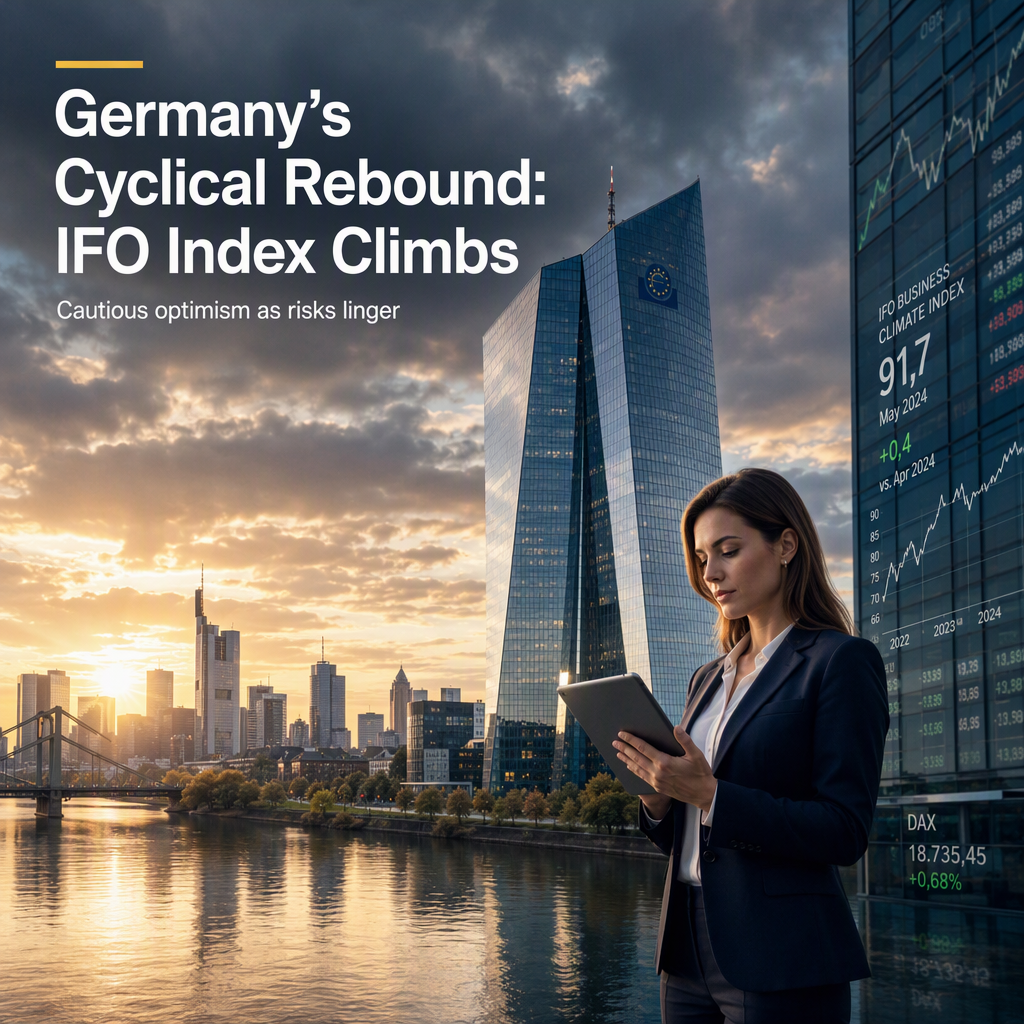
Germany's economy has demonstrated unexpected resilience, as highlighted by ING's Carsten Brzeski, with the IFO index—a key leading indicator—rising for five consecutive months. In September, the IFO index reached 89.9, up from 88.8 in August, marking its highest level in over a year and suggesting a cyclical rebound in economic activity [1]. This improvement is attributed to recovering order books in recent months and the positive effects of government fiscal stimulus, particularly in defence and infrastructure, which have begun to support economic activity [1].
Despite these positive developments, ING cautions that the current rebound is not yet a structural recovery. Several downside risks remain, including ongoing political uncertainty, the war in the Middle East, persistently high oil prices, the potential for higher gas prices in the upcoming heating season, and renewed trade tensions [1]. These factors could negatively impact Germany's economic outlook in the near term.
Looking forward, ING forecasts German GDP growth of around 1% for the year, which would represent the country's best growth performance since 2022, largely due to the strong first half of the year [1]. However, the outlook remains clouded by the aforementioned risks, and ING emphasizes that the recovery is still fragile and subject to external shocks [1].
CONCLUSION
Germany's economy is showing signs of cyclical resilience, supported by a rising IFO index and fiscal stimulus measures. However, ING warns that significant downside risks persist, and the recovery is not yet structural. The market takeaway is cautiously optimistic, with GDP growth expected around 1% for the year.