
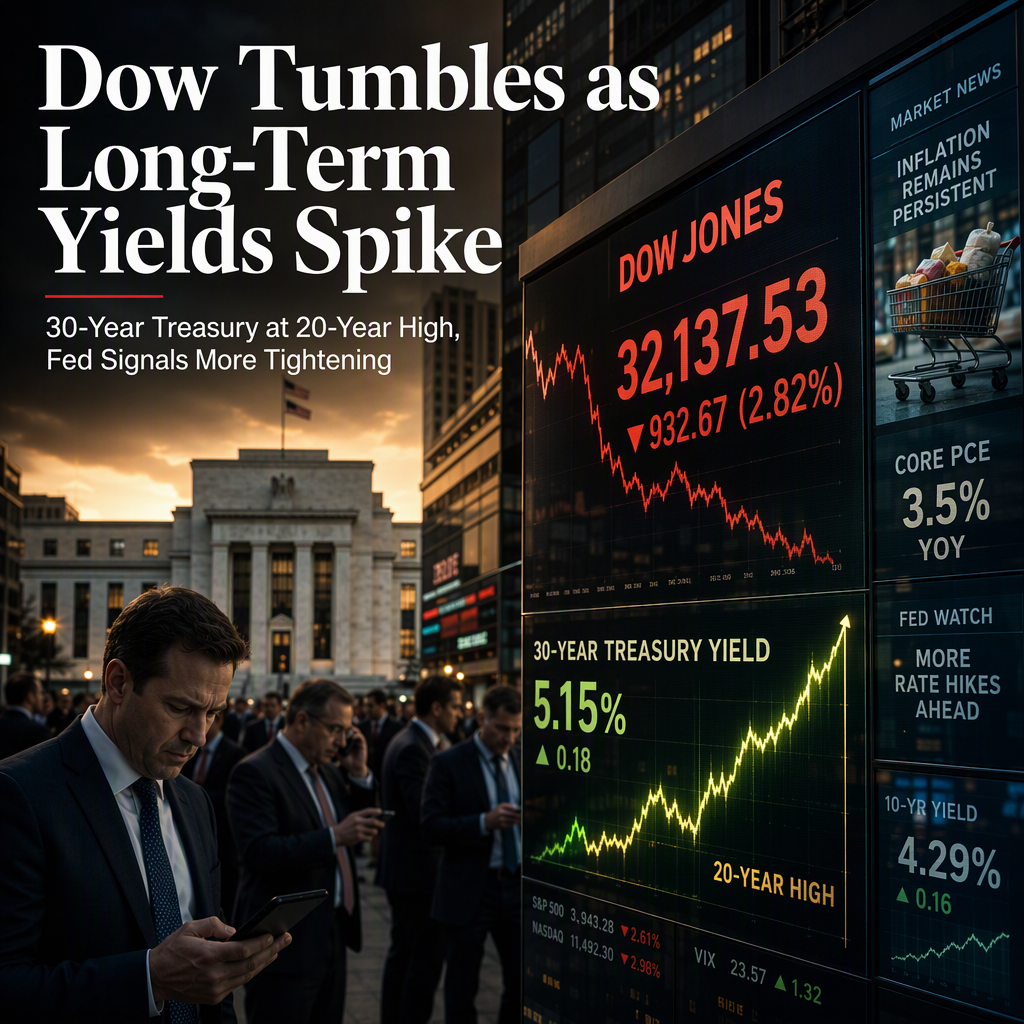
The Dow Jones Industrial Average dropped to 51,100 on Thursday, marking its lowest level since June and extending its losing streak to three consecutive sessions, as the 30-year Treasury yield climbed to its highest point since 2004 [1]. While the two-year yield remained relatively unchanged, the surge in the long bond yield reflects investor demands for higher compensation to lend to the U.S. government for three decades, amid persistent inflation pressures and elevated government borrowing [1].
Federal Reserve officials provided commentary on Thursday, with New York Fed President Williams stating at a London conference that the era of explicit forward guidance is over, echoing Fed Chair Warsh's stance. Williams also noted that market expectations for another rate hike before year-end appeared reasonable to him [1]. Philadelphia Fed President Paulson, a voting member this year, suggested that further tightening may be necessary following the September 16 hike to 3.75-4.00%. Paulson attributed new inflation pressures to the Middle East conflict and the expansion of artificial intelligence, while noting that tariff pressures are easing [1].
Despite these remarks, the two-year yield, which tracks expectations for Fed policy, remained near its 2023 high and showed little reaction, indicating that markets have already priced in the likelihood of another quarter-point hike. Futures suggest an October hike is more likely than not, and 16 out of 18 Fed policymakers project at least one more rate increase this year. Paulson commented that underlying inflation has not worsened in 2023, which she described as a positive sign [1].
The mortgage market has already absorbed the impact of four rate hikes, with the 30-year mortgage rate nearing 7%, a full percentage point higher than before the Iran war. This has affected Dow members such as Home Depot (HD) and Sherwin-Williams (SHW), whose businesses are tied to the housing market, where fewer people are moving at higher mortgage rates. Conversely, JPMorgan Chase (JPM) could benefit from the wider gap between short- and long-term yields, as banks borrow short and lend long [1]. Bank of America analysts reported that U.S. federal interest costs reached a record 3.3% of GDP in Q2, up from 1.7% when the 10-year yield was last near 5% in 2007 [1].
CONCLUSION
The Dow Jones Industrial Average is under pressure as surging long-term yields and persistent inflation concerns weigh on investor sentiment. With the likelihood of further Fed tightening and elevated mortgage rates impacting key sectors, market volatility is expected to remain high. The outlook for rate-sensitive stocks and broader market performance hinges on upcoming Fed decisions and evolving macroeconomic conditions.