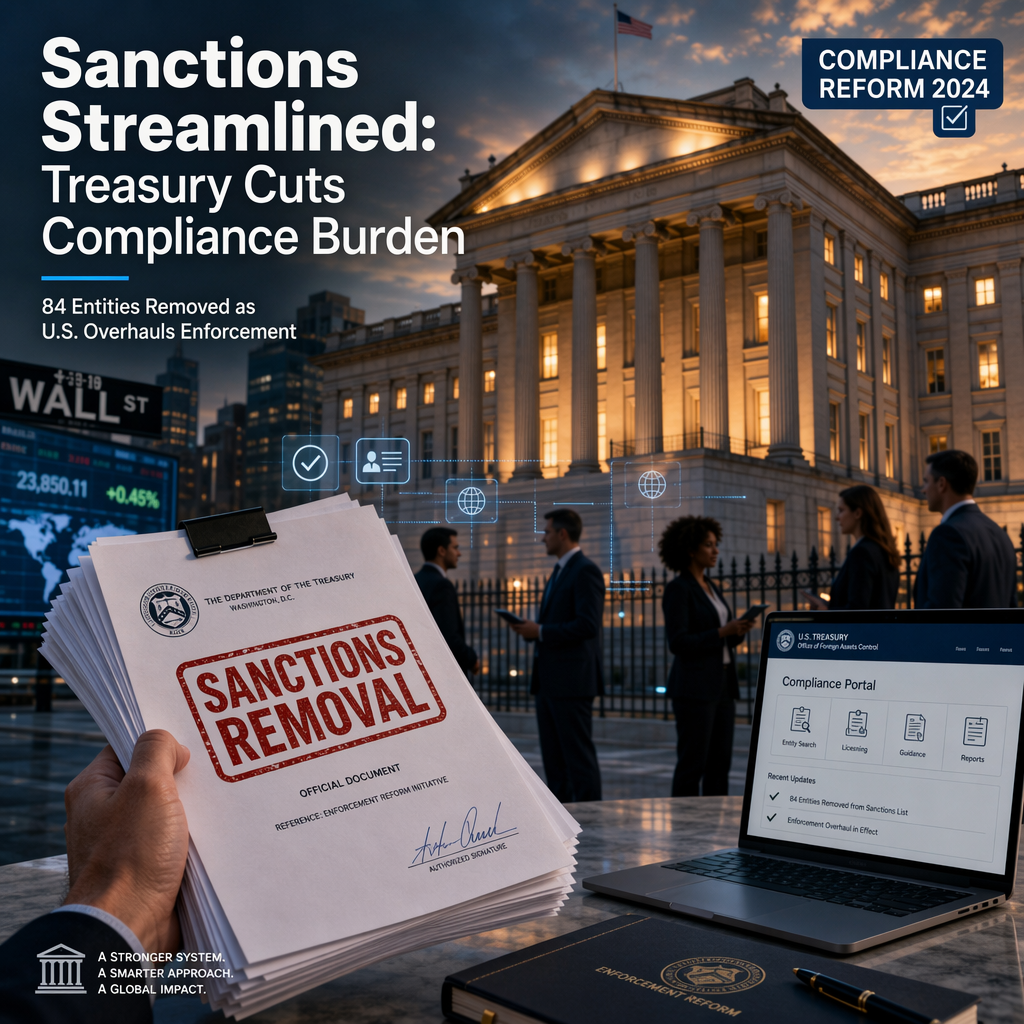
The U.S. Treasury Department announced the removal of 84 individuals and companies from its sanctions lists on Monday, as part of an ongoing review aimed at streamlining sanctions programs and reducing compliance burdens for financial institutions [1]. This marks the second round of removals since Secretary Scott Bessent initiated a review in May, which previously resulted in 76 people and firms being taken off the more than 17,000 entries on the sanctions lists [1].
The latest removals include 36 deceased individuals and their associated listings, 33 Iraq-related entities first designated in 1991 or 1992, seven outdated narcotics-related listings tied to Colombia, and eight disrupted narcotics kingpins [1]. Additionally, the Treasury's Office of Foreign Assets Control (OFAC) updated listings for 22 people and entities to clarify or add missing key identifiers, such as place and date of birth, unique identification numbers, nationality, or gender, to facilitate easier compliance screening for banks [1].
A Treasury official emphasized that the goal is to ensure sanctions remain 'efficient, sharp, and focused,' removing outdated entries and reducing 'bloat left over from previous administrations' [1]. The official also noted that more than 3,000 names were designated in 2024, compared to only 880 in 2017, highlighting the evolving nature of the sanctions program [1]. The department resolved 18 sets of duplicate entries with the latest removals and stated that each removal was reviewed by other federal agencies to ensure no adverse impact on foreign policy or national security interests [1].
The Treasury reiterated that 'sanctions are not intended to be a forever tool' and that names could be reinstated if necessary [1]. The review has focused on older sanctions entries, which often lack the detailed identifiers now standard in new sanctions, and aims to make compliance screening more efficient for financial institutions [1]. Last month, the Treasury also launched a new online portal to facilitate the process for sanctioned individuals or companies [1].
CONCLUSION
The Treasury's removal of 84 entities from its sanctions lists reflects a strategic effort to modernize and streamline sanctions enforcement, reducing compliance burdens for financial institutions. While the immediate market impact is moderate, the move signals a shift toward more targeted and effective sanctions, with ongoing reviews and updates expected to continue.