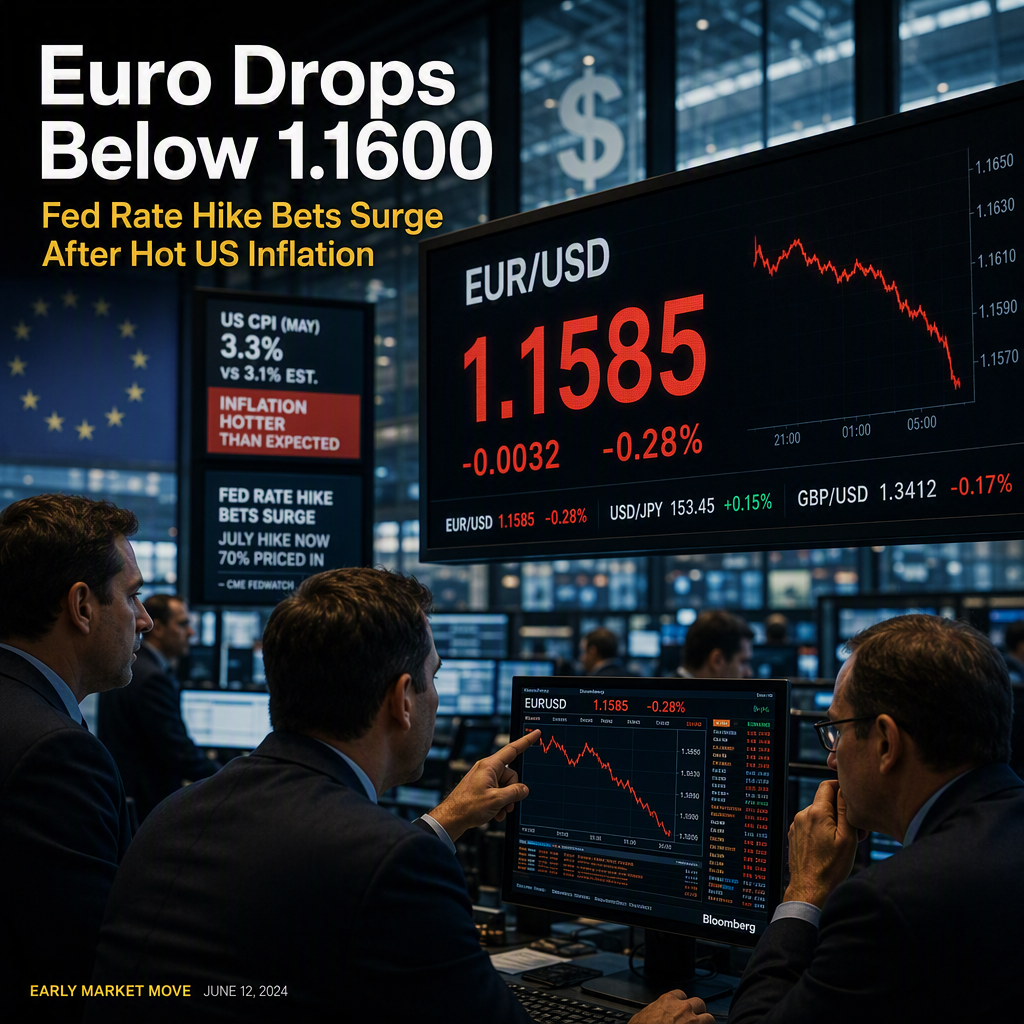
The EUR/USD pair declined to approximately 1.1585 during the early Asian session on Monday, extending its losses as aggressive Federal Reserve (Fed) rate-hike bets intensified following stronger-than-expected US inflation reports [1]. The US Consumer Price Index (CPI) rose 0.4% month-over-month in August, with a 12-month increase of 3.4%, both matching market expectations [1]. Core CPI, which excludes food and energy, increased by 0.3% on a monthly basis, beating the forecast of 0.2% [1]. These figures have reinforced expectations that the Fed will raise interest rates at its upcoming meeting, with financial markets pricing in a 91% probability of a quarter-point hike, up from 72% before the US Producer Price Index (PPI) data, according to the CME FedWatch tool [1].
Chris Zaccarelli, chief investment officer for Northlight Asset Management, commented, “There’s no guarantee that the Fed will hike next week, but it’s hard to see how the central bank can justify leaving rates on hold,” highlighting the strong market conviction for further tightening [1]. Meanwhile, the European Central Bank (ECB) raised its deposit facility rate to 2.50% at its September policy meeting, marking its second hike this year after the June increase [1]. Barclays analysts expect the ECB to hike further, citing a hawkish policy decision and concerns that inflation could remain elevated for longer [1].
Scotiabank analysts noted that the ECB's messaging was mixed but overall hawkish, with policymakers publishing a forecast that sees inflation remaining above target through the end of the projection horizon [1]. ECB President Christine Lagarde and other key council members have signaled a leaning toward further near-term hikes, pushing markets to price nearly 40 basis points of additional tightening by year end [1]. Despite the ECB’s hawkish tone, the euro remains under pressure, reflecting market concerns about persistent inflation risks and the impact of US monetary policy [1].
Technical analysis shows EUR/USD is supported above the 100-day simple moving average (SMA) and the lower band of the Bollinger Bands, suggesting a modest underlying bid. However, the price remains below the Bollinger middle band, capping the topside, and the Relative Strength Index (14) at 48.8 indicates balanced momentum, leaving the near-term bias broadly sideways as the pair consolidates between support and resistance [1].
CONCLUSION
The euro's decline below 1.1600 reflects heightened expectations for a Fed rate hike following strong US inflation data, while the ECB's hawkish stance has not been enough to support the currency. Market sentiment remains cautious as both central banks signal further tightening, and technical indicators suggest EUR/USD may consolidate in the near term. Investors are closely watching upcoming Fed and ECB decisions for further direction.