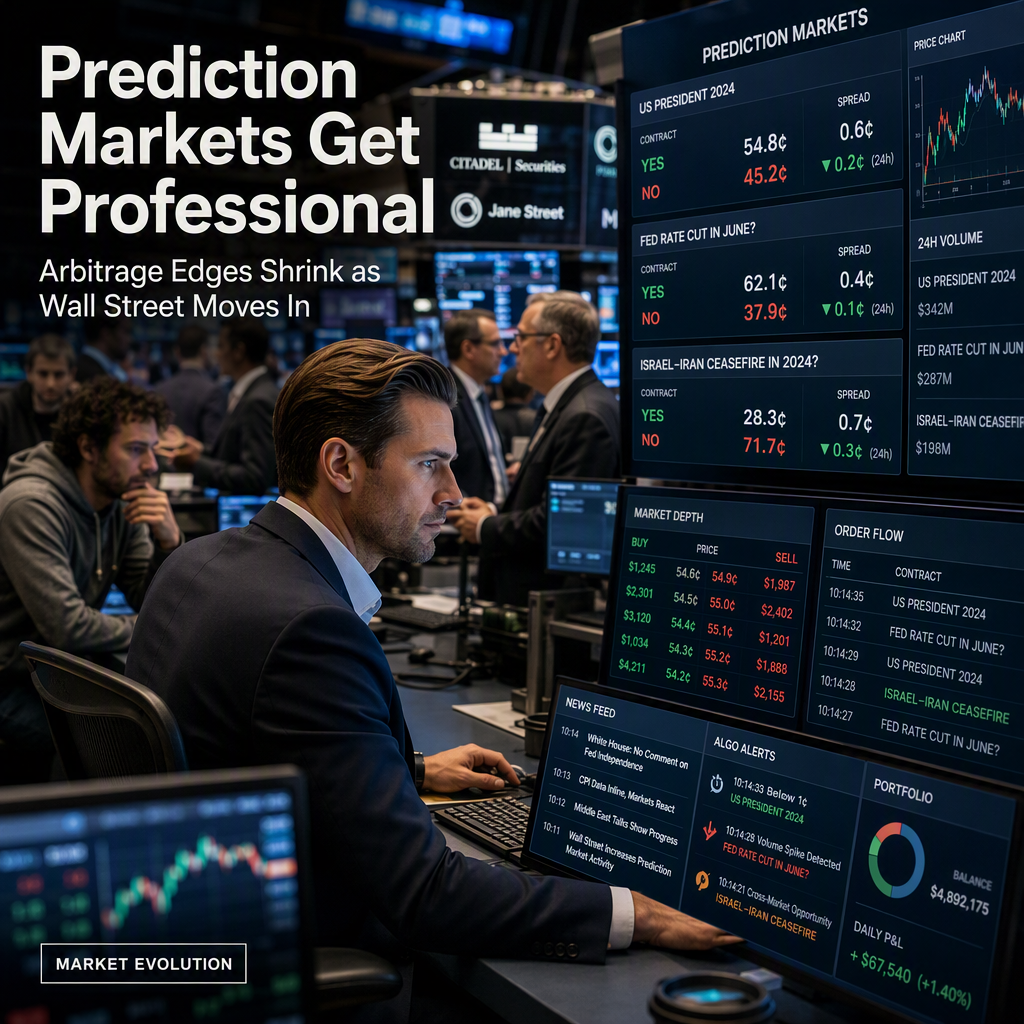
Prediction markets are undergoing a significant transformation as they attract more professional liquidity, making pricing errors and arbitrage opportunities increasingly difficult to exploit [1]. This shift is expected to challenge traders whose strategies depend on market inefficiencies, while ordinary traders may benefit from improved price accuracy [1]. The move towards professionalization is driven by prediction-market platforms courting Wall Street, which is bringing in deeper liquidity and intensifying competition [1].
An academic working paper analyzing $13.76 billion of Polymarket trades found that roughly 27% of dollar profits were captured by just 3% of accounts that are 'persistently skilled,' meaning these traders consistently moved market prices toward outcomes that eventually occurred [1]. These skilled accounts profited by reacting quickly to public news, arbitraging inconsistent pricing across related contracts, and trading against behavioral errors [1]. However, as more institutions pursue the same discrepancies, prices adjust faster and the available edge becomes scarcer [1].
Yale economist Theis Jensen, co-author of the paper, stated, 'If you have a lot of skilled people, then they compete, and in doing so, they make prices more correct' [1]. Julie Hoover, a Bank of America equity research analyst, noted, 'It's harder as markets get more efficient and spreads get tighter. It's going to be harder to find these mispricing and arbitrage opportunities' [1]. Jensen expects the proportion of traders with an edge to shrink from 3% to potentially below 1%, suggesting that only the very best, such as hedge funds, may be able to consistently beat prediction markets [1].
Despite this, Hoover pointed out that smaller skilled traders could still retain an edge in niche markets due to the breadth of contracts, allowing for specialized expertise and market making [1]. Large institutions may face scale constraints in thin markets, as relatively small orders can move prices enough to eliminate their own edge, making them less likely to enter lower-liquidity markets where specialists may still have an advantage [1]. For less skilled participants, increased market efficiency could be beneficial, as better-calibrated prices reduce the risk of consistently overpaying due to pricing errors [1].
CONCLUSION
The professionalization of prediction markets is making them more efficient, reducing arbitrage opportunities for most traders while potentially benefiting ordinary participants through improved pricing. Only the most skilled traders, particularly in niche markets, may continue to find an edge as competition intensifies and spreads tighten. Overall, the maturation of prediction markets is expected to create a fairer, more accurate trading environment.