
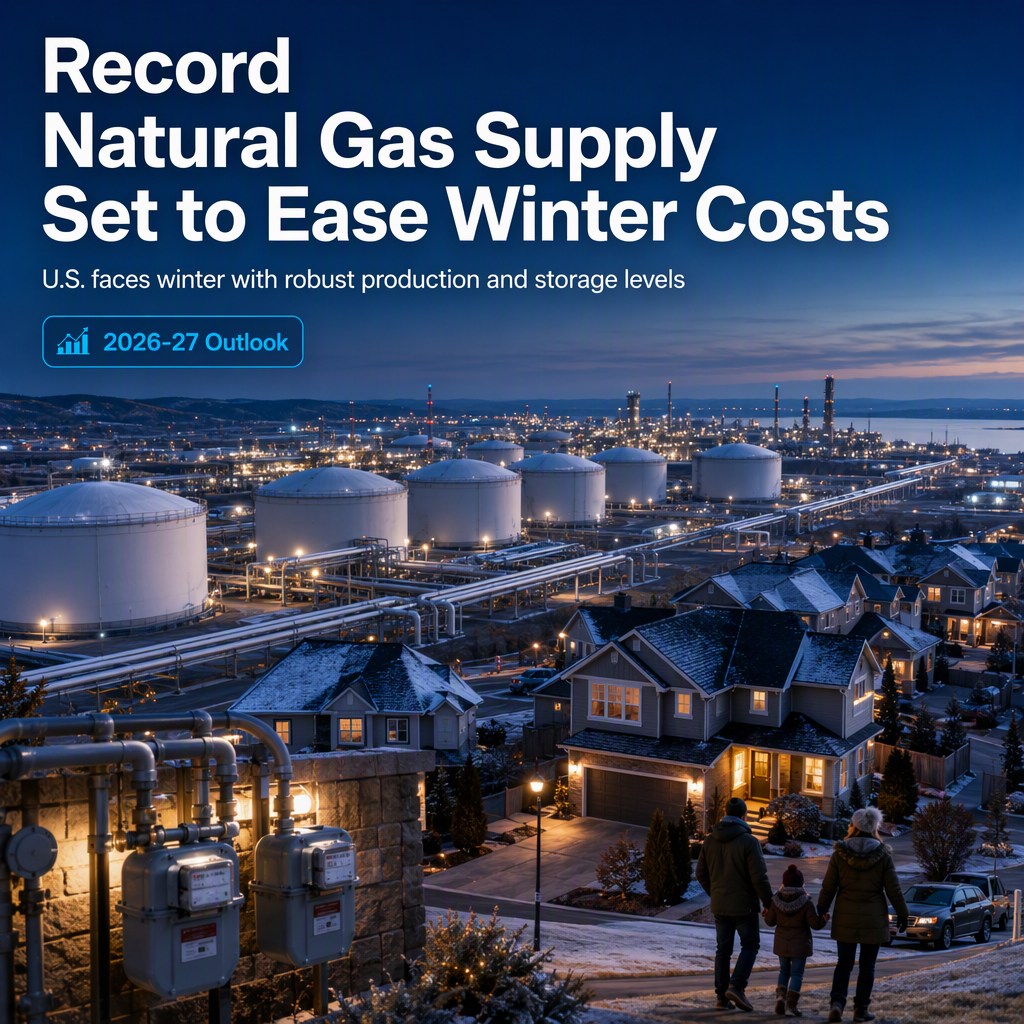
The U.S. is entering the winter heating season with record-setting natural gas production and robust storage levels, which could help mitigate potential price spikes for consumers as colder weather approaches [1]. According to the Natural Gas Supply Association's (NGSA) 2026-27 winter outlook, U.S. dry gas production is projected to reach a record 112.5 billion cubic feet (Bcf) per day, while storage levels are expected to be high at 3.88 trillion cubic feet (Tcf) [1]. Dena Wiggins, president and CEO of the NGSA, emphasized that the U.S. is in a 'very strong supply position' heading into winter, providing a significant cushion against possible market disruptions caused by shifts in winter weather [1].
The NGSA report highlights that the anticipated increase in demand is primarily driven by rising liquefied natural gas (LNG) exports, projected to grow by 2.3 Bcf per day year over year, and the expanding power needs of data centers [1]. In contrast, residential, commercial, and industrial usage is expected to remain steady under normal weather conditions, making LNG exports and power generation the main contributors to total winter demand [1].
Market implications hinge largely on weather patterns, with Wiggins noting that a milder winter could reduce heating demand and exert downward pressure on prices, while a colder winter could increase demand and potentially drive prices higher, especially during extended periods of extreme cold [1]. Despite the strong supply outlook, Wiggins cautioned that U.S. pipelines are operating near capacity, signaling a need for further infrastructure investment to ensure natural gas can be delivered where it is needed most [1].
The NGSA report also points out that U.S. natural gas maintains a cost advantage over Europe and Asia, but infrastructure constraints remain a key challenge as interstate pipelines approach capacity [1]. Natural gas currently supplies about 40% of U.S. electricity generation and is described as the 'most scalable resource for meeting grid reliability needs and expanding digital infrastructure' [1]. Looking ahead, Wiggins stated that the primary concern is not the adequacy of supply, but whether there is sufficient infrastructure to transport gas to homes, power plants, and businesses [1].
CONCLUSION
The U.S. natural gas market is well-positioned for the upcoming winter, with record production and storage levels expected to cushion against demand surges. However, infrastructure limitations could pose challenges in meeting peak demand, underscoring the need for investment in pipeline capacity. Overall, the outlook is positive, but weather and infrastructure remain key variables for market stability.