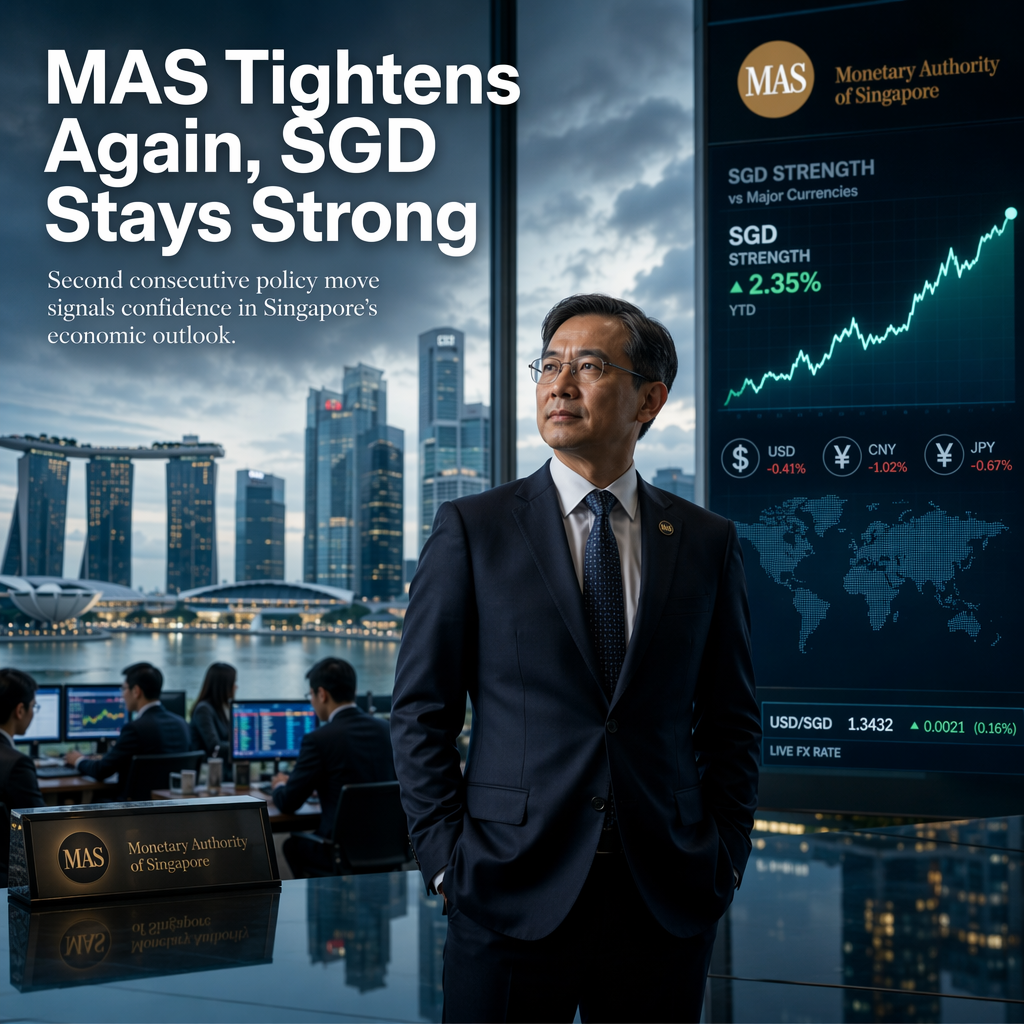
The Monetary Authority of Singapore (MAS) has implemented a second consecutive tightening of its monetary policy by slightly increasing the slope of the Singapore Dollar (SGD) Nominal Effective Exchange Rate (NEER) policy band, according to MUFG’s Lloyd Chan [1]. The adjustment, estimated at a 25 basis point increase to 1.25% per annum, was described as smaller than the previous move in April, signaling that MAS views only a measured response as necessary at this stage [1].
This policy action was significant as it surprised markets and confirmed MAS’s growing concern about persistent imported inflation pressures, while also reflecting confidence in the strength of Singapore’s economy [1]. Recent data showed GDP growth of 6.3% year-on-year in Q1 and 5.7% in Q2, with MAS expecting the positive output gap to widen in 2026 as the economy continues to expand above trend. The growth is broad-based, spanning construction and financial services in addition to tech-related sectors [1].
Despite the tightening, domestic inflation pressures remain contained, with moderating unit labour cost growth, healthy productivity gains, and little evidence of broad-based second-round inflation effects. This explains why MAS opted for a modest adjustment rather than a more aggressive move [1].
The SGD remains sensitive to high US yields and potential geopolitical tensions that could drive safe haven flows into the US Dollar (USD). However, the latest MAS policy move reinforces a hawkish bias and is expected to keep the SGD well supported. MUFG anticipates that USD/SGD will trend lower over the medium term, though external USD dynamics are seen as the key near-term risk [1].
CONCLUSION
MAS’s modest but hawkish tightening signals confidence in Singapore’s economic outlook and a proactive stance against imported inflation pressures. The move is expected to support the Singapore Dollar, with analysts forecasting a lower USD/SGD trend in the medium term, though external risks remain.