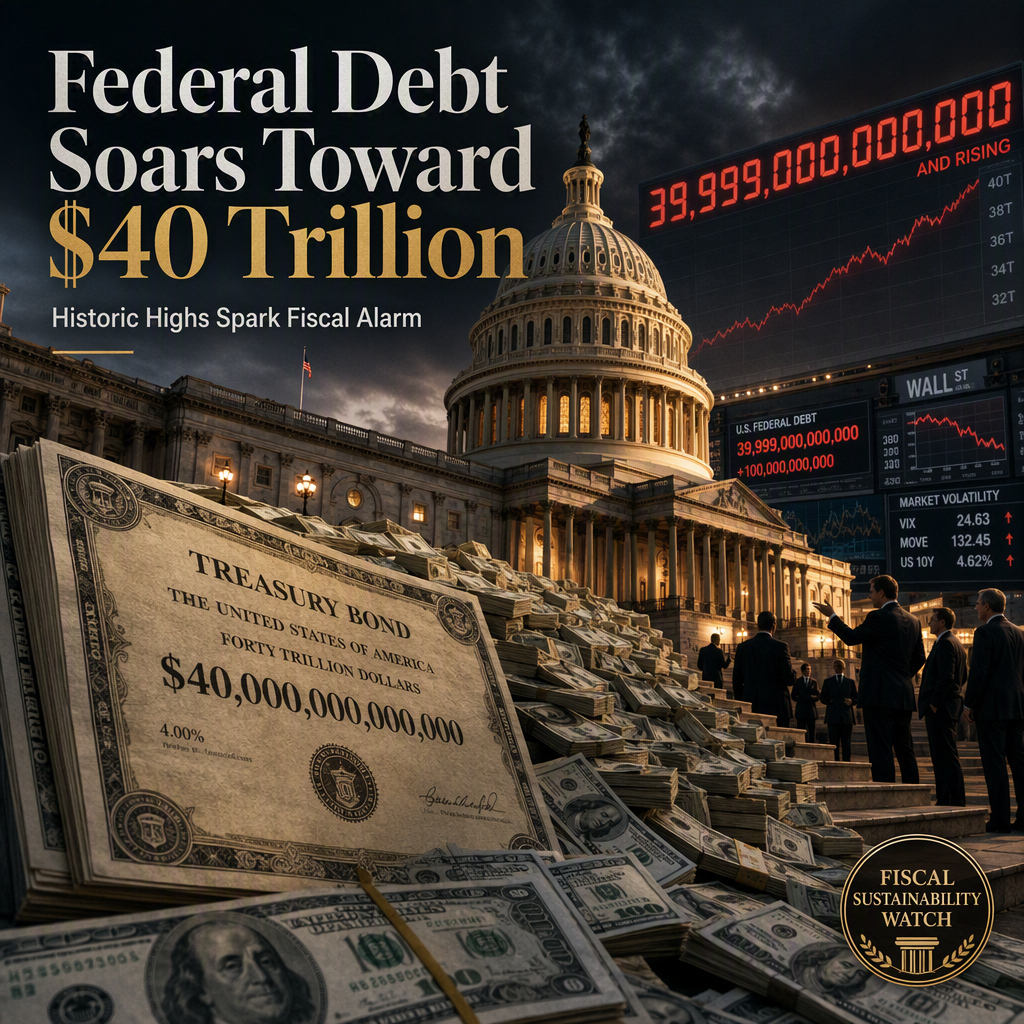
The United States is rapidly approaching a federal debt level of $40 trillion, with the threshold expected to be crossed soon, according to commentary by Les Rubin in Fox News. Over the past year, the national debt has increased by approximately $3 trillion, despite the annual deficit being about $2 trillion. This discrepancy highlights the accelerating pace of debt accumulation beyond the official deficit figures [1].
Debt as a percentage of GDP currently stands at roughly 125%, surpassing the post-World War II peak of 114%. In contrast, after World War II, the U.S. exercised financial restraint, keeping debt growth below 1% per year for two decades, which allowed the economy to triple in size and the debt-to-GDP ratio to fall below 50%. The current trajectory, however, points to both higher absolute debt and a rising debt-to-GDP ratio [1].
Projections that assume no new wars, recessions, or major government programs estimate that the federal debt could reach $64 trillion within a decade. The article draws on warnings from the late Senator Tom Coburn, who predicted in his book 'The Debt Bomb' that the U.S. was on an unsustainable fiscal path—a prediction the author argues has now materialized [1].
The opinion piece suggests that the shift from statesmen to career politicians focused on re-election and increased government spending is a key driver of the current debt crisis. The author references a widely attributed quote to Alexander Tytler, warning that democracies collapse over loose fiscal policy, ultimately leading to negative consequences for the nation [1].
CONCLUSION
The rapid growth of U.S. federal debt, now nearing $40 trillion and projected to rise significantly, is raising serious concerns about fiscal sustainability. With debt-to-GDP ratios at historic highs and no signs of restraint, the market may face increased uncertainty and risk if current trends continue.