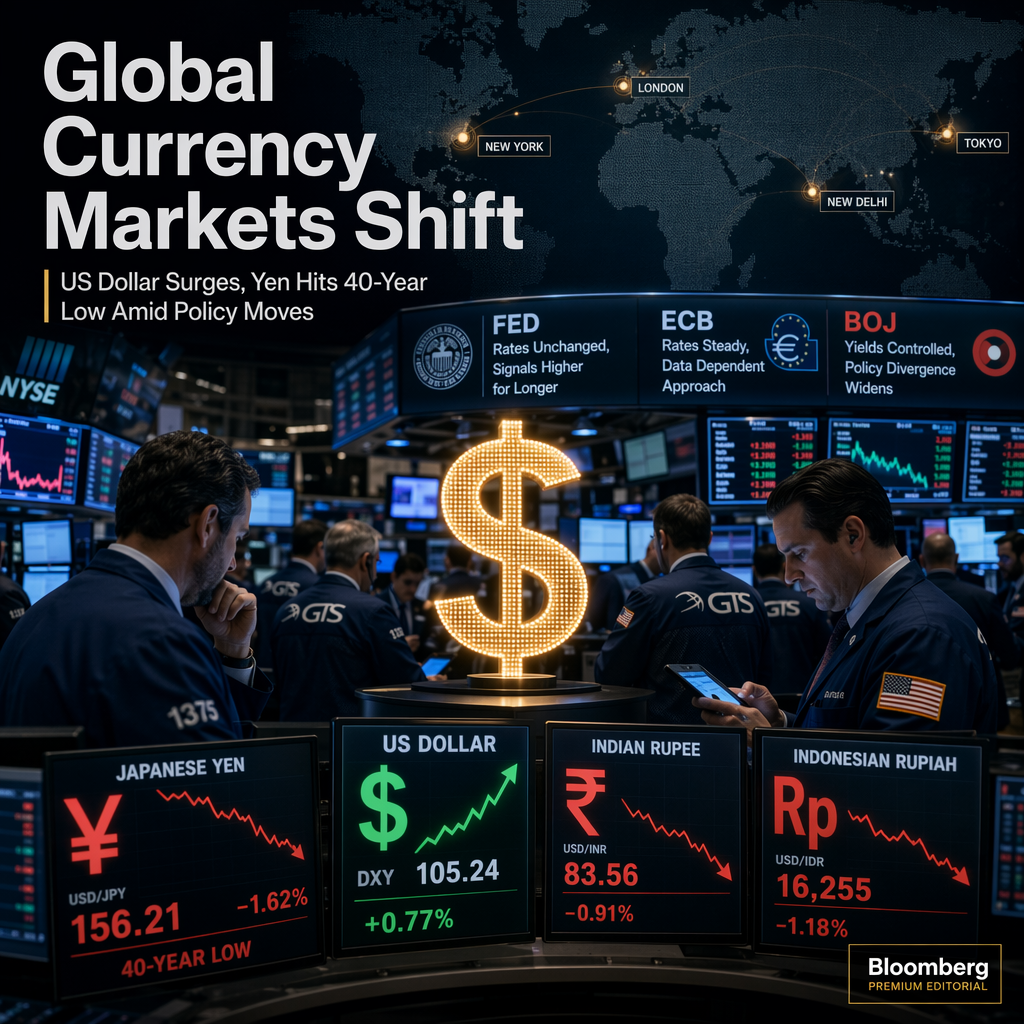
The US Dollar (USD) strengthened against multiple major currencies on Tuesday, driven by firm expectations of Federal Reserve (Fed) interest rate hikes and anticipation of key US labor market data, including the Nonfarm Payrolls (NFP) report for June, which is expected to show job growth of 110,000 to 114,000 and an unemployment rate holding steady at 4.3% [1][4]. The US Dollar Index (DXY) traded 0.2% higher near 101.32, reflecting broad dollar strength [1]. Money markets are pricing in at least one Fed rate hike this year, with a 50-60% chance of a second hike, according to LSEG and CME FedWatch data [2][4]. Fed Chairman Kevin Warsh is set to make his first public comments since the Fed announcement on Wednesday, with his recent remarks indicating a lack of forward guidance, which is seen as significant for market expectations [1][6].
The Japanese yen (JPY) has sunk to a 40-year low against the US dollar, prompting heightened vigilance for possible intervention by Japanese authorities. Finance Minister Satsuki Katayama stated that the government is ready to take decisive action against excessive currency moves, as confirmed between Japan and the US [5][6]. Currency strategist Carol Kong commented, "It's a question of when, not if, the Ministry of Finance (MOF) intervenes again to support the yen" [5]. The EUR/JPY cross traded around 184.85, with the yen rebounding slightly on intervention speculation [5].
The Indian Rupee (INR) edged lower against the US Dollar, with the USD/INR pair trading near 94.65. Lower oil prices, supported by a ceasefire between the US and Iran, have provided some support to the rupee, as India relies heavily on oil imports [1]. Foreign Institutional Investors (FIIs) remained net sellers in the Indian stock market, offloading Rs. 1,350.10 crore on Monday [1].
Elsewhere, the USD/CAD pair held gains above 1.4200, supported by Fed rate hike expectations and lower crude oil prices, which negatively impact the Canadian Dollar (CAD) due to Canada's status as a major oil exporter [2]. The GBP/USD pair retreated from a one-week top, trading around 1.3235, as the dollar firmed and UK political uncertainty weighed on the pound [3]. The Indonesian Rupiah (IDR) weakened, with USD/IDR trading around 17,940, amid governance concerns and rising US dollar demand. Traders are awaiting key Indonesian economic data, and the probability of a Fed rate hike by September is nearly 60% [4].
European Central Bank (ECB) President Christine Lagarde emphasized a return to "back to basics" in monetary policy, stating that unconventional instruments and complex forward guidance are no longer needed. Lagarde described the ECB's recent rate hike as "justified under every scenario" [6]. Markets have pared expectations for further ECB rate increases as energy prices retreat, with some analysts expecting no additional hikes, though investors are still pricing in one more quarter-point move [5].
Geopolitical developments remain in focus, with US President Donald Trump announcing fresh US-Iran talks in Doha, Qatar, though Iran contradicted this claim, stating no negotiations are scheduled [4][6]. Lower oil prices due to the ceasefire have supported some currencies, while persistent Middle East tensions contribute to safe-haven demand for the US dollar [1][4][6].
CONCLUSION
The US Dollar's broad strength, driven by Fed rate hike expectations and geopolitical developments, has led to significant moves across global currency markets, including a 40-year low for the Japanese yen and weakness in the Indian rupee and Indonesian rupiah. Central bank policy signals from the Fed and ECB are shaping market sentiment, with investors closely watching upcoming US labor data and potential interventions in currency markets. The overall market takeaway is heightened volatility and a strong dollar bias amid policy and geopolitical uncertainty.