
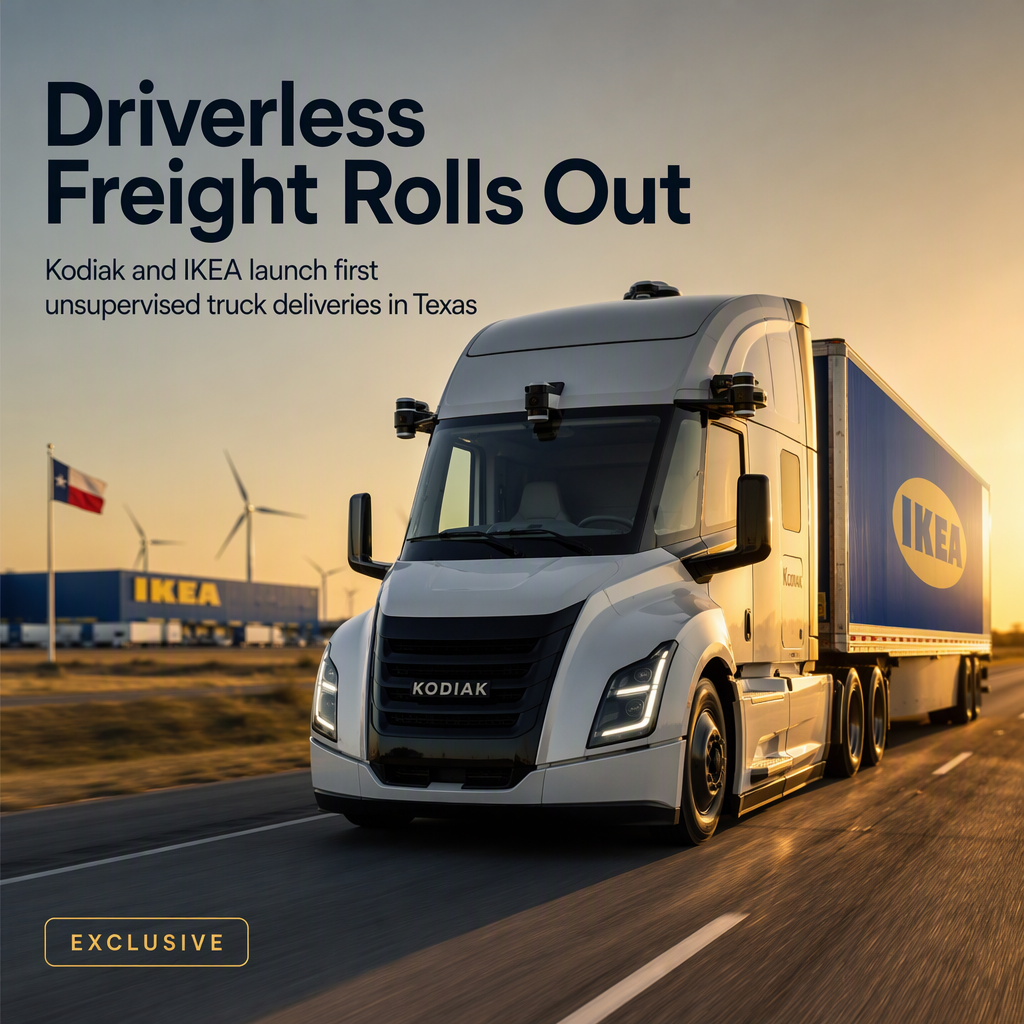
Kodiak is set to launch its first unsupervised driverless long-haul delivery truck on Texas roads by the end of the year, marking a significant milestone in autonomous freight delivery technology. The rollout is part of Kodiak's partnership with Swedish furniture giant IKEA, which will serve as the launch partner for this new phase of operations. According to Kodiak founder and CEO Don Burnette, the company will begin with one truck and plans to scale operations throughout 2027 and beyond [1].
The initial phase will involve trucks making trips just over 200 miles, with no driver present in the cab. Burnette emphasized that Kodiak's AI-powered software acts as the 'brain' of the autonomous trucks, ensuring safety and reliability. He stated, 'We've proven the technology is safe and reliable. We've done a lot of work over the last decade or so to make sure we've covered every contingency, and now we're ready to go' [1]. The trucks are designed to handle emergency situations independently and can safely stop, pull over, or call for remote assistance if needed [1].
Burnette highlighted several advantages of the autonomous trucks, including improved fuel economy, adherence to speed limits, and defensive driving behavior, all of which contribute to cost savings. He noted, 'They don't drive anywhere they're not supposed to. They're very smooth. And more importantly, they're safe. They sit in the right-hand lane. They go the speed limit. They mind their own business. They are very defensive. And so that additionally has cost savings down the line' [1].
The announcement follows Kodiak AI's $2.5 billion Nasdaq debut, underscoring the company's commitment to advancing autonomous freight delivery technology. The news comes amid industry concerns over rising diesel fuel costs and the potential economic impact of automation, with CEO warnings that high fuel prices could trigger a 'vicious cycle' of surging food prices [1].
CONCLUSION
Kodiak's upcoming launch of unsupervised driverless trucks in partnership with IKEA signals a major step forward for autonomous freight delivery. The company's focus on safety, cost savings, and scalability positions it as a key player in addressing industry challenges such as rising fuel costs and automation concerns. Market participants are likely to view this development as a significant advancement in logistics technology.