
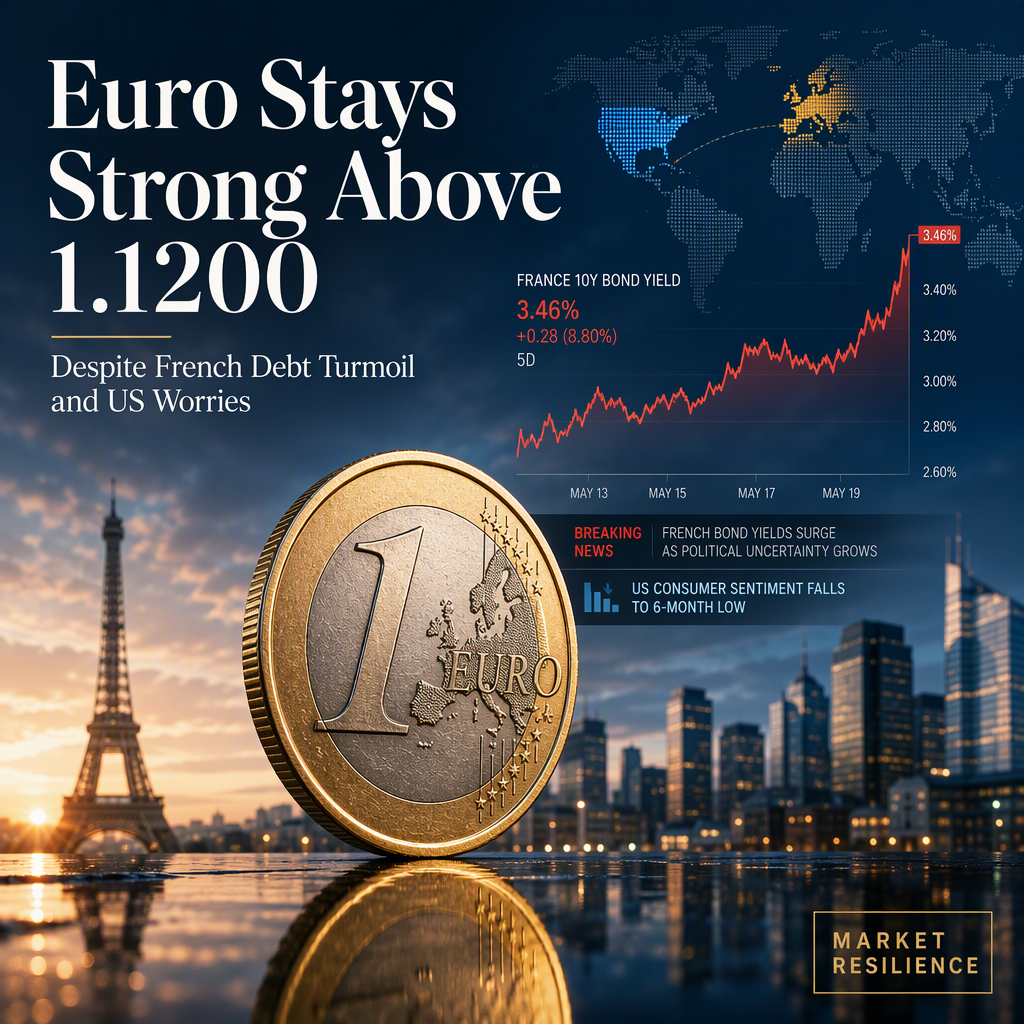
The EUR/USD pair recovered some lost ground, trading near 1.1215 during early Asian hours on Monday, as the US Dollar softened against the Euro following weaker-than-expected US Consumer Sentiment data [1]. The University of Michigan's Consumer Sentiment Index dropped to 46.3 in October from 48.1 in September, falling below the market consensus of 47.6 [1]. Additionally, one-year US inflation expectations rose to 4.7% in October from 4.6%, while five-year expectations increased to 3.5% from 3.4% [1]. This data has reinforced expectations for a 25 basis points Federal Reserve rate hike at the upcoming meeting [1].
Despite the Euro's resilience, French government bond yields have surged to multiyear highs amid concerns over France's mounting debt crisis, which has fueled broader worries about Europe's strained public finances [1]. Traders are also closely monitoring Italy, where new government spending plans are expected to increase the country's budget deficit and push its debt-to-GDP ratio toward the highest level in Europe [1].
Analysts at MUFG note that, despite recent Euro weakness, there is evidence of economic resilience in Europe that could help stabilize the currency at lower levels [1]. For example, Germany's Economy Ministry revised up its GDP growth projection for this year and next to 1.3% and 1.1%, respectively, from previous estimates of 0.5% and 0.9% [1]. However, mounting trade frictions with China pose a potential headwind for the Euro, with speculation that Europe may soon implement a more flexible trade policy mechanism, including possible import caps and additional tariffs, which could escalate trade tensions and prompt retaliation from China [1]. MUFG warns that ongoing talks may be the final opportunity to avoid increased tensions [1].
ECB Vice President Boris Vujčić is scheduled to speak later in the day, which may provide further insights into the central bank's outlook amid these developments [1].
CONCLUSION
The Euro has shown resilience above 1.1200 despite French bond market turmoil and weak US consumer sentiment data. While economic upgrades in Germany and cautious optimism from analysts offer some support, ongoing fiscal concerns in France and Italy, as well as rising trade tensions with China, present significant risks for the Euro going forward.