
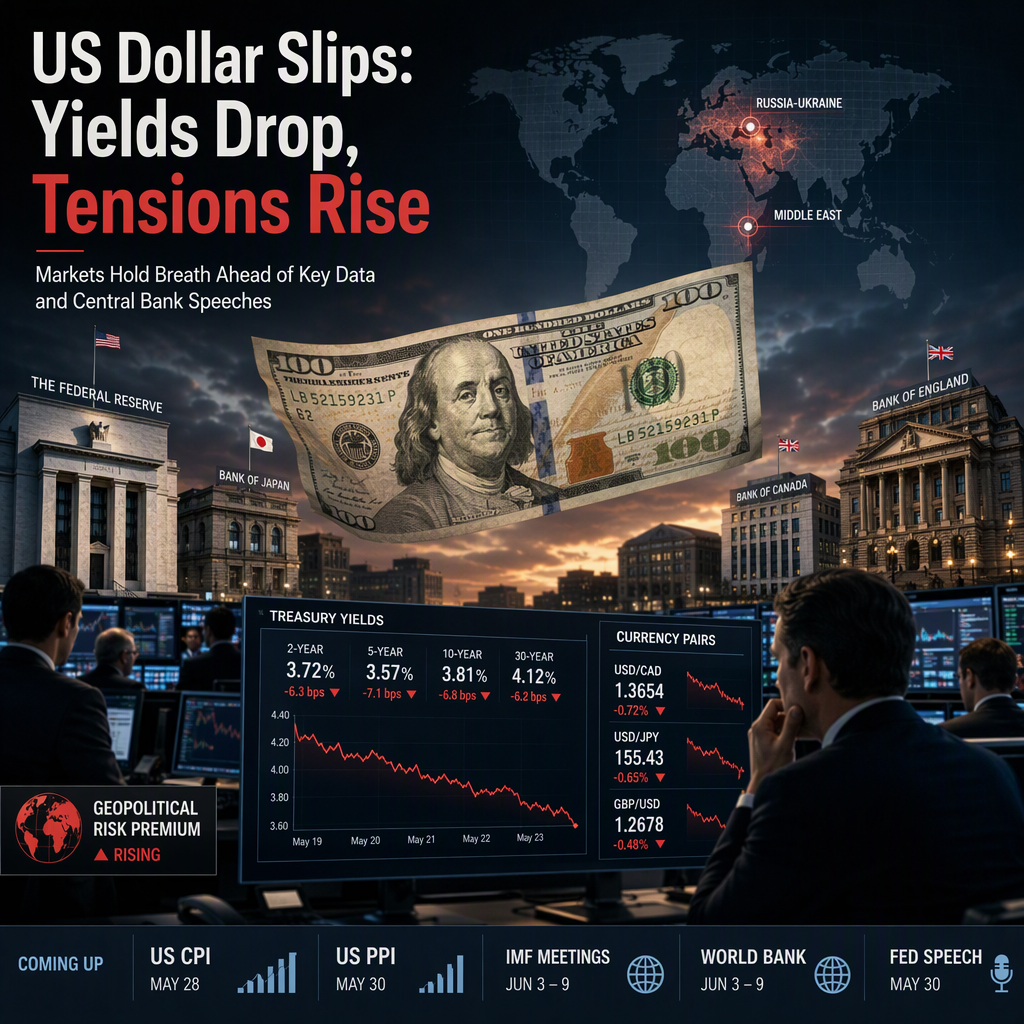
The US Dollar (USD) experienced broad-based softness at the start of the week, influenced by a minor pullback in US Treasury bond yields and cautious market sentiment ahead of key inflation data releases and central bank speeches [1][2][3]. The USD/CAD pair retreated to the mid-1.4200s after failing to sustain a gap-up open, with sliding crude oil prices—amid hopes for a Russia-Ukraine energy ceasefire—countering the impact of USD weakness and limiting Canadian Dollar (CAD) gains [1]. The Bank of Canada (BoC) is expected to maintain a dovish stance due to a sluggish domestic economy and weak jobs data, while the US Federal Reserve (Fed) has adopted a more hawkish outlook, signaling a potential 25-basis-point rate hike in late 2026 [1].
In the Japanese market, the USD/JPY pair hovered around 158.10 during thin trading conditions due to a Japanese holiday [2]. The Bank of Japan (BoJ) is unlikely to implement a back-to-back rate hike at its upcoming meeting, despite resilient export data and elevated business costs [2]. Market participants anticipate a possible rate increase to 1.50% from 1.25% in December or January, with a further hike to 1.75% in March or April [2]. The USD/JPY pair faced additional pressure as the University of Michigan's Consumer Sentiment Index dropped to 46.3 in October from 48.1 in September, missing expectations [2].
The British Pound (GBP) gained positive traction for the third consecutive day, with GBP/USD trading in the mid-1.3200s, supported by softer US bond yields and UK Chancellor John Healey's commitment to fiscal discipline ahead of his budget speech on October 28 [3]. However, the pair remained range-bound, with technical resistance near 1.3260 and 1.3300, and traders awaited further cues from upcoming speeches by BoE Governor Andrew Bailey and Fed Chair Kevin Warsh, as well as the release of UK GDP and US inflation data [3].
Geopolitical tensions continued to influence market sentiment, as Iran's top security official deemed Washington's response to reopening the Strait of Hormuz insufficient, and US President Donald Trump considered renewed military action against Tehran [1][3]. These developments maintained a geopolitical risk premium for the USD, limiting aggressive bearish bets against the currency despite its recent softness [1][3].
Looking ahead, investors are focused on the upcoming US Producer Price Index (PPI) and Consumer Price Index (CPI) reports scheduled for Wednesday and Thursday, respectively, and central bank speeches at the IMF and World Bank meetings in Bangkok on Friday [1][2][3]. These events are expected to provide further direction for major currency pairs.
CONCLUSION
The US Dollar's recent weakness is driven by lower Treasury yields and cautious sentiment ahead of key inflation data and central bank events. Geopolitical risks and divergent monetary policy outlooks are keeping major currency pairs in tight ranges. Market participants are expected to remain on the sidelines until clearer signals emerge from upcoming economic releases and policy statements.