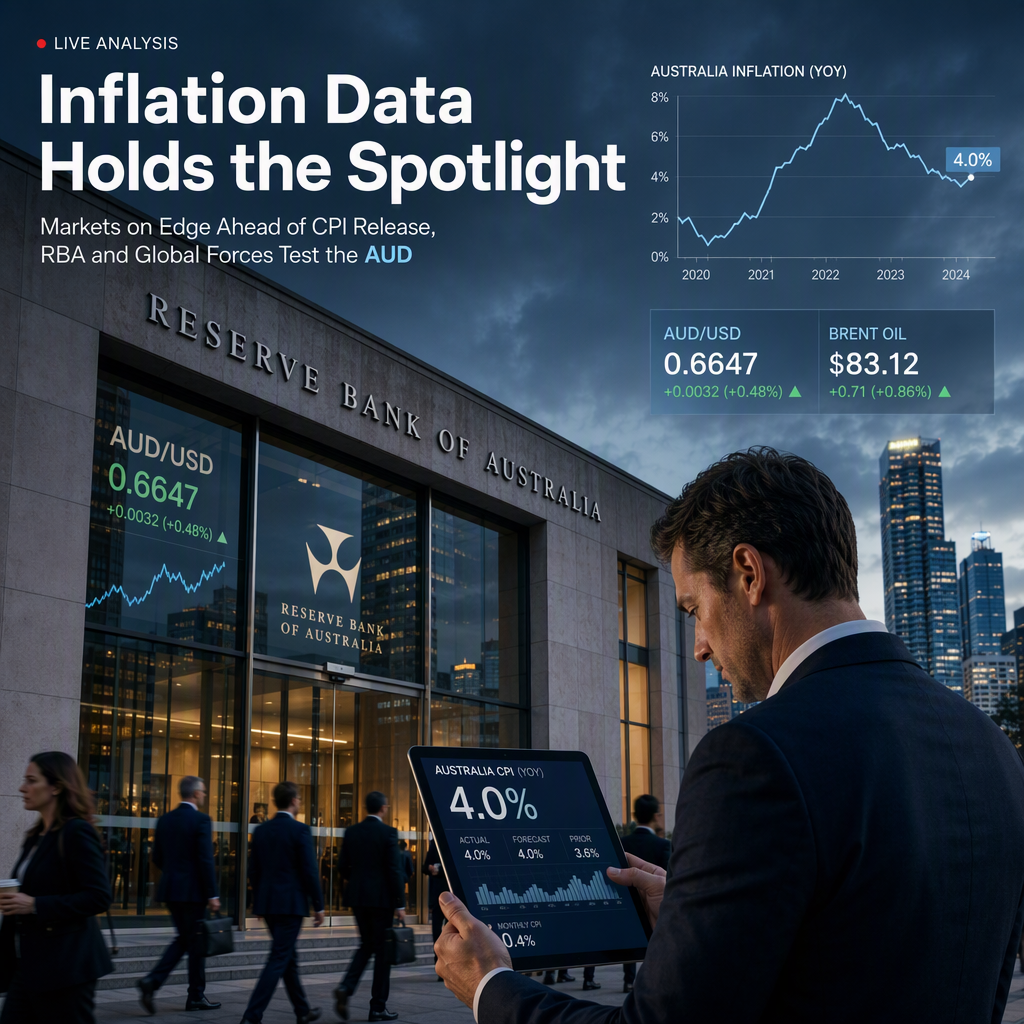
The Australian Bureau of Statistics (ABS) is set to release the June Consumer Price Index (CPI) on Wednesday at 01:30 GMT, with market expectations pointing to a 4% year-on-year rise, matching the May reading. The monthly CPI is forecast at 0.2%, a rebound from the -0.7% print in May. The Trimmed Mean CPI, the Reserve Bank of Australia’s (RBA) preferred inflation measure, is anticipated to come in at 3.7% annually, slightly above the previous 3.6%, and to remain unchanged at 0.4% on a monthly basis [1].
Ahead of the CPI release, the Australian Dollar (AUD) is trading around 0.6950 against the US Dollar (USD), with the USD strengthening due to increased demand for safe-haven assets. Market confidence has been undermined by a sharp decline in global stocks, driven by concerns over potential returns from large-scale AI investments [1].
The RBA, which left its cash rate target unchanged at 4.35% in June after three hikes in 2026, continues to view inflation as 'still too high,' according to Governor Michele Bullock. Policymakers have noted that disruptions to global oil supply, particularly due to ongoing geopolitical tensions in the Middle East and restricted transit through the Strait of Hormuz, are contributing to inflationary pressures. Oil prices remain elevated, with West Texas Intermediate (WTI) at around $80 per barrel and Brent at $84, sustaining speculative caution in the markets [1].
The RBA acknowledges that tighter monetary policy has helped slow consumption spending, but uncertainty about the inflation outlook persists. Even if the Middle East conflict were to resolve soon, global supply chain issues are expected to continue exerting upward pressure on energy prices and inflation. The US Federal Reserve is also set to announce its monetary policy decision later on Wednesday, with expectations that rates will remain on hold at 3.75%. Fed Chair Kevin Warsh is anticipated to maintain a hawkish tone, which could further influence market sentiment [1].
CONCLUSION
The upcoming Australian CPI release is a key event for markets, with inflation expected to remain elevated and ongoing geopolitical tensions adding to uncertainty. The RBA’s cautious stance and persistent global supply issues suggest continued upward pressure on prices, while the AUD remains sensitive to both domestic data and international developments. Market participants are closely watching both the CPI and the US Fed’s policy decision for further direction.