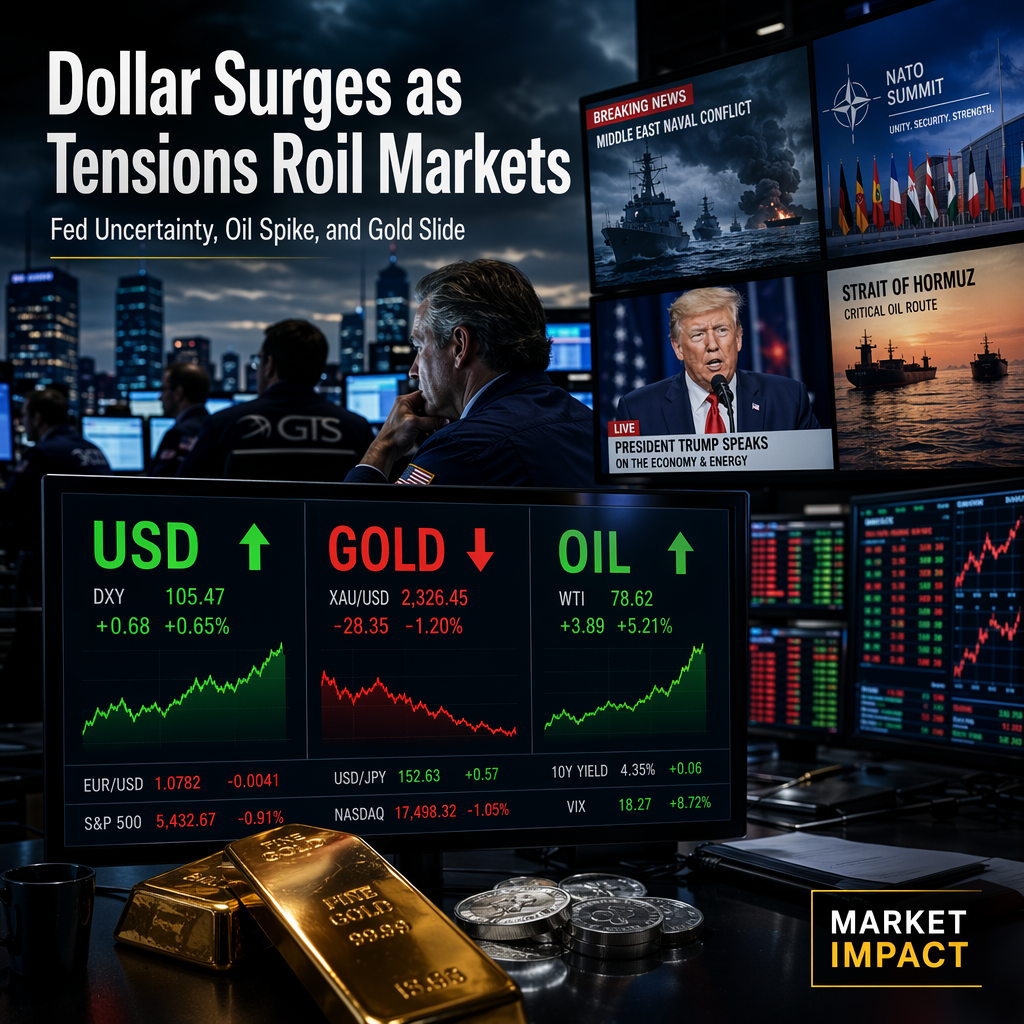
On Wednesday, the US Dollar Index (DXY) hovered around 101.00, reflecting muted price action despite significant underlying developments from the Federal Reserve and escalating Middle East tensions [1][2]. The Federal Open Market Committee (FOMC) voted unanimously (12-0) to hold the target range at 3.50% to 3.75%, but the minutes revealed deep divisions among participants, with some favoring a hike and others seeing the current stance as not restrictive enough. Year-end projections were split, with nine out of eighteen expecting at least one hike, eight favoring a hold, and one projecting a cut [1]. The Fed removed language signaling an easing bias, and Chair Powell announced five task forces to re-examine monetary policy, signaling a shift in the Fed's approach [1]. Staff estimates put headline PCE inflation at 4.1% in May and core at 3.4%, with risks tilted to the upside due to factors like tariff pass-through, supply disruptions from the Strait of Hormuz closure, and AI-driven demand [1]. The June projection round marked 2026 headline inflation up to 3.6% from March's 2.7% [1].
Geopolitical tensions surged after US President Donald Trump declared the ceasefire deal with Iran "over" at the NATO Summit in Ankara, Turkey, raising fears of renewed conflict and supply disruptions in the Strait of Hormuz [2][4]. Iran threatened to close the Strait if attacked, following IRGC assaults on commercial vessels earlier in the week [4]. Oil markets reacted strongly, with West Texas Intermediate (WTI) climbing to an intraday high of $75.73 before settling around $73.60, up 2.20% on the day [4]. The US Energy Information Administration (EIA) reported a surprise build in crude inventories (+2.998 million barrels), ending a ten-week streak of declines [4].
The US Dollar strengthened, with DXY up 0.10% at 101.20, as higher oil prices and Treasury yields (10-year T-note up 8.5 basis points to 4.589%) fueled inflation concerns and bets for further Fed tightening. Swaps markets priced in 27 basis points of Fed tightening by year-end, though odds for a July hike remain at 35% versus 65% for a hold [2].
Precious metals suffered as risk aversion and dollar strength prevailed. Gold (XAU/USD) fell over 1.30%, hitting a four-day low of $4,021 and trading at $4,059 [2]. Technicals remain bearish, with a 'death cross' on the daily chart and RSI pointing toward oversold territory. Bank of America lowered its 2026 gold forecast by 14% to $4,360 but still sees $5,000 as attainable after the tightening cycle [2]. Silver (XAG/USD) collapsed nearly 2.50%, trading at $58.41 after opening at $61.03, with technicals showing a downward bias and RSI nearing oversold [3]. If silver breaks below $56.61, it could target $55.79 and potentially $54.39 [3].
The British Pound surged against the Euro, reaching a one-year high, as markets fully priced in a Bank of England hike following the White House's Iran ceasefire announcement and rising Brent crude prices [5]. The Euro, despite hawkish ECB messaging and a June hike to 2.25%, barely reacted as flash inflation cooled and urgency faded [5].
There is a discrepancy regarding President Trump's remarks: Source [4] notes that Trump declared the ceasefire "over" at the NATO Summit, but Reuters later reported he did not repeat those remarks, citing a source familiar with the talks.
CONCLUSION
The combination of Fed uncertainty, persistent inflation risks, and renewed Middle East tensions has driven the US Dollar higher, pressured precious metals, and boosted oil prices. Markets are pricing in further Fed tightening, while technicals for gold and silver remain bearish. The British Pound has benefited from rising rate expectations, while the Euro remains subdued despite hawkish ECB signals. Overall, the event has had a high market impact, with risk aversion and inflation concerns dominating trading.