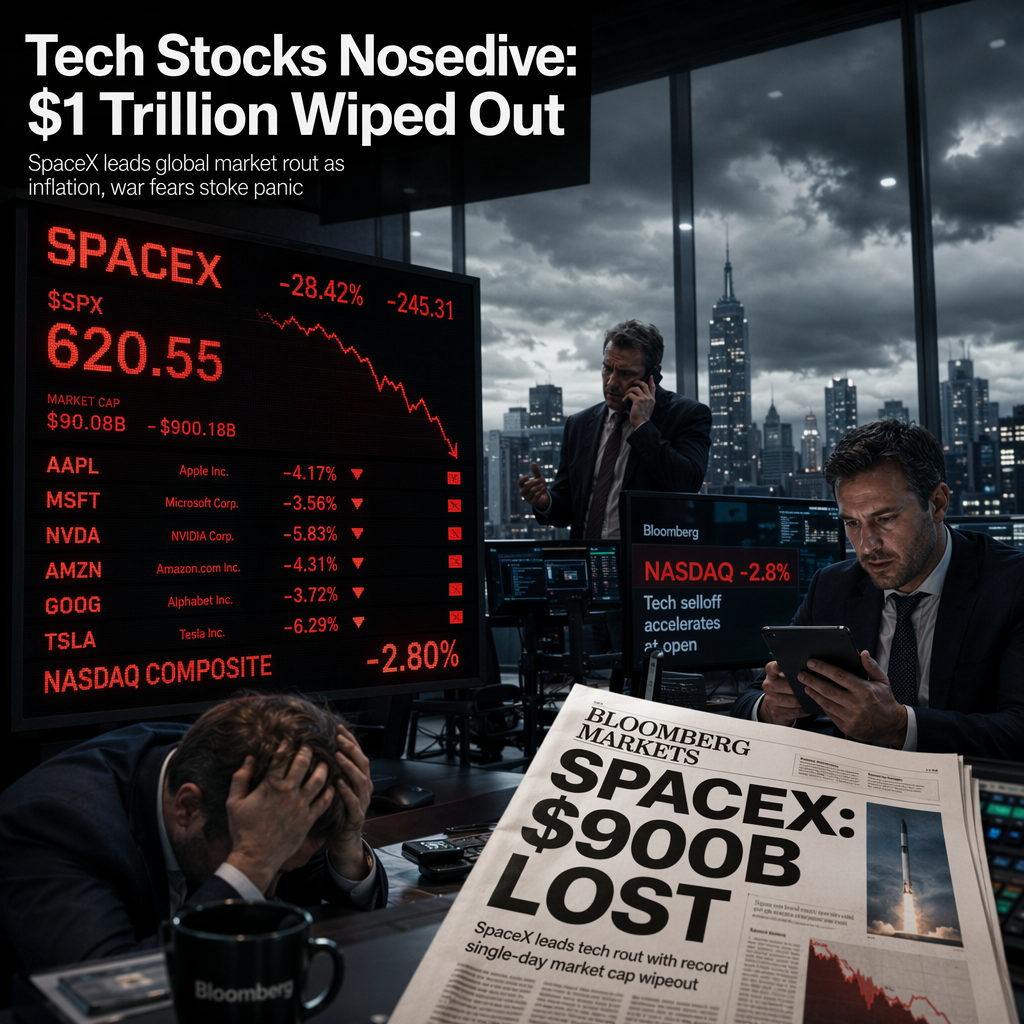
Global markets experienced a sharp sell-off on Tuesday, driven primarily by a steep decline in leading technology stocks, with SpaceX at the forefront of the downturn. The sell-off intensified as concerns mounted over high valuations in AI, chip, and memory stocks, compounded by fears that inflation—exacerbated by the Iran war and the closure of the Strait of Hormuz—could prompt higher interest rates and more expensive borrowing for the global AI infrastructure buildout [1].
Nasdaq 100 futures plunged 2.8%, putting the index on track to erase more than $1 trillion in market value if the decline persists through the trading day. S&P 500 futures fell 1.6%, Dow futures dropped nearly 300 points, and the Russell 2000 index declined 1.4%, indicating broad-based market weakness [1]. In pre-market trading, shares of Intel, Marvell, Western Digital, and AMD dropped over 5%, while Broadcom, Nvidia, Tesla, and Alphabet fell more than 3% [1].
SpaceX shares, which are set for their fourth consecutive down session, tumbled another 4% in pre-market trading to about $147, falling below their $150 opening price but remaining above the $135 IPO offering price. The recent sell-off in SpaceX has wiped out over $900 billion in value from its peak of $225 per share just a week ago. On Monday alone, SpaceX shares fell nearly 17%, erasing $400 billion in value—the second largest one-day loss for any stock on record, according to Bloomberg [1]. The selling pressure intensified after SpaceX announced an inaugural bond offering, reportedly seeking to raise about $20 billion, in addition to the $85 billion raised through its IPO two weeks prior [1].
The so-called 'magnificent seven' stocks—Alphabet, Amazon, Apple, Meta Platforms, Microsoft, Nvidia, and Tesla—were all down in pre-market trading except for Microsoft, which showed a brief gain. Nvidia and Tesla were expected to be the worst affected among them [1]. Alphabet shares continued their decline, falling another 2.3% in early Tuesday trading after recording their worst single day in a year on Monday, following the departure of high-profile AI talent [1].
The sell-off extended globally, with Korea's Kospi index closing 10% lower after significant declines in Samsung and SK Hynix, two of the country's most valuable companies [1]. Bond yields were mixed, with shorter-term U.S. Treasury yields rising slightly and longer-dated yields, such as the 10-year, falling slightly [1].
CONCLUSION
The global tech sell-off, led by SpaceX's dramatic decline, has triggered a significant loss in market value and heightened volatility across major indices. Investor concerns over inflation, interest rates, and AI sector valuations are driving the downturn, with no immediate signs of stabilization. The market remains on edge as participants await further developments in both macroeconomic and company-specific factors.