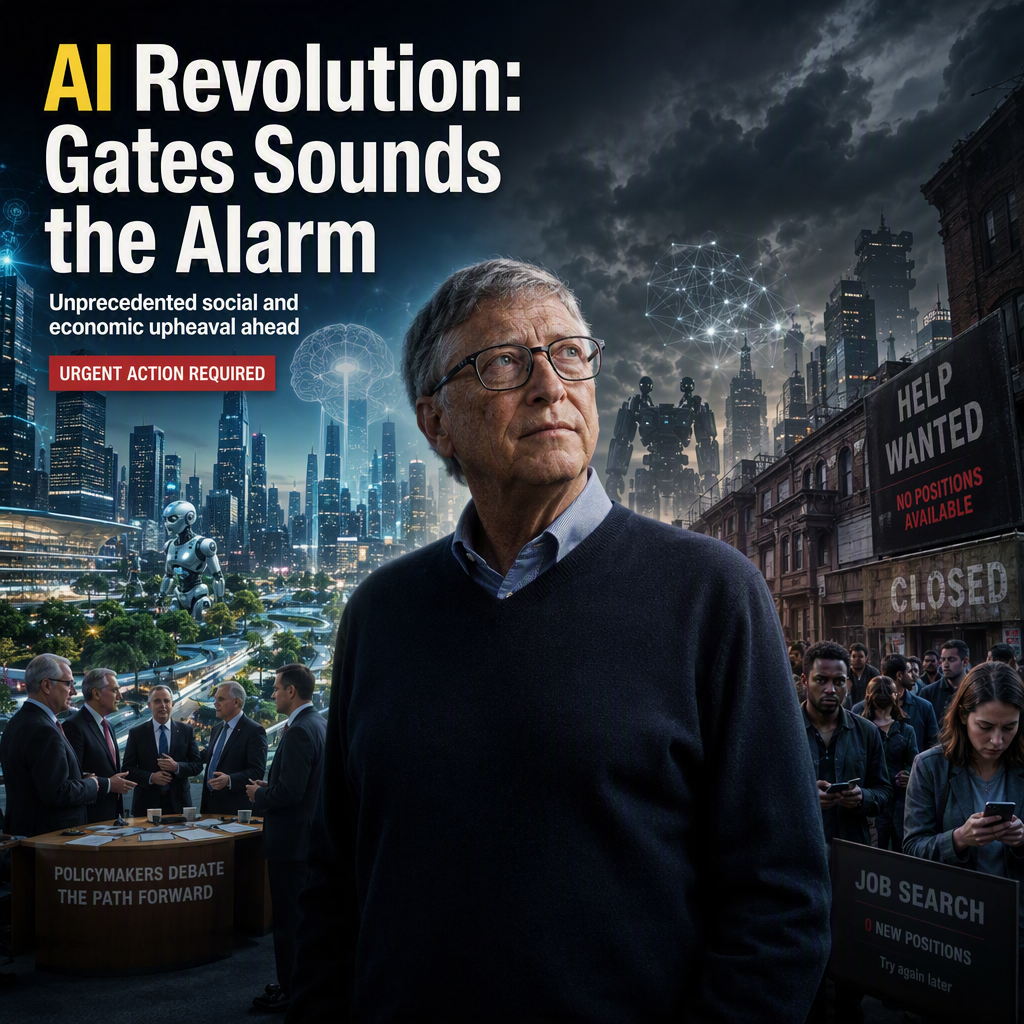
Bill Gates has issued a stark warning about the disruptive potential of artificial intelligence, stating that there is currently 'no plan' to manage the 'social, political, and economic upheaval' that AI is poised to cause [1]. In an essay published on August 26, 2026, Gates called for the creation of national coordinating bodies and a new international organization to oversee the turbulent transition to the AI era [1]. He emphasized that AI could become either 'the greatest equalizer ever invented, or the worst source of injustice,' highlighting the risk of widespread worker displacement across both white- and blue-collar industries [1].
Gates noted that AI is already affecting white-collar employment, with roles in sales, customer support, software engineering, and paralegal work among the first to be impacted [1]. He warned that AI could soon take over tasks such as loan assessment, data analysis, and patient triage, while increasingly capable and affordable robots threaten blue-collar jobs as well [1]. Young people, in particular, may face a labor market with fewer openings, and those most vulnerable to job loss may have the least time to adapt [1].
The essay marks a shift from Gates' previous, more optimistic statements about AI. He now stresses that policymakers must rethink employment, education, and the social safety net to address the coming challenges [1]. Gates argued that, unlike previous technological shifts, AI could replace human cognitive work faster than displaced workers can transition into new roles, creating a 'vicious cycle' of disruption [1].
Gates concluded that the transition to the AI era will be 'one of the most turbulent times in human history,' and that current leaders, experts, and communities are not adequately preparing for the challenges ahead [1]. He called for urgent action to coordinate and safeguard against evolving AI risks on a global scale [1].
CONCLUSION
Bill Gates' warning underscores the urgent need for coordinated action to address the disruptive effects of AI on the workforce and society. Without comprehensive planning and new institutions, the transition to the AI era could result in significant social and economic instability. The market and policymakers are urged to take these risks seriously and prepare for a turbulent period ahead.