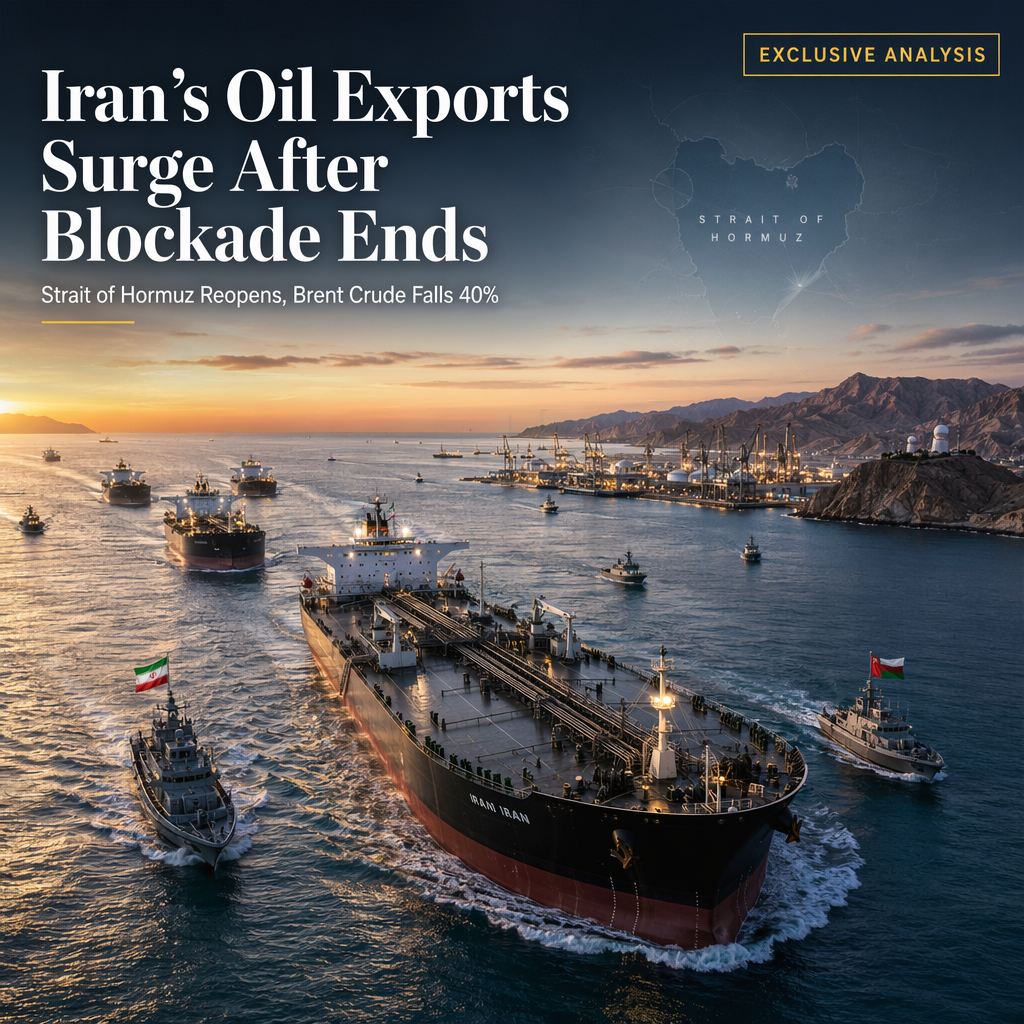
Iran has exported more than 40 million barrels of crude oil since the United States removed its naval blockade of Iranian ports, according to parliament speaker and chief negotiator Mohammad Bagher Ghalibaf. He stated that Iranian oil is now selling at prices roughly 20% higher than before the war, following the signing of a memorandum of understanding (MOU) between the U.S. and Iran on June 17, which ended nearly four months of conflict and reopened the Strait of Hormuz for 60 days of toll-free transit under Iranian and Omani administration [1].
TankerTrackers.com, a tanker tracking firm, estimated that Iran had exported 50 million barrels of crude oil since the blockade was lifted two weeks ago, using satellite imagery and other tracking methods [1]. Prior to the MOU, Iran had been unable to export any oil during the roughly two-month blockade [1]. The ceasefire and reopening of the Strait of Hormuz led to a surge in crude shipments, which in turn sent oil prices sharply lower. Brent crude traded near $73 a barrel on Wednesday, down almost 40% from the war's peak of $118 in April, as diplomatic progress and expectations of increased Gulf supply weighed on prices [1].
Before the war, Iranian crude was sold at a discount of $10 to $15 per barrel below Brent to compensate buyers for sanction risks, according to Gregory Brew, a senior analyst at Eurasia Group [1]. Under the current MOU, Iran has agreed to allow toll-free ship transit through the Strait of Hormuz for 60 days but emphasized that it will retain control over the waterway's administration. Ghalibaf asserted that the sovereignty of the Strait of Hormuz lies with Iran and Oman, and that Iran will not relinquish its rights over the strait [1].
The future governance of the Strait of Hormuz after the 60-day window remains unclear, with vessels currently using either a southern corridor along Oman's coast or Iranian-controlled lanes to the north [1]. Ghalibaf also refuted President Donald Trump's claim that unfrozen Iranian assets would be used to purchase American agricultural goods, stating that $12 billion of the approximately $24 billion in frozen assets abroad would go to Iran's central bank for purchasing any goods needed, in any currency [1].
CONCLUSION
The lifting of the U.S. naval blockade has enabled Iran to rapidly resume oil exports at a significant price premium, contributing to a sharp decline in global oil prices. The reopening of the Strait of Hormuz and ongoing negotiations signal a major shift in Gulf energy dynamics, though uncertainty remains over the long-term governance of the vital waterway.